So grateful to have the opportunity to venture out today, to a place where we encountered only two other vehicles, no power lines, billboards, buildings or pavement. So grateful. Yet my heart worries for the creatures there. Their tenuous freedom. Their beauty. Nature breaks my heart.
Having dedicated a great deal of time, energy, effort, and money–but mostly dreams and heart–to writing throughout my life, I’ve always longed for close relationships with other writers. People who would “get me” in a way that I didn’t feel “got.”
So it was with great pleasure when I learned that my dear friend Jan married a man who wrote. This was many years ago, and, like mine, John Halter’s career was varied and interesting. In my own case, I would add soul affirming, which is probably the case for John as well, but I have never asked him. Anyway, we both did something other than write to earn our livings, but we both always wrote. I worked in flower shops, and libraries, and taught school, while John was a professional sailor, riverboat pilot, and marine mechanic.
Driving Dad Home is John’s first published book, a memoir. It is published by Nodin Press, LLC out of Minneapolis, MN and is available on Amazon. Bravo, John!
John Halter’s Driving Dad Home is in part the story of John and his father, Russ, and their road trip from Arizona to Wisconsin where Russ’s family has procured a place for him in a memory care facility. That, in itself, provides more than enough to immerse the reader. A 96-year-old father who doesn’t want to leave the home where he chose to live out the remainder of his long life “hoodwinked” by his family, the dying alcoholic second wife they wish to save him from, the terror, anger, and anguish of Russ’s dementia—all told in the author’s particularly engaging style—would be plenty. But Halter gives us more.
In his attempts to placate his agitated father and make it to their destination safely, he learns that getting his dad to talk is the best remedy. As the miles unfurl, so too do Russ’s recollections about everything from his childhood on a South Dakota farm, to his years serving in the Navy in WWII, to his years as a husband and father living in Minneapolis, and to the years that followed, when John and his siblings were all grown, when their mother died, and the life their father made for himself afterward—all of which is as important to the author as it is to his dad. I don’t want to give anything away, but it was an excellent read, and I was left with a renewed appreciation and understanding of the generations before us. And I also came away believing that love is often a silent force swirling around us that we do not know and cannot recognize.
For some of us, thankfully, there comes another chance. This is a story about one of those chances.
Thoughts on Writing After a Year of Sending out Queries for my WWII-Era Homefront Historical Fiction Novel Set in Lake Arrowhead, CA… and A Whole Lots of Maybes
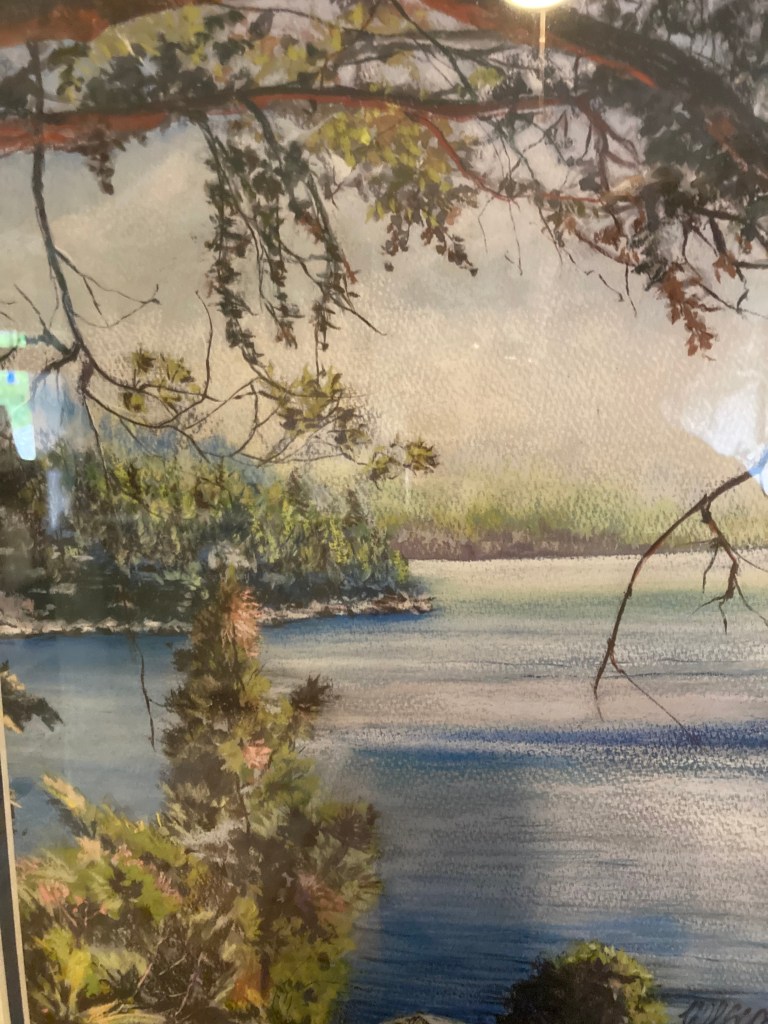
Photo from my collection of prints of paintings by Lake Arrowhead artist and friend, Dave Wescott.
I am discouraged. It’s been a long haul, and I’m tired. I wonder if it’s too late—if I’m even a capable writer. Maybe I am a past-prime-nothing-special-mainstream kind of a writer with nothing new to offer in a world crowded with bright-fresh-creatives churning out compelling new stories that I am not equipped to write.
Maybe, more accurately, I wouldn’t write those compelling new stories even if I could, because I truly don’t want to. But that doesn’t mean I never will. Maybe I’m going to want to! With creating, one never knows. Meanwhile, what I write these days is what I feel the magical desire to create. If I were being paid to write, or I were writing an assignment for a course I was taking, it would be different. At least a little bit different, but still really fulfilling. And I have done that successfully.
So I think that means that stubbornness is not the problem. But who among us knows well their own foibles? A self-examined life is not worth living perhaps, but I am not always sure my self-examinations are thorough or astute enough. That is one of the many reasons I need you, my friends!
Writing from my heart for no other reason than I want to create something of my own is a very different task than an assignment or a job, and that is what I’ve been at with A Fine Suddenness, and with many earlier projects. This self-appointed task has been with me for most of my life, with innumerable hours invested outside of my “real” life, most of them happily. Those hours have stretched into a lifetime of practice.
Another beautiful painting of Lake Arrowhead by my dear friend, Dave Wescott.
Pretty great setting for a novel, don’t you think?
I’ve invested a good amount of my limited income into writing as well. There have been many journals, computers, printers, reams and reams of paper, hundreds of pens (and oh how I love those pink, yellow, green, and blue highlighters!) and yes, the multitude of books I’ve purchased on writing, and the subscriptions to writing magazines. Then there’s the cost of attending various writing events—retreats, conferences, special courses, all of them fabulous and expensive.
The MFA in Creative Writing I earned in 2009 was a big investment that took me years to pay off. I do not regret it. Graduate school was an amazing experience. I loved every moment of being part of a group of writers immersed completely in our projects, all of us in over our heads, happily drowning in words, study, reflection, discussion, research, and ideas, all filled with the satisfying knowledge that no one among us questioned the importance of what we were doing. It often feels as though the rest of the world could care less about poets, screenwriters, non-fiction writers, and novelists, but it didn’t feel that way when we were in school together.
Cheers to all of my creative friends–and all creatives everywhere!
Few parents would encourage their children to enter into any of these fields. I’ve had friends who must have temporarily forgotten what my degrees are in, because they openly laugh at their children’s desires to study any of the humanities while in conversation with me. “Imagine,” they say. “What a waste of tuition.” It’s clear what they mean. Those fields don’t make any money.
I understand that money is necessary, and my life would have been easier if I had more, but I also know my soul would have shriveled had I worked in any field that didn’t allow me to at least exist in close proximity to the world of literature and learning and language that teaching and library work gave me.
It was never about money.
Writing has been my passion for a very long time. And I believe it has been worthwhile, even at this moment, seeing how things stand. I have never developed a writing platform. I don’t have much of a following on my blog (which is admittedly not something I have any technical skill in setting up or growing). Despite regularly studying the publishing field, sending out personalized queries to agents who work with my genre, and working, working, working on improving the queries, the summaries, the comp list, my bio… all the while making my manuscript the best it can possibly be, I haven’t secured an agent.
Maybe I should stop trying. Maybe I should write, but just stop trying to find an agent, or a small publishing house that might consider publishing my work. After all, it’s not about the money. I’ve never expected that.
What is money?
Photo courtesy of Pexels Free Images
Holding a beautifully bound copy of my own work, that’s definitely at least part of what I want, since I so value books, but I understand the process of writing and the joy of finding readers who might enjoy reading what I’ve written are what would move me most.
Maybe I should seriously consider self-publishing, even though I do not want to. Maybe it’s the only way, and maybe it wouldn’t humiliate me in a Willy Loman Death of a Salesman kind of way.
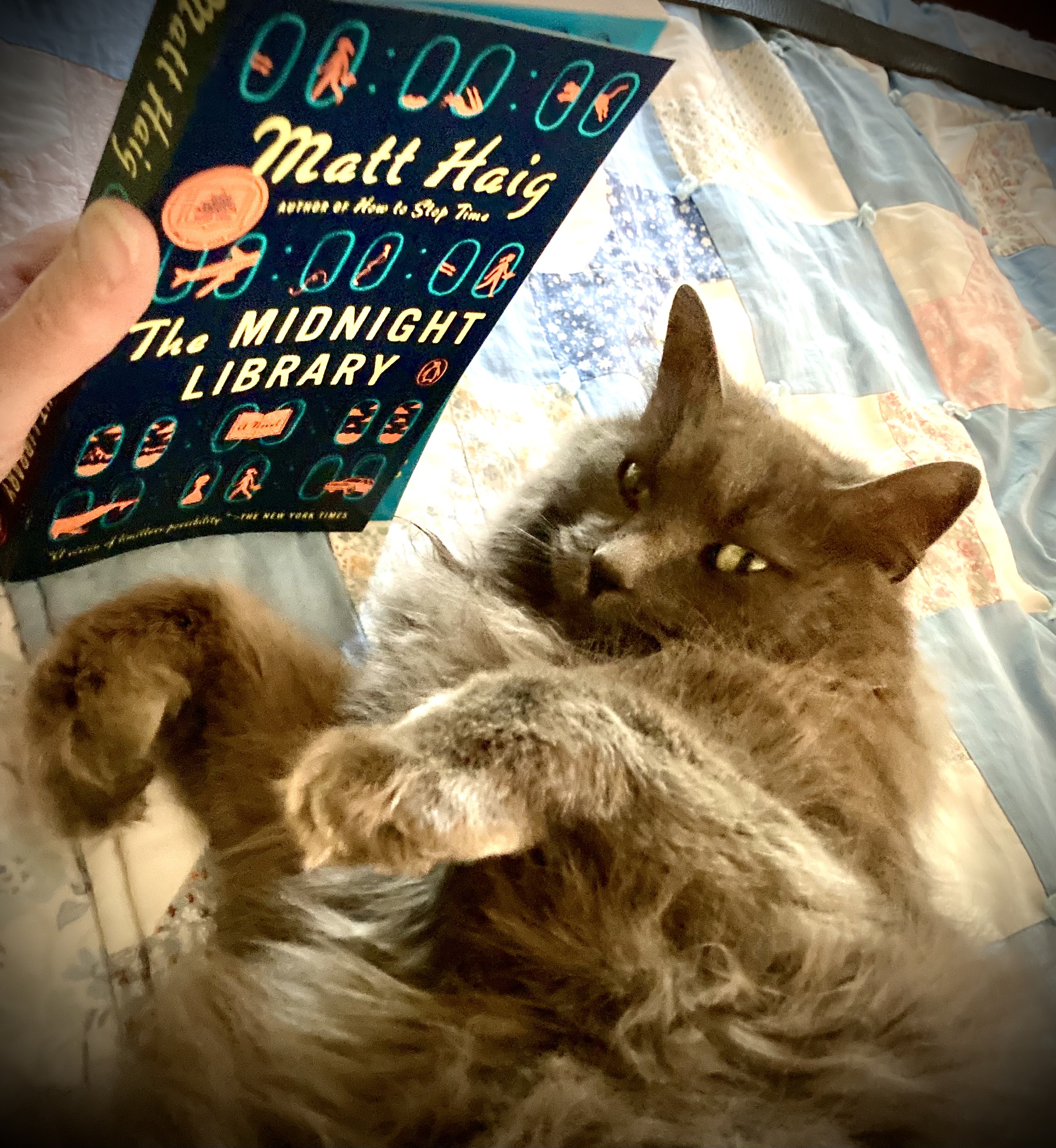
Hello, Readers! I just finished The Midnight Library and wanted to linger over it a while longer. One way to preserve and examine a recent experience is to write about it. Another way would be to get together with my friends at the Austin Ladies Book Club, but it’s been a busy summer and we are on hiatus. Here then, is my short take on Matt Haig’s “whimsical” novel (as The Washington Post aptly calls it).
It’s an intriguing little book, chockful of tiny little chapters, each one the piece of a puzzle containing alternate lives for our damaged, yet clever and likable heroine, Nora Seed. It’s midnight, and as Nora’s consciousness flickers between life and death, a wise and kind librarian directs Nora to endless books of possibilities—the myriad different paths her choices may have led her, and may lead her still.
This is a puzzle many of us have played in our minds, and often, as in The Midnight Library, we move these pieces around in the wee hours of the night.
Imagine if I had… What if I hadn’t… If only I could go back and change…
Regrets. Lost opportunities.
Shame.
Like Nora Seed, I’ve had plenty of these, and being the imperfect human I am, I continue to accrue new ones regularly. It can be a heavy load. The nights can be very dark.
Sometimes, a book can help. Some night soon when I drift off to sleep, perhaps I will find myself in a magic library like Nora’s. After all, I often have vivid dreams where things I experience in my waking hours revisit me in interesting and revealing ways (sometimes horrifying ways, too, but this isn’t that kind of book, thank goodness). So it could happen. Maybe tonight.
The Midnight Library is an obvious win-win for me, the lady lucky enough to run the local library and the lady who finds reading and writing endlessly captivating. It is wonderful for all the right reasons. Fun, and funny, too. Sweet, sad, insightful, and smart—it’s a little volume that may just lighten your heart.
Tatiana De Rosnay’s Historical Fiction Novel, Sarah’s Key, A Review
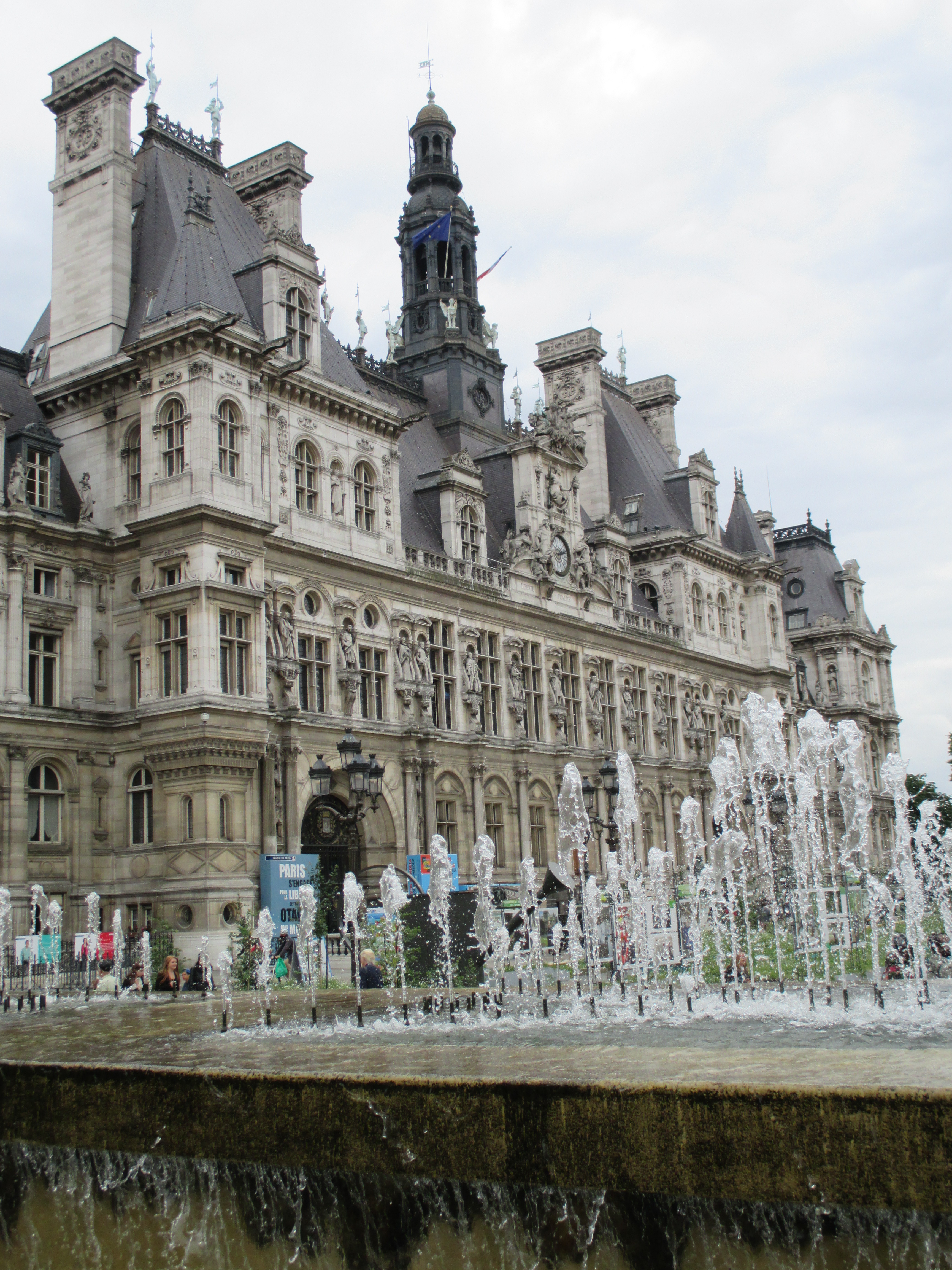
Sarah’s Key tells the intertwined stories of two fictional inhabitants of Paris; Sarah, a ten-year-old girl caught in the terror of Nazi-occupied France, an innocent Jewish child desperate to protect her little brother, and Julia, the journalist destined to discover Sarah’s story sixty years later. Though Sarah and Julia are fictional characters, the situations of the story are sadly all too real.
Before reading Sarah’s Key, I hadn’t known of the Velodrome d’Hiver roundup, which was ordered by Nazis, and carried out by French police officers, but as with all events relating to this terrible time of human history, the story is by equal measure unimaginably catastrophic and yet characteristically illustrative of the horrors of the systematic application of the NAZI party’s stated objective to eradicate Jews in what they termed “A Final Solution to the Jewish Question” at the Wannsee Conference on January 20, 1942.
The Velodrome d’Hiver roundup in Paris, France is one example of the implementation of that horrific policy.
Here is a brief summary of the real events:
“Beginning in the early hours of July 16 [1942], French police rounded up thousands of men, women, and children throughout Paris. By the end of the day, the police had taken 2,573 men, 5,165 women, and 3,625 children from their homes. The roundup continued the following day, but with a much smaller number of arrests.
Approximately 6,000 of those rounded up were immediately transported to Drancy, in the northern suburbs of Paris. Drancy was at that point a transit camp for Jews being deported from France. The rest of the arrestees were detained at the Vélodrome d’Hiver (Winter Cycling Track), an indoor sporting arena in Paris’s fifteenth arrondissement.
After five days, Jews incarcerated at the Vél d’Hiv were transferred to other transit camps outside Paris. At Drancy, Pithiviers, and Beaune-la-Rolande, French police guarded these men, women, and children until transport to concentration camps and killing centers in the east. At the end of July, the remaining adults were separated from their children and deported to Auschwitz.
Over 3,000 children remained interned without their parents until they were deported, among adult strangers, to Auschwitz as well.
German authorities continued the deportations of Jews from French soil until August 1944.
In all, some 77,000 Jews living on French territory perished in concentration camps and killing centers—the overwhelming majority of them at Auschwitz.”
De Rosnay’s novel expertly weaves the stories of her two heroines, as one suffers through the event and the other learns of it in a surprisingly intimate way many years later. This book reminds me of the importance of historical scholarship—true scholarship that doesn’t shy away from the painful realities of the past—and of the absolute necessity of bearing witness to the suffering of the innocent—as a way to honor them, of course, and also as a way to teach each new generation the lessons that seem so easy to forget, so fragile, and always under attack. We need to hear the stories. We cannot be allowed to forget.
Sarah’s Key is one of those books that takes us on an unforgettable journey, touches our hearts and souls, and joins us to the hearts and souls of others who were forced from this world before their natural times, and in terrible ways. It is both deeply dark and sweetly hopeful. A strange truth about literature, and part of its magic, is that you can enjoy it even while it is hurting you. Sarah’s Key is worth it.
It is a small library in a small town. It sits on Main Street in a 150-year-old building that also houses a pub. Both the library and the pub are in the process of renewal, endeavoring to revive their historical importance, their usefulness and vibrancy, their centrality to our community. I began working there last week, and immediately felt a satisfying appreciation at the completion of a circle, which joins both my journey and destination…of coming home, of continuing to matter, and also, of an immediate and curious closeness to my deceased father, who I recalled had loved it when I worked in libraries before, and to his mother, my children’s librarian grandmother, Lorene.
Nonny Lorene died when I was an infant, but I was given her name, a small collection of children’s books, and a legacy of library lore which included the often-told story of how she, a widow, supported her two sons, her spinster sister, and various other relatives throughout the Great Depression, the only one left with a steady income during those hard years. Her library job saved the family, I was told. There could be no better job. For that reason, and many others, I believe that, and so even though Dad and Nonny have been gone from this earth for many, many years, I feel their presence in my little library, and know that they are pleased.
It feels right. I love every minute I spend there—reading the shelves, looking up classification numbers, typing up spine labels, adding genre stickers, covering books—touching them, reading them, smelling them, discovering new titles and authors, revisiting the old. Planning a new computer corner, training soon on our newly purchased county-wide circulation system, looking forward to story times and book signings, all that and so much more. There is nothing like a library.
I’ll end with the wisdom of Carl Sagan:
“Books permit us to voyage through time, to tap the wisdom of our ancestors. The library connects us with the insight and knowledge, painfully extracted from Nature, of the greatest minds that ever were, with the best teachers, drawn from the entire planet and from all our history, to instruct us without tiring, and to inspire us to make our own contribution to the collective knowledge of the human species. I think the health of our civilization, the depth of our awareness about the underpinnings of our culture and our concern for the future can all be tested by how well we support our libraries.” ― Cosmos
And E. B. White:
“A library is a good place to go when you feel unhappy, for there, in a book, you may find encouragement and comfort. A library is a good place to go when you feel bewildered or undecided, for there, in a book, you may have your question answered. Books are good company, in sad times and happy times, for books are people – people who have managed to stay alive by hiding between the covers of a book.”
Quotes from Hooked to Books, hookedtobooks.com. “50 Inspiring Quotes About Libraries and Librarians”









 LakeArrowheadLadyWriter
Leave a Reply