Tag Archives: Reading

Books Get Me Through The Great Alone

It’s been two weeks since I left Nevada and one week since I arrived at my new Michigan home. All of these days have been solo; I drove alone, I arrived alone to an empty house, I spend my days here alone. There’s a theme building . . . For now!

The Way In

But husband and kitties will be joining me soon.

The Dreaded Cot (I do not love it)
A Lonely Room (but I love it!)

As an introvert, this hasn’t been particularly tough. I love people, but I also love solitude. I just got the internet yesterday, and that’s fun because now I can write and publish my writing more easily. No TV here yet. No furniture to speak of. I have one little lamp table that fit in my car, a folding camp chair, and a cot. That’s it. Everything else will come in the moving van next week. So, what do I do all day?

I clean and I read. Often, at the same time, by listening to audiobooks using the Libby library App. One of the books I’ve enjoyed so far during this extended period of solitude is aptly The Great Alone by Kristin Hannah. It’s a tough book about a tough time and a tough place, but I liked it. Alaska in the 1970s, mental illness, abuse . . . it’s got it all, but it isn’t only that, of course. It’s also a book filled with nostalgia, love, and the awesomeness of nature.

Other books I read either just prior to moving, during the drive, or since my arrival are: We All Live Here, Moyes; Sandwich, Newman; The Secret Book of Flora Lea, Henry; Remain, Spark and Shyamalan; The Missing Half, Flowers and Kiester; and currently, The Island of Sea Women, See. Each book has its merits.

I found both We All Live Here and Sandwich charming and humorous. Both are light, contemporary novels with women protagonists wrestling with life changing events and the love of family.

The Secret Book of Flora Lea took me to one of my favorite historical settings, World War II England, in the countryside and also to London in the 1960s. It’s a delightful book about sisters, families, love, and the importance of stories.

Remain and The Missing Half are mysteries, with Remain being the more entertaining of the two for me. The Missing Half helped pass the time, but Remain’s ghostly love story captivated me at times, including during several memorable scenes that made me shiver.

And now I’m listening to The Island of Sea Women. It’s taken me to a part of the world I know very little about, which I love, because I am learning so much. It’s set in Korea from the story’s beginning in the 1930s and will move through the war years and take me to the present day. It’s about women sea divers (an amazing group of female divers who earn the money for their families while their husbands care for the children), and it’s the story of two friends Mi-ja and Young-sook.   

As you can see, I’ve not been alone, not really, for I’ve been traveling through time and place along with the characters created by the authors of these varied and appealing novels, carried away by their stories. It’s a kind of magic really, the way a reader lives both inside and outside of a book—simultaneously in the room, and also somewhere else far away.

I love this line about reading from Stephen Chbosky from his young adult novel, The Perks of Being a Wallflower:

“Sometimes, I read a book, and I think I am the people in the book.”

Exactly.

33 Comments

Filed under Authors, Books, Commentary, Fiction, HIstorical Fiction, Home, Identity, Literary Fiction, Nature, Personal History, Reading, Uncategorized, Winter, World War II

Best Offer Wins?

“In his witty and thought-provoking manner, Mark Twain once famously said, ‘It’s no wonder that truth is stranger than fiction. Fiction has to make sense.’” https://www.socratic-method.com
Sometimes, though, truth is not stranger than fiction. And thankfully, sometimes truth is kinder than fiction, too. Recently a friend and I had both just finished books that bothered us in various ways, which isn’t to say books shouldn’t bother us—it’s quite often important that they do—it was just that in the case of these books, the way we’d been bothered had less to do with subject matter and more to do with the marketing expectation that readers would respond positively to the various dastardly deeds of the protagonists, and that, indeed, there did seem to be plenty of readers out there who backed up that claim—readers who “loved” these books (and so maybe by extension that means they loved the protagonists? Maybe?).

I don’t remember the title of the book my friend was referring to; she said it was something about killers who were in love and only killed bad people—sounded like a Dexter type theme, and I know that was a highly watched television series, so I guess there’s an audience for that. I can’t claim to be someone who is above consuming questionable content. I’ve read hundreds of books in most genres and not all of them have been particularly elevating. That said, I have seldom read a novel with a less likable protagonist than the one Marisa Kashino gives us in Best Offer Wins (With the possible exception of Humbert Humbert, the protagonist/narrator of Vladimir Nabokov’s Lolita).

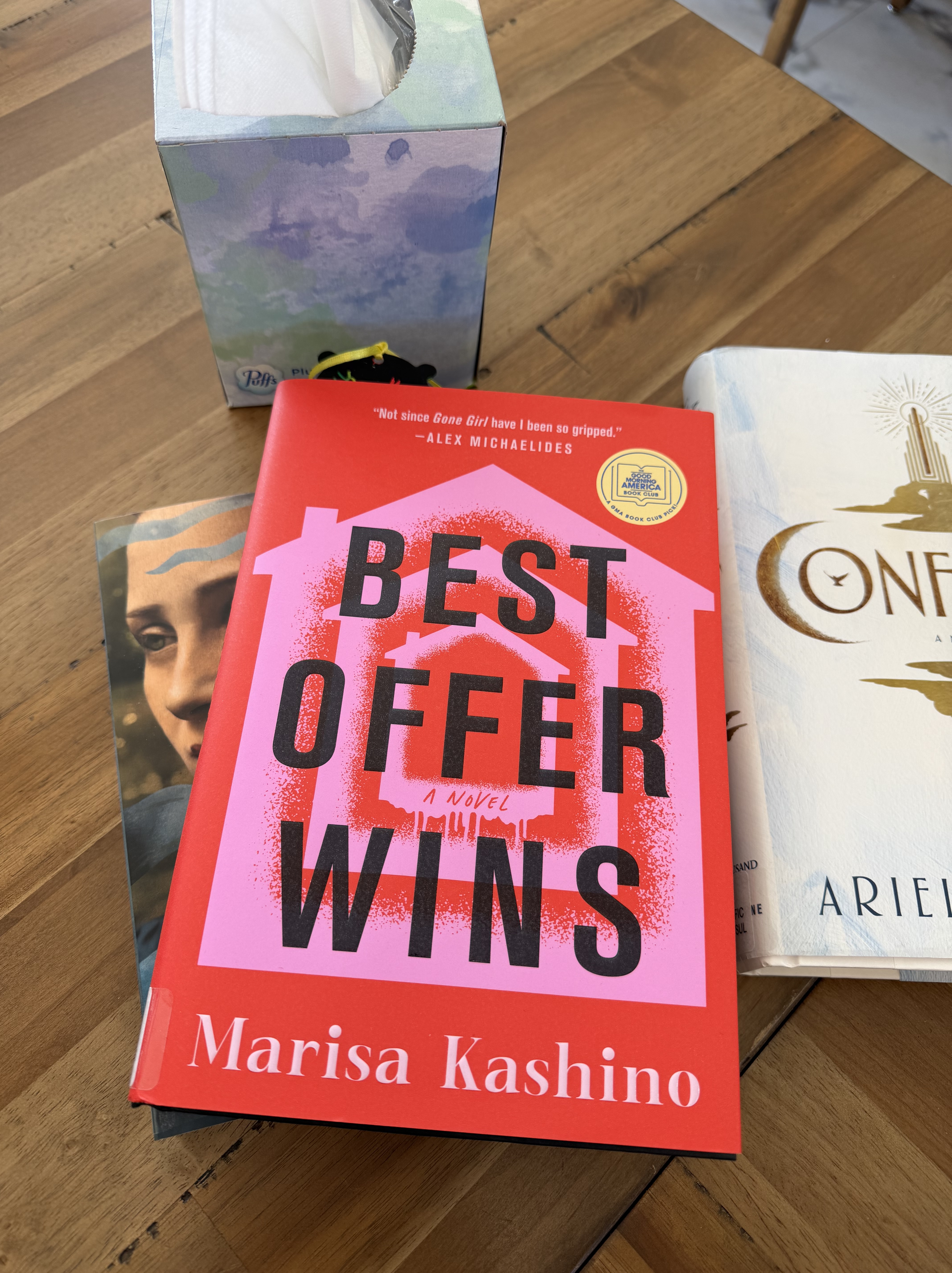
Best Offer Wins is a Good Morning America Book Club Pick and was published by Celadon Books in 2025. From the book jacket: “…Margo will prove again and again that there’s no boundary she won’t cross to seize the dream life she’s been chasing. The most unsettling part? You’ll root for her, even as you gasp in disbelief.”

Uh. No. But let me take you back to the reason I read that blurb and took the bait. Coincidentally, on the same day my husband and I were submitting a bid on a house we wanted, Marisa Kashino’s thriller about a woman who will stop at nothing to get her dream house came across my desk at the library. It was a new purchase, and my job was to catalog it and get it ready for patron check-outs. I joked with my realtor that I hoped I wouldn’t become as obsessed with home buying as the teaser on the book jacket hinted the book’s protagonist, Margo, did.

Truth being, in this case anyway, less strange than fiction, I didn’t. Thank goodness. But I did check the book out and take it home to read over the weekend. I’m not normally inspired to write reviews about books I don’t like, but there’s something about this one that pushes me. What that tells me is that I did find it engaging, at least enough to finish it, but that, also, it troubled me. I think I kept reading to see if it would be possible to “root for her even as [I] gasped in disbelief.”

That stage never arrived. The backstory on Margo did indicate she’d had very tough breaks, enough of them, too, and that would normally soften a reader’s judgement and bring her to life in a way that would help the reader to care about her, but Margo’s behavior was so egregious that she remained not only unlikable, but monstrous. And I don’t mean monstrous in the sad way that Frankenstein was a monster because he was a victim and you felt sorry for him. Margo’s kind of monstrous is the carefully calculated kind that lacks any hint of personal responsibility or remorse.

I’m not sure what it says about me that I read the whole book anyway, and that gives me pause. I think perhaps my weird fascination with the book represents a part of contemporary America to me that I don’t understand and cannot accept, but that I still keep trying to fathom. I want people to have homes. I want people to care for each other. I want to love my neighbors as myself.

Each turn of the page offered hope, however slight, that Margo would learn some kind of moral lesson or would offer her a kernal of insight, forgiveness, or redemption, but in the end, there was none. No tenderness. No justice. Just a sad expose of a society where dreams can become as dangerous as despair, and the only thing that matters is the win.

In that way, the book is a success, I guess. A pretty good satire. Excellent social criticism, and social criticism is very much in order these days in my opinion. With Best Offer Wins out of the way, I’m happy to announce that Mr. P and I purchased a delightful home in the beautiful UP—the upper peninsula—in the lovely U.S. state of Michigan. We will be off to a new chapter there soon and leaving the awe-inspiring West and central Nevada behind with love for all we’ve learned and the friendships we treasure. By the way, we accomplished the purchase of the Michigan house without any nefarious activities nor bidding war mayhem.  Sometimes, you see, truth is not stranger than fiction, and sometimes it is kinder.

Wishing you all happy days and cozy nights as we move through February and into March. Be Well!

The Upper Peninsula, Michigan, U.S.

58 Comments

Filed under Books, Commentary, Fiction, Home

Dog Days, But With Cats

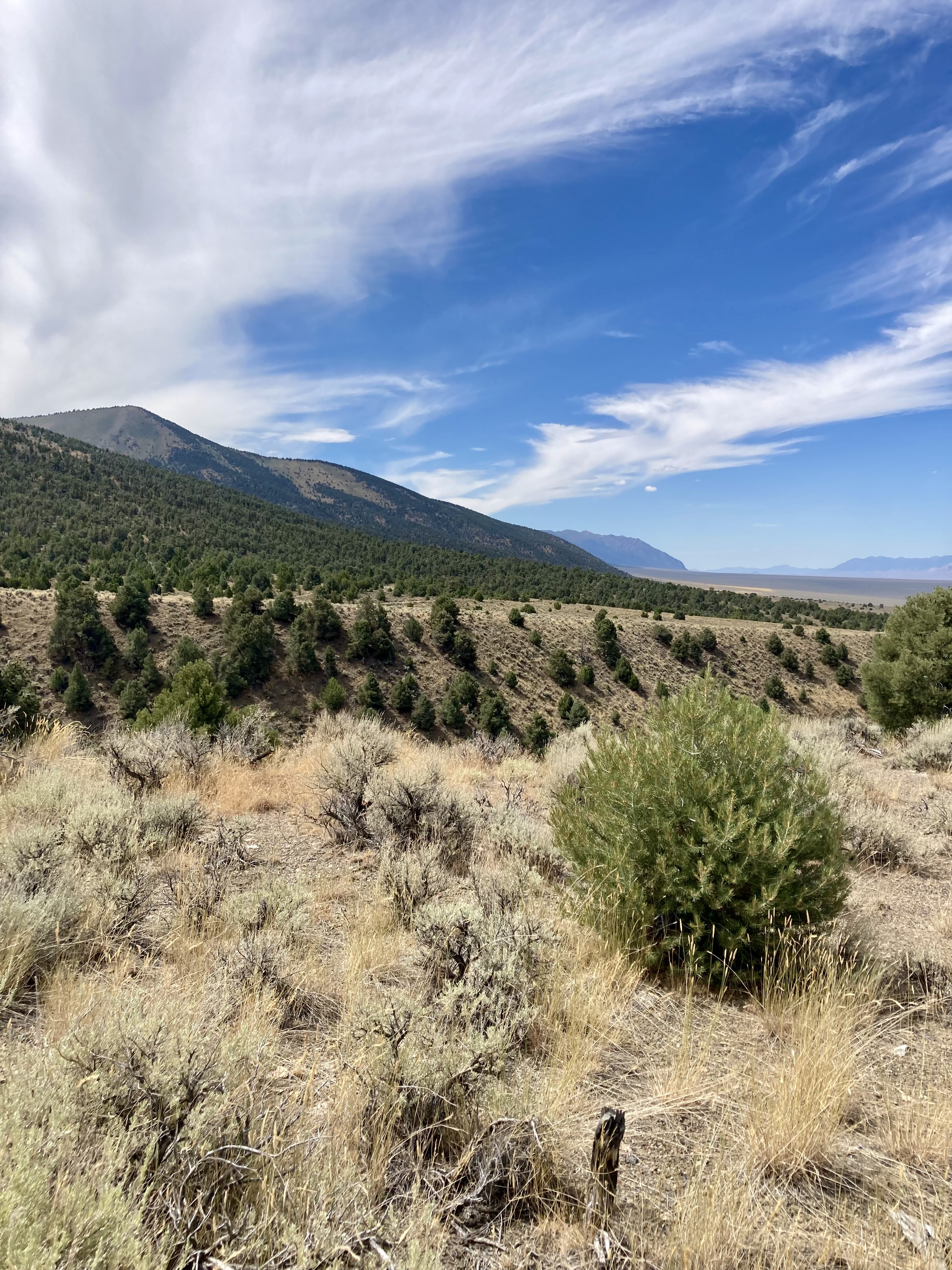
August in Austin, Nevada… Waiting on Queries, Minding the Library, and Marveling at Nature.

Much of the country (and the entire Northern Hemisphere) is hot. It’s August, a time we refer to as “the dog days of summer.” -Days so hot that even the friskiest of canines refuse to venture out in the blazing sun, barely raising themselves for any reason. A slamming screen door, tri-tips on the grill, Junior home from summer camp . . . all excruciatingly exciting otherwise, barely elicit a thump of the tail during the grip of a heat wave.

We miss you, Atticus!

Dog Days have always been about dogs, right?

I guess not! I was surprised when I looked up the origin of the phrase. According to Dictionary.com,
“The dog days, in the most technical sense, refer to the one- to two-month interval in which a particularly bright star rises and sets with the sun, shining during the daylight hours and staying hidden at night. This star is known by three names: Sirius, the Dog Star, and Alpha Canis Majoris. Apart from being the most prominent star in the constellation Canis Major (Latin for “Greater Dog”), this heavenly body is responsible for the origin of the expression dog days, a phrase that has endured through millennia.”

Now I need to find that star!

Photo by 一 徐 on Pexels.com

Dog Star or not, August is hot. We head higher up in the hills to cool off. I wrap ice cubes up in my scarf and wrap it around my neck. We play with the hose…

When I’m in the library, I keep the air conditioner set at 65 beautiful bone-chilling degrees Fahrenheit. I check my email compulsively, waiting on agent query replies for my manuscript, and one in particular. I had a fantastic literary agent contact me and request a full reading of said manuscript back at the end of June. I am so honored she asked! In the meantime, I’m getting more reading done (loved I Cheerfully Refuse by Leif Enger), and have had some great getaway weekends. Soon I will be back in Lake Arrowhead for a few days. So much to be grateful for!

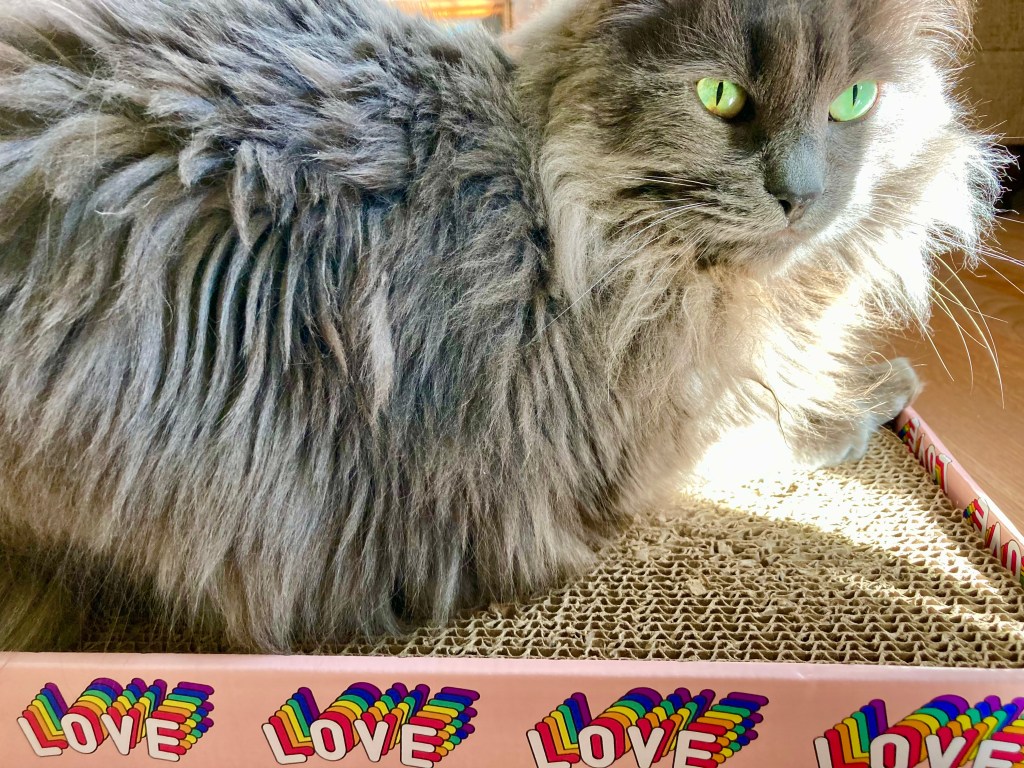
And then there are the cats. Somehow, perhaps because we no longer have a dog, all manner of cats, along with their little kittens, and a small number of mule deer, have made our yard, our driveway, and our carport, if not their full time home, at least part of their daily rounds. A few of the kittens now come in through the cat door to look around the house, lounge on the sofa, or eat out of the resident cats’ (Jack, London, and Annabelle Lee) bowls. The mule deer, thankfully, cannot fit through the kitty door, but they do come into the carport at times, which unnerves the visiting cats, their kittens, and our own cats. We even had a near catastrophe last week when a deer wandered in, not noticing Mr. P was in there– and then spooked when he saw him and bolted, running over poor London, our sweet gray long-haired cat. London took a solid hit and was knocked senseless for a time. It was horrifying! Thankfully, he suffered no permanent damage and was back to himself the next day.

London

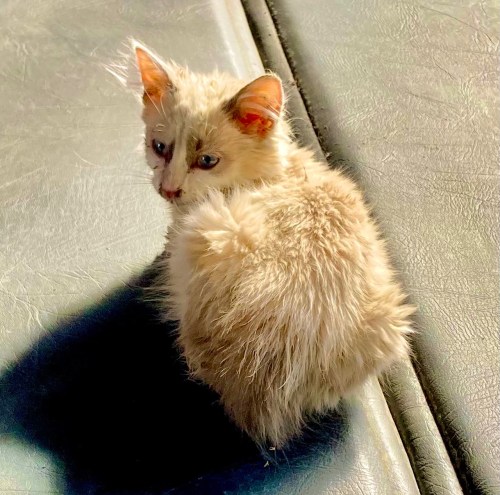
Two of the four baby kittens who showed up early in the summer got sick. Mom eventually left them with us, and we’ve done our best to nurse them back to health. Happily, they are doing much better, but of course, now we are thoroughly hooked.

Gremlin, the tiniest and most ill of the babies, now thankfully, on the mend.

Where will it all end?

The dog days of summer have gone to the cats!

10 Comments

Filed under Uncategorized

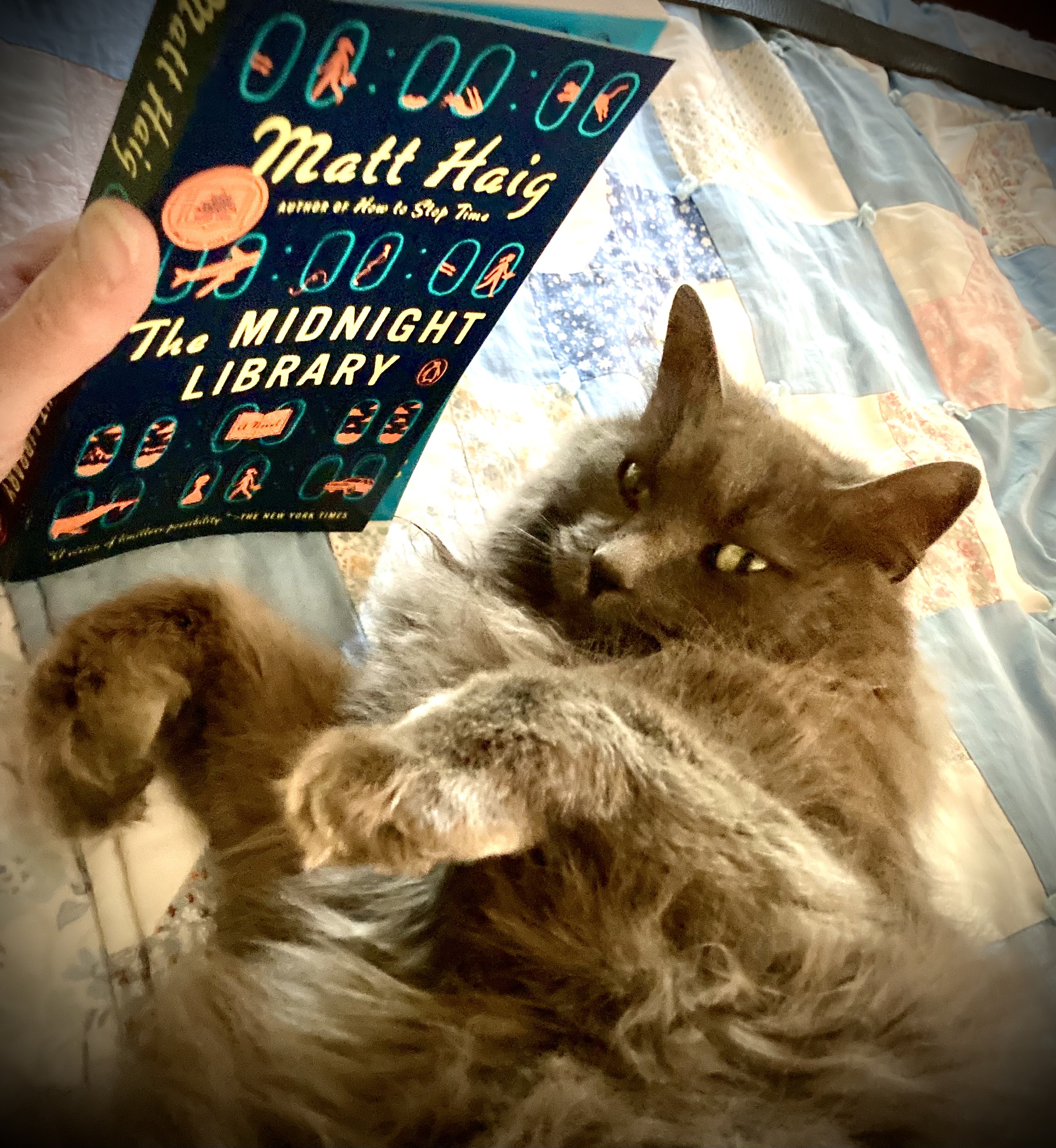
What I’m Reading: The Midnight Library by Matt Haig

Hello, Readers! I just finished The Midnight Library and wanted to linger over it a while longer. One way to preserve and examine a recent experience is to write about it. Another way would be to get together with my friends at the Austin Ladies Book Club, but it’s been a busy summer and we are on hiatus. Here then, is my short take on Matt Haig’s “whimsical” novel (as The Washington Post aptly calls it).

It’s an intriguing little book, chockful of tiny little chapters, each one the piece of a puzzle containing alternate lives for our damaged, yet clever and likable heroine, Nora Seed. It’s midnight, and as Nora’s consciousness flickers between life and death, a wise and kind librarian directs Nora to endless books of possibilities—the myriad different paths her choices may have led her, and may lead her still.

This is a puzzle many of us have played in our minds, and often, as in The Midnight Library, we move these pieces around in the wee hours of the night.

Imagine if I had…      What if I hadn’t…      If only I could go back and change…

Regrets.           Lost opportunities.                 

Shame.

Like Nora Seed, I’ve had plenty of these, and being the imperfect human I am, I continue to accrue new ones regularly. It can be a heavy load. The nights can be very dark.

Sometimes, a book can help. Some night soon when I drift off to sleep, perhaps I will find myself in a magic library like Nora’s. After all, I often have vivid dreams where things I experience in my waking hours revisit me in interesting and revealing ways (sometimes horrifying ways, too, but this isn’t that kind of book, thank goodness). So it could happen. Maybe tonight.

The Midnight Library is an obvious win-win for me, the lady lucky enough to run the local library and the lady who finds reading and writing endlessly captivating. It is wonderful for all the right reasons. Fun, and funny, too. Sweet, sad, insightful, and smart—it’s a little volume that may just lighten your heart.

If you read it, let me know what you think!

8 Comments

Filed under Books, Commentary, Reading

“Reading with Ghosts” Some thoughts on a post by Jenny Lawson, The Bloggess: “Sometimes tattered and worn = loved” August 9, 2016

FallWinter2015Mostly 200

Like Jenny, I love used books, books that have a history of relationship with other readers that I can see and hold in my hands. The cover doesn’t need to be in great shape. There should be a name written in long hand somewhere within the first pages. Notes written in the margins. Words, phrases, paragraphs underlined. Exclamation marks, hearts, question marks in the margins. Old shopping lists stuck between the pages. Dedications to lovers, children, grandchildren, friends on the title page. This book reminds me of how very much I love being your mom.

Despite my librarian grandmother, my own library training and teacher training, and my years working in libraries and public schools, I’ve always been much more of a book sharer than a book protector. This doesn’t mean I condone random doodling, especially not of the tasteless variety, or nasty vulgarisms of any sort in any book (and I’ve seen plenty of those, believe me). And I am not advocating writing in any book that you do not own—please, respect all library books, and school texts! But I do appreciate a pithy comment that pertains to the content. I love knowing that I am sharing the experience of reading a particular piece with someone who found something striking enough to comment on right then and there, in the moment.Paris, 2013 154

Jenny Lawson says, “…reading those found books is like reading with ghosts, ones who eagerly point out their favorite passages or share their thoughts or questions in the margins.”

Books that I can remember writing in that are sitting around my house right now include:

Jane Eyre, A Prayer for Owen Meany, The Catcher in the Rye (probably my first!), The Diary of Anne Frank, Man’s Search for Meaning, Teacher Man, Rebecca, Atonement, Prodigal Summer, The Glass Castle, Learning to Walk in the Dark, and lots of poems—“The Raven” comes to mind along with some of Shakespeare’s sonnets. And memorably, the teacher edition of a literature anthology I used in my classroom for many years (not sure if this qualifies as defacing a public school text, but it did raise a few eyebrows during department meetings).

Funny story there. I was told, “That’s not your book! You can’t write in that!” back in 1998 by a wonderful teacher I respected and admired. Even so, I continued to write in the book. I planned on outlasting the book adoption cycle, and I wanted to remember what worked, what went flat, what insights, funny or touching, or what “light bulb” moments were expressed by my kids. When I retired in 2014 a young English teacher retrieved the same teacher anthology from the school library that I had written notes in for years. There hadn’t been a new book adoption in all of those years because the budget was just too tight for the district to purchase a new anthology. This new teacher wrote me a letter. “What a treasure!” she said. “Thank you for writing all of that down.”

A reader after my own heart. A teacher after my own heart. I hope she never forgets to write in the margins.Paris, 2013 108

Leave a comment

Filed under Books, Commentary, HIstorical Fiction, Humor, Jenny Lawson's Blog, Literary Fiction, Teacher, Used Books, Writing, Writing Advice