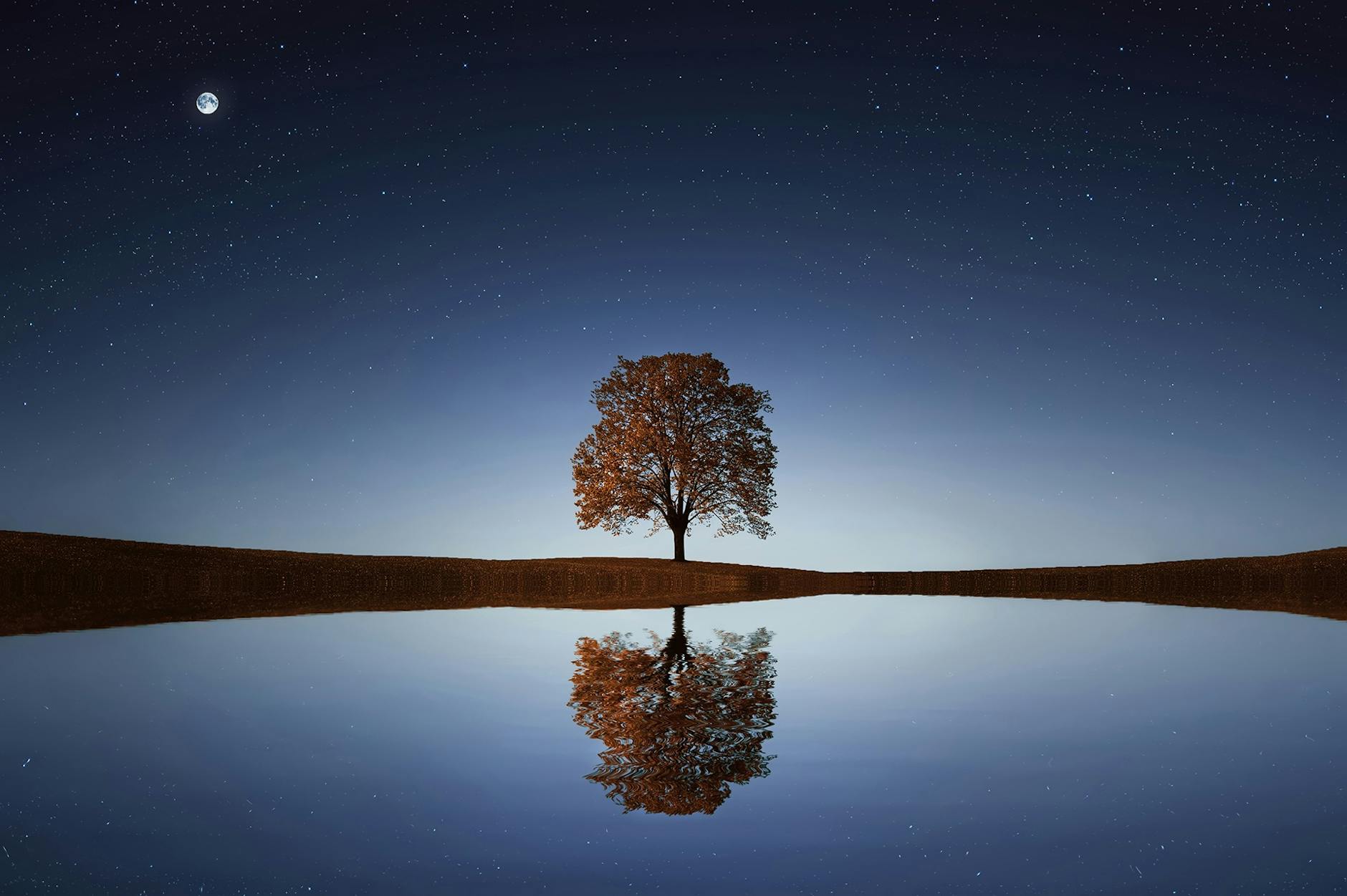
“The strongest oak of the forest is not the one that is protected from the storm and hidden from the sun.It’s the one that stands in the open where it is compelled to struggle for its existence against the winds and rains and the scorching sun.” – Napoleon Hill
Hello, Reader and Writer Friends! I hope this post finds you well and blessed with the energy, time, and resources you need and deserve. I am grateful to you and wish you joy. The past few weeks have brought both expected and unexpected news, tasks, challenges, joys, and sorrows to my little corner of the planet, and I suspect they may have to yours also.
Changes of season, the holidays, national and world events, community and family celebrations, work, play, plans, and the shadow of illness and even death for some have been on the hearts and minds of many.
This week in my little town we’ve lost a young woman to suicide. The tragic and violent event has left many of us in shock, and the pain is palpable. And yet, standing right beside that horror, we also have grace in the shape of a group of dear people who planned and cooked and decorated our community center, and fed everyone in town who wished to come. And we had the Christmas tree lighting in the park, followed by fireworks. And we have a live nativity on Main Street coming in a few days. And I’m going to Disneyland with my grandkids next week. And yet, a friend’s cat died and one of our own adopted cats disappeared (you see how the sadness creeps back in). And yet, I got a surprisingly good medical report from my doctor. And in the netherworld of being a writer, I began another round of manuscript submissions today, sending out queries to six publishers.
The light shifts, the wind blows.
We manage as best we can, remembering that the strongest oak
Something I don’t write about much is my writing background. And of course there’s a reason for that. I have spent a significant amount of time, effort, and money over a period of many years on writing, and though I don’t consider any of that effort to be wasted, I do think sometimes, sometimes when the shadows fall a little too dark, a little too thick, that I should have done more with it, this writing thing, by now. That it should have gone somewhere. Perhaps I’m even a bit embarrassed to admit that with a BA in English and an MFA in creative writing, and years of study and teaching under my belt, I still haven’t published a novel.
Have I written a novel? Oh, yes. I wrote my first novel three decades ago. I was teaching English and became active in the National Writing Project, a fantastic program for teachers that encourages us to become writers, ourselves. I wrote a contemporary novel during that time but never attempted to have it published. It was my learning novel, the one that I would never throw away, but also, the one that wouldn’t be good enough to publish. Don’t ask me exactly how I came to this conclusion. I think I read an awful lot of books and articles about writing, and this was my take on first novels. They were like the first pancake, or the first kiss. You just had to do it and get it out of the way. The payoff would be better pancakes and better kisses later. Fluffier, more evenly browned, delicious. Or maybe my own writing just embarrassed me so much that I couldn’t even think of approaching anyone with it. So, I printed it out and boxed it away.
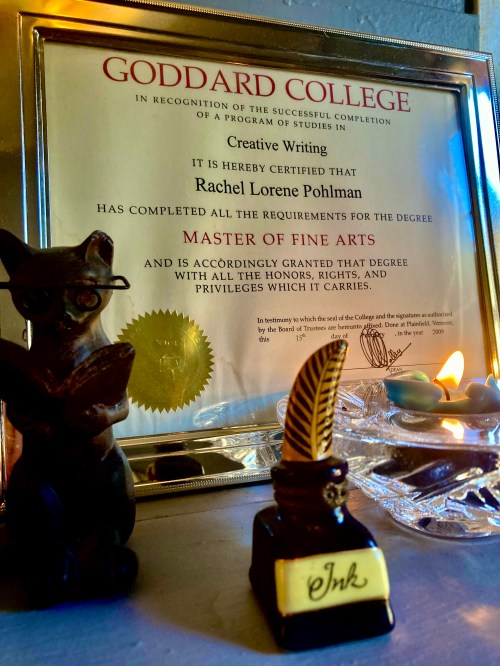
The itch to learn more and to focus more on writing took me to Goddard College next. I continued teaching and worked on my master’s from 2007-2009. During this exciting period, I wrote constantly, including many formal papers for my instructors and my thesis, which was a young adult historical fiction novel about a Catholic Polish teen and his Jewish neighbors during World War II. This one, I thought, I would try to get published. I just didn’t hurry it.
I attended Goddard West in Port Townsend, WA. I have never been to the original campus in Vermont, which has sadly, closed, but I still hope to visit there someday.
After the MFA, I focused on researching agents and publishers and writing queries. Admittedly, I didn’t try very hard. It was excruciating for me to put myself out there—my writing out there—which to me, amounted to putting my inexperience and inadequacy on full display, a neon sign of not-good-enough, flashy and annoying, just begging someone far more hard-working and talented than myself to squash it.
Time went by and I wrote with friends for fun, and to learn more. Shout out to you, Alicia, Lynn, Mike, Maria Elena, and of course all of my amazing students! I thought maybe I needed to put more time between me and my second novel. I started blogging. I was still teaching.
But then I found myself seriously ill with a rare form of cancer, and the world stopped spinning. I lost track of days, weeks. My brother was also ill and had come to live with us. My surgeries were successful. But I felt unwell. Months of chemo took a toll. And my brother. My beautiful brother, my only sibling, died.
I read that the average life span for appendiceal cancer was seven years, and yes, I also read that was not to be taken to mean that I would die in seven years—there were so many factors involved, and it was just an average. Many people died sooner. Others lived for twenty years or more. Blah, blah, blah, I thought. I have seven years.
With my husband’s blessing, I cashed in a small savings account and took a short trip to London and Paris (my one and only trip outside the U.S.), and it was wonderful, and I knew I wanted to write. My writing vision could not have been more clear. I came home and worked on a new novel.
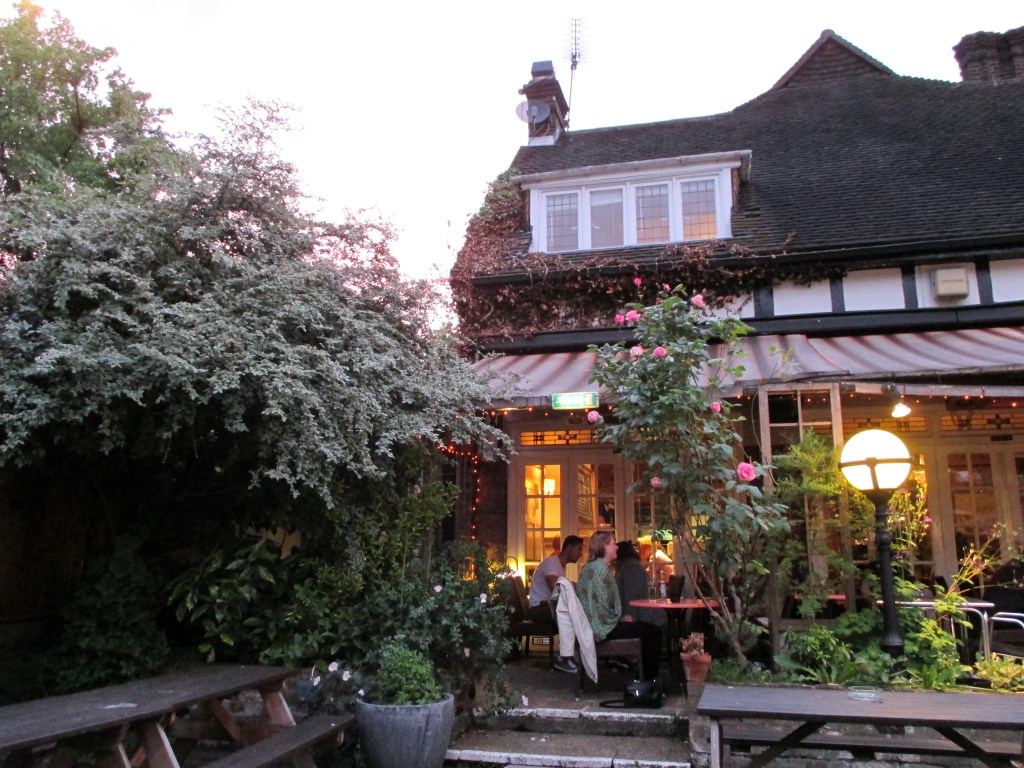
East Finchley, Outside London.
A Beautiful Place to Write.
I taught for a couple more years. Other than my family, my teaching career was what I was most proud of and committed to. Still, I felt my energy shifting. I expected an early death. I imagined myself too weak to be the kind of teacher I had always aspired to be, which was the Robin Williams as John Keating kind of teacher from Dead Poet’s Society. That was who I should be, but instead, I felt—I believed, I was tired, in failing health, more Virginia Poe dying slowly of tuberculous while Edgar became ever more prolific than John Keating taking on the entire world of poetry and elevating young minds and spirits. I saw myself settling into an early writing retirement where my husband would continue to work, but I would just be . . . . the quiet writer in residence.
Robin William as the victorious Mr. Keating
The sadly beautiful Mrs. E. A. Poe
And so, I finished my third book. It is not published.
I found I missed gainful employment and have steadily worked part-time since my early retirement, teaching and library work mostly. I am fighting my hermit-like tendencies, and I’m enjoying getting more involved in actively reading and responding to my fellow writers online, as well as the few writers I know personally. This is a joy and a responsibility. I believe we must support each other, and I am so in awe of all of you! I just finished reading a fellow Goddard graduate’s Sci-Fi thriller, The Regolith Temple, yesterday, and was blown away! Roxana Arama, I will be writing a review for your excellent book very soon!
I am still waiting to hear back from an agent who requested my full manuscript many months ago. I’m considering next steps.
I’m not dead. I stopped going in for cancer scans several years ago. I can’t afford them, and anyway, I’m quite spectacularly healthy. Weirdly! So maybe the seven years thing was really just about itches and actually had nothing to do with my diagnosis. Whatever the reason, I’m grateful, and I’m still in love with this beautiful planet. And pancakes and kisses.
I’m walking every day and working on another novel.
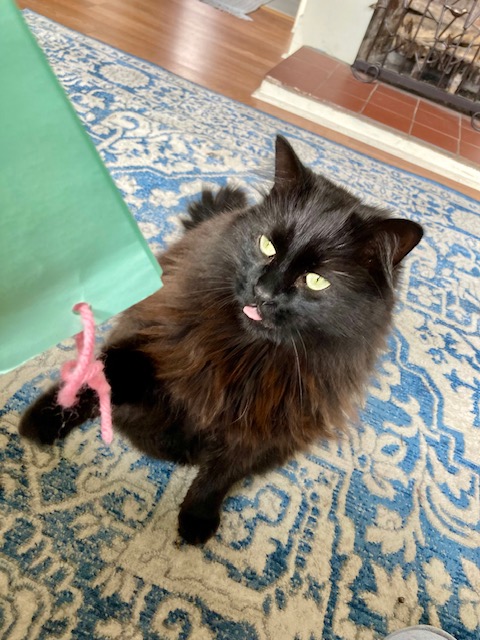
This is not my kitty. It’s a sweet expression though, and I love kitties.
I woke up this morning acutely aware of several things. None of them were good, considering the state of current affairs, but, for me, the first breath of consciousness each day brings the unwelcome reminder that I no longer have any teeth (on the top of my jaw anyway. This may or may not be called the “crown” of my gums . . . I have asked Mr. Googly, but I’m still not sure). Also, I only have 13 teeth left on the bottom, which, hey, I’m grateful for so that’s why I state it only as an aside and not as part of my general complaint. Anyway, this is what waking up means to me.
I am aware that this is not an appealing topic.
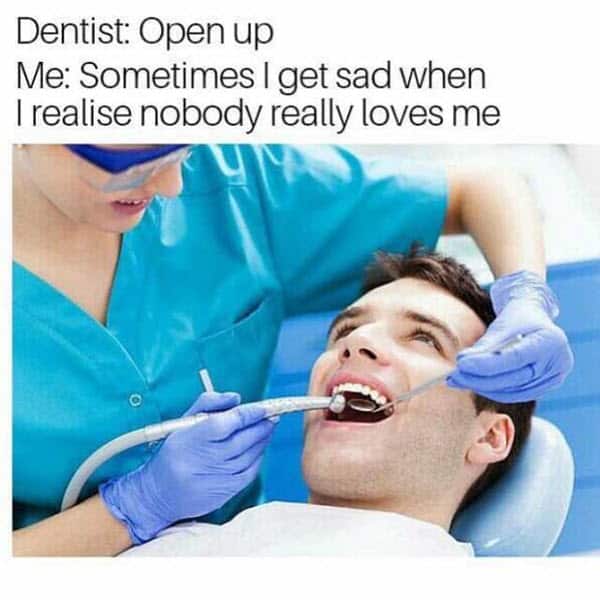
Well, some people love me. But sometimes I get sad anyway.
I am an American woman with ill-fitting dentures that I take out at night. Most nights. Some nights I just leave them in.
But you aren’t supposed to leave them in. Why? Something about giving your gums a rest and not letting bacteria build up. According to The American College of Prosthodontists (ACP), the association that represents the specialty of prosthodontics: “Yes, you can wear your dentures at night, but it is preferred that they be removed. You should remove your dentures at night, and this will give your gums and bone a chance to relax from the pressure of the denture during the day. If you need to wear your dentures for social reasons or to prevent your jaws from over closing, you should find time during the day to properly clean your mouth and your prostheses. You should never wear your dentures 24 hours a day without performing proper oral hygiene. Dentures should be cleaned at night and stored in water during the night.”
So, that’s a no, yes? My guy in Fallon said to take them out . . . (he never mentioned unless I needed to keep them in for “social reasons” or to avoid over-closing jaws) . . . more on that later.
So, I usually take them out. Then—I wake up in the morning feeling like my face is a sad stretch of the Pacific Coast Highway after a torrential downpour. Part of me is washed away.
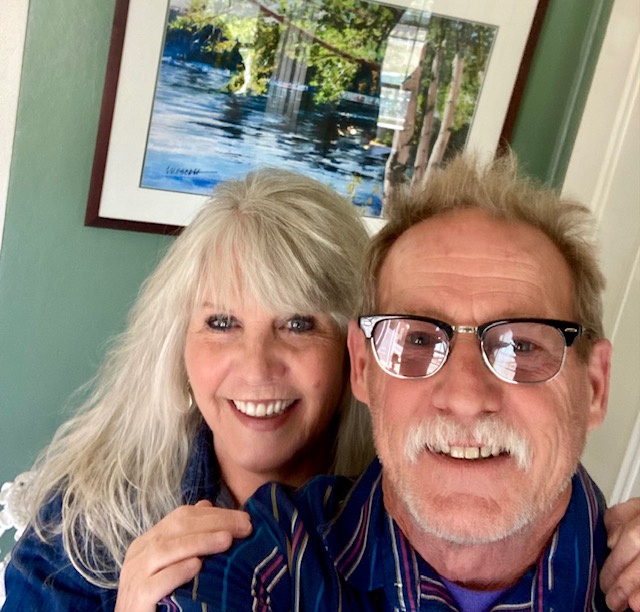
That’s me on the left. All smiles. Brand new teeth.
By now, some readers might be thinking (in addition to oh dear lord please stop), what about implants?
When I inquired about the cost of implants, I was given the “ballpark” figure of $40,000. “It’s like buying a car,” my Fallon guy said. Indeed. And I would be the first person to say that I’d much rather have a complete set of permanent teeth than a new car. Absolutely! But that’s false equivalency; it isn’t a choice between teeth and a car. Not at all. There’s no money for either of those things. I was lucky to be able to scrape the money together for the dentures, which came to something closer to $4,000 (including the cost of the extraction of my “unsavable” natural teeth). I drive a car that I bought used 10 years ago for much less than $40,000 and have managed to pay off. So I’m not in the market for a new car, and implants were never going to happen.
This breaks my heart, and it also angers me. Why is dental care so difficult to attain? Is it because of a general American lack of concern for healthcare for its citizens overall? Is it because I am lazy and do not deserve teeth? I mean, I have a job. I’ve always had jobs, but some of them (at peak important dental crisis periods), didn’t include dental insurance. If I had been born into a wealthy family, or perhaps if I had been born in a different country, would I still have my teeth? I don’t know. Certainly, lifelong, consistent dental care could have saved me some of my dental losses. I remember having a tooth pulled when I was in my twenties that could have been saved if I’d had the money for a root canal and a crown.
I’d like to hear about the experiences of people from other places. Is this something that happens to many of my peers, but I just don’t know about it because it is humiliating, and no one dares speak of it? And what about people who lose their teeth to accidents or illness? What recourse do they have?
More big smiles. Happier days.
I know there are people suffering much more in places that are much worse. I know that many people of my parents’ generation wore dentures for much of their adult lives, and I don’t remember hearing much grumbling about it, perhaps another reason that their designation as The Greatest Generation is so apt. My parents survived The Great Depression, they fought in World War II (Dad was a Marine in the Pacific) or supplied the troops (Mom worked in an airplane factory), they ballroom danced like athletes, swinging with The Big Bands, and they never complained. Perhaps part of the saying about keeping a stiff upper lip comes from their ability to hide their discomfort about dentures? I don’t know, but I admire them for it.
Does that mean I should just embrace my toothlessness? I mean, my parents weren’t crying about it. And if I should embrace my loss, how, exactly, do I do that?
I miss my teeth. I miss my smile. Like Elf, I love to smile. Smiling is my favorite.
Also, I can’t eat numerous foods that I love. This includes crispy raw vegetables and taco shells and chewy candy—the obvious things—but also many others like pizza or sandwiches or good crusty bread. Believe me, dentures do not allow it.
Again, I could be wrong. According to The American College of Prosthodontists, “Most patients need to learn how to use dentures properly and as a result, it takes a little time to get used to them. After a while, you should be able to eat fairly normally, but it may take more time to get comfortable with harder foods or sticky foods. Using a small amount of denture adhesive (no more than three or four pea-sized dabs on each denture) may help stabilize the dentures and help hold them in place while you learn how to get comfortable with them and may make the learning process easier.”
“Fairly” is one of the key words in that paragraph. Fairly normally seems to include scrambled eggs, overcooked vegetables, soup, cooked cereals such as cream of wheat, mashed potatoes (a high point), and pudding. Oh! and thank goodness, ice cream is still an option.
Perhaps I struggle with eating because my dentures are particularly ill-fitting compared to others. This I don’t know. What I do know is that they fall out, they move around, and they whistle occasionally (something I could never accomplish before, that, no, I am not grateful for).
I also know that the denture adhesives help a bit, but the downside of using them includes the overflow stickiness that can make it impossible to move parts of my lips at times. True, I use more than the American College of Prosthodontists’ advised “three or four pea-sized dabs.” That’s because three or four pea-sized dabs do absolutely nothing!
Also, said stickiness, which isn’t sticky enough to stop the dentures from moving around during everyday activities like talking and eating, is somehow too sticky to allow its removal at the end of the day. The only way to get most of the adhesive off I’ve found is to scrape my gums and the roof of my mouth vigorously with one dry paper towel after another until I am sore and gagging and my husband has left the room.
I would be remiss if I didn’t also mention that many dental adhesives contain zinc, and though a certain amount of zinc is recommended, and is usually sourced from a regular diet, digesting extra zinc via the adhesive breaking down and being swallowed can mean that the denture wearer using adhesives with zinc may experience health issues. Excess “oral zinc can cause copper deficiency, and zinc contained in dental adhesives may thus cause hypocupraemia.” [Prasad R, Hawthorne B, Durai D, McDowell I. Zinc in denture adhesive: a rare cause of copper deficiency in a patient on home parenteral nutrition. BMJ Case Rep. 2015 Oct 9;2015:bcr2015211390. doi: 10.1136/bcr-2015-211390. PMID: 26452740; PMCID: PMC4600814]
The good news here is that I’ve just done a search and discovered there are many varieties of dental adhesive currently on the market that are zinc free. This was a welcome surprise! Examples include: Secure Waterproof Denture Adhesive – Zinc Free, Extra Strong 12 Hour Hold Super Poligrip, and Effergrip Zinc Free Denture and Partials Adhesive Cream Extra Strong Denture Adhesive Cream, Zinc Free.
This bit of happy news, you might hope, will conclude my treatise on the sorrows and lessons of dentures, but I would be remiss if I did not mention . . ..
Intimacy in the bedroom at night on the rare occasion my spouse and I are both awake past eight o’clock. I think this must be one of the unmentionable “social reasons” cited by the American College of Prosthodontists. Alas, my post-natural-teeth desirability rating has fallen. I was never a supermodel, but I was the woman who never went without mascara or lipstick, who shaved her legs every day, and did everything possible within my budget to remain healthy and attractive.
Perhaps I’m being punished for my “vanity.”
I lost my teeth because I tried too hard?
I don’t think so. Mostly because it was never vanity to begin with. It was insecurity. Or, it was being a woman and knowing how women were judged. It may have been many things, but whatever sad mid-century thing it was, it was certainly never vanity.
But, hey. I’ve been up for hours now. I’ve put myself back together. Therefore, the only things I have left to worry about for the rest of today are: The state of current affairs. My missed visit to my family. Medical bills. Owing the IRS. More stray kittens needing to go to the veterinarian. The car that suddenly broke down.
Never mind.
I’m going to make a nice dinner and have a glass of wine. Some nice, homemade, soft and easy-to-chew food. Maybe soup? And a chilled Chardonnay. Definitely, a chilled Chardonnay.
After all, what do I have to worry about? What do any of us?
I headed home from my holiday travels at the end of December, heart-filled with the love of family. I was tired, but happy in the distinct way grandmothers know well. I had just been given a multitude of irreplaceable moments with my best beloveds . . . Tiny hands holding mine, some still so small, and some growing too fast. Also bigger hands and hearty hugs. Teens and twenty-somethings updating me on their lives. Strong, beautiful, and grown. Smiles. Laughter. Storybooks shared. Snowman crafts. Game playing. Sleepy cuddles. All of it so cherished.
After tearful goodbyes, I checked in for my flight and went in search of a new journal at the airport gift shop, thinking I could begin it on January 1st. Last year, returning from my Christmas trip, I had purchased one there, and it had been a terrific addition to my writing life. Alas, this time nothing spoke to me, probably because I already had it in mind that I wanted a guided journal like the one I used in 2024 (The Breathe Journal 52 Week Guided Planner) and they didn’t have anything similar.
Once home, my usual routines resumed, but with more than the usual spark of wonder and worry that a new year brings. This was not going to be just any new year. Apprehensive, sad, and often angry, too, I knew that I was going to have to work hard to maintain my usual optimism and good will. Honestly, my optimism was at one of the lowest levels I have ever known. Somehow, I was still hanging on to my feeling of good will in all my daily encounters. My genuine love of the people I see during the course of a regular week’s activities lifts me up. But when I was at home reading the news, I was feeling helpless and exceptionally low.
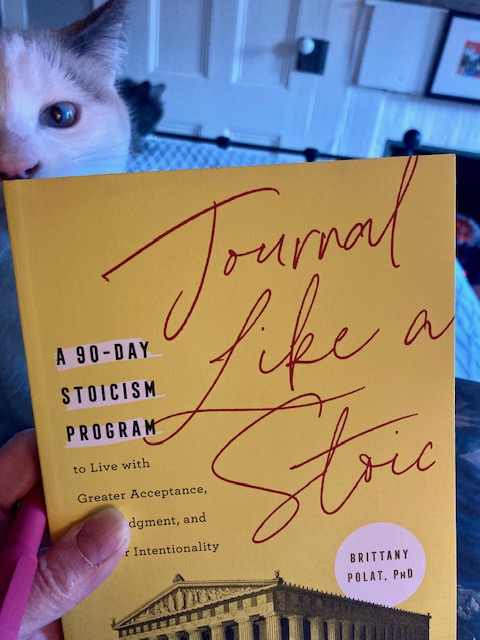
Mr. P and I stuck to our walking schedule, which we know is a nonnegotiable necessity, and I was happy to return to my library job and to church on Sundays. These things always help. Still, I knew I needed to get more writing in, and was stuck—am stuck—as far as my historical fiction manuscript goes, so I searched online for a new journal. I found and ordered Journal Like a Stoic: A 90-Day Stoicism Program to Live with Greater Acceptance, Less Judgment, and Deeper Intentionality by Brittany Polat, PhD.
By the time the journal arrived, we were more than halfway through January, and I was physically unwell. I am only into my third day of using it, but I would say it is helping me in the way that almost any honest attempt at writing truthfully from my heart and mind can do. It focuses my mind with reading, questions me with depth, and sets a task before me. I like it.
From the book: “Stoicism is a philosophy of life in the fullest sense. As a framework for daily living, it can guide us in every decision we make, from our career choices to what’s for dinner tonight. What’s more, it helps ground us when we’re living through what feels like unprecedented times.”
The kitty is also interested in stoicism.
The three disciplines of stoicism are logic, ethics, and physics. The four virtues of stoicism are wisdom, justice, courage, and temperance. All these things I can get behind, believe that I mostly already embrace them. I say mostly, because I am ignorant when it comes to physics, and historically slack when it comes to temperance. Still! I am in. I will faithfully read and respond to the prompts in the book. I will write honestly.
I plan to continue with the other things in my life that sustain me: my love of friends, family, community, church, library, nature, reading, art, music, cooking, and pets (to name a few). And I will write the occasional blog post! I love connecting with all of you!
Cheers
To us! To a year of introspection and growth, and to a lifetime of love-motivated action and purpose. God Speed.
The American Writers Museum is located in Chicago, Illinois. My Photo.
Saturday afternoon. Wondering what to write. Obviously, lots to comment on if I were to verge into current events, but I don’t want to do that. I want to find one good thing to write about—something good for writers, since this will be a post on my writer website.
Perhaps something about writing into your pain, both as a way to expunge it, and as a way to find a path through it. A way that perhaps can teach you something about what you really think, or want, or can make possible, and if you can do this, then so can anyone else. It can be healing.
So, let’s see what comes up in a five-minute timed writing. Just a furious spilling of whatever comes up. It must be nonstop and unedited. Ready?
If I ask you to do it, I must do it, too. . . (sad writer nervously sets timer). . .
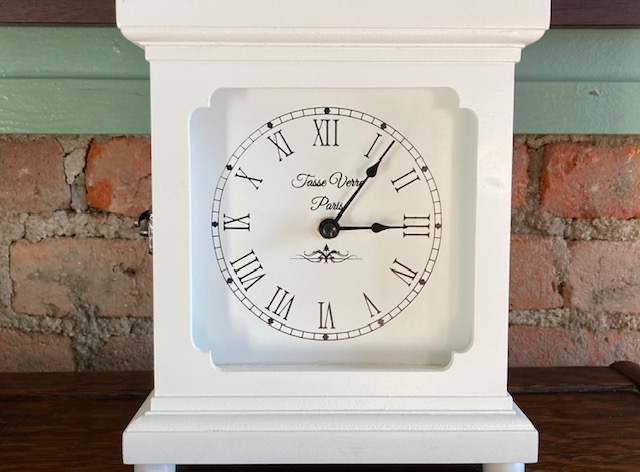
My Clock
Begin!
The first thing I want to say is that I am sad and I wish that things were different. I wish I had gotten busier being successful so that I would have more options now. Now that I want to change things and move and find a yoga class and travel more and eat wonderful vegetarian food in beautiful restaurants and have a home big enough to have a guest room with an extra bathroom and I want to have a place right near my daughter and grandchildren but I cannot afford to live there and it’s because I never figured out a way to make enough money when I was young and never knew how to save money or grow money and money is the only thing that seems to make freedom work in America.
I have always been a dreamer. I have always been a worker, too, and I thought I could be a dreamer and just keep working and that things would consistently get better over time. By get better, I think I meant that I would be able to afford health care and all those things I mentioned above. I also expected that people would want to love each other, help each other, and understand each other. Teachers and librarians and ministers and social workers would always be revered. A college education would be attainable and who wouldn’t want to go to college?
And it would be a great equalizer, because a lifetime of learning and studying history and art and literature, science and geography and math … all of this could illuminate anyone who wished it … and why wouldn’t everyone wish it?
But I was wrong. And I am filled with regret about so many of the choices I made that probably made things worse, but my mind is vague about what those things were and why they were so wrong when obviously I was doing the best I could at the time. But it was never enough. I’ve never been enough.
And I miss my kids. And I want to live in a little house near water where I can walk every day and admire the ducks and the geese, I miss Canada geese, and where I can stop in a little coffee shop and write on my laptop. Which I do not have. But I have a desk computer, and I have a lot of journals and paper is still affordable and I can write longhand, which is better in some ways for me anyway, So why can’t those things happen?
My Photo. The Drawing of Our House is by Derek Zacharias.
I know that the outrageous cost of housing in this country is not my fault. I don’t know who is at fault for that, but there’s a part of me that blames the people who made better choices than I did or who were born into “better” families… And it does me no good to think that way.
Bitterness is knowingly biting into the peel of a grapefruit, chewing it slowly, perversely enjoying it, even though as a child your mother cut the sections loose for you, sprinkled the pink fruit with sugar, and centered your portion with a cherry. That’s the way I like my grapefruit still, that, or in a grapefruit martini with a sparkly sugared rim.
I don’t want to be bitter. I want to find a way back to optimism. It’s just so hard. I miss my kids. The holidays I so love to celebrate are nearly upon us, and I don’t have a way to enjoy them with my family all together. I come and go always somewhere where I am half happy or half as happy as I fantasize, I would be if everyone I love would be there together at the same time. But the drive to Arrowhead from here is much harder than I thought it would be, and since we now know that it’s more expensive here because we regularly leave and stay far away in the city when we have a healthcare need, such as my husband’s recent helicopter trip to Reno and subsequent stay in the hospital there. The hotel bills for me to stay near him during his procedure. All the money spent on gas and restaurants.
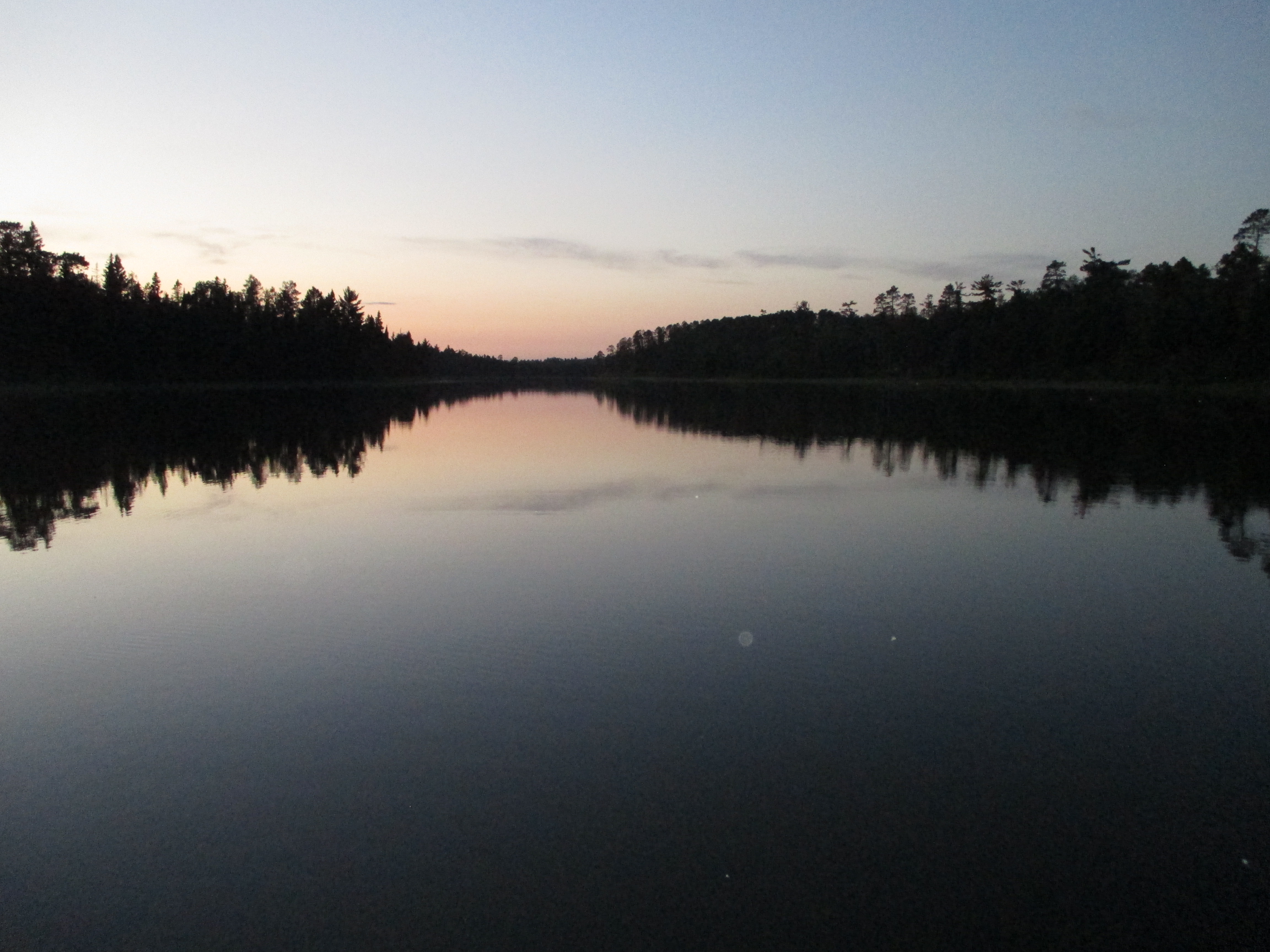
Lake Itaska, Minnesota. My own photo.
Moving to Minnesota seems the only semi-practical solution. At least there will be doctors nearby. We still won’t have a lot of money to pay doctor bills, but at least we won’t have to spend extra money just to get to the place where the medical facilities are located. And the houses in Minnesota that are outside the Twin Cities range in price of course but some of them are much more affordable than anything in the West. We can’t afford anything here near healthcare.
I will still have to fly to see my kids of course. The flights may cost slightly more from St. Paul, Minnesota to California than they do from Reno, Nevada, but that’s the only way I can go. I don’t know how I will afford it, but perhaps I can get a part-time job again like I have here (never as lovely as this job here, I don’t think… I’ve been so lucky in that way). My library position is the reason I’m able to buy plane tickets, and it is a complete joy. But I believe whatever happens, moving again offers the only glimmer of hope.
Time.
And there you are. Or there I am. Do I feel better? Maybe a bit, and I’ll take it! Next a walk. A walk after a writing session helps all the thoughts flow better and meet one another and mix and calculate. Also, writers need to take care of the body that carries them around and allows them to experience many of the things that feed them as creatives.
I believe I’ll go for a walk now.
Wishing you lots of “free to worry” (and resolve) writing time—and all the healing you need and all the hope.
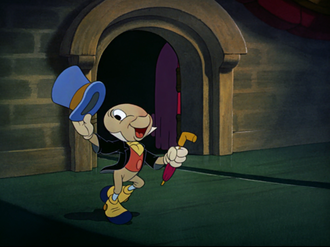
Jiminy Cricket from Pexels Free Photos, Disney.
P.S. I came back from my walk and edited my freewrite just a tad. It’s what we writers do!
Sammy was a truck driver stuck in my husband’s place of work, a truck fixing place—what’s that called anyway—a really big garage I guess. Anyway, it was Christmas Eve and Sammy was supposed to be home with his wife and children in Georgia, but instead he was stranded in Wisconsin in a cold garage. He was leaning against the service counter with his head down when I arrived to pick up my husband from work. I’d brought our two dogs into the shop as a special Christmas treat for everyone. Merry Christmas, Guys! Time to get home and celebrate. Atticus, the schnauzer, promptly lifted his leg on one of Sammy’s tires, unleashing a steamy stream of urine that left an impressive puddle. It was kind of fitting really because Sammy’s truck wasn’t going anywhere for some time. I guess it was super broken. It had let him down, and on the most important night of the year. Atticus must have sensed that.
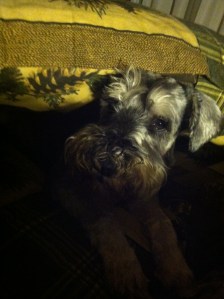
Atticus likes to hide in bed, too!
I’d been feeling pretty blue, but had been trying to hide it in public for quite a while by then. I found it difficult to get out of bed in the morning and impossible to stay away from that same bed with its heating pad and two willing dog companions as each gray day unfolded. I mean, it was Christmas and I was going to be with none of my kids or grandkids, not for months. Granted, I had just gone to visit them the month before, but I already deeply missed them and I’d never been away from the little ones, who really aren’t that little anymore, on Christmas. And I was living in a state I loved but that was 2,000 miles away from the state where I’d built a life for thirty-eight years.
I was missing all kinds of things and people I had loved and many that I had taken for granted. I still planned on making a big Christmas dinner, but it would only be a dinner for three: my husband, his father, and me. And it had rained for weeks in a state that should have been a winter wonderland by then. My roof leaked. The yard was a mud hole. The holding tank had filled up just that very morning, setting off an alarm almost as offensive as the smell in the mud hole yard, and nobody likes to call Pat’s Crap Pumping Service on Christmas Eve. My solar Christmas lights obviously wouldn’t turn on because there’d been no sun forever. My pink fudge didn’t set. I wasn’t writing. What was there to get up for?
I took this picture at the Kenosha Museum, but it represents my dilemma quite well I think.
And then came Sammy, and Sammy wanted to get home for Christmas. He hadn’t been able to rent a car with his out-of-state driver’s license. My husband suggested the airport. Could he get a flight? We would drive him. Sammy didn’t know if he could get a flight, but it was his best chance. Soon, Sammy, my husband, Atticus, our other dog, Diesel, and myself were all crowded into my little blue Beetle headed for the airport. It was about a half hour drive going in the opposite direction from the mud hole, making the round trip to pick up my husband something like two hours.
I’m a nervous driver when it comes to driving on freeways or anywhere near a city, but I found myself relaxing as Sammy told his story. He had left Africa at twelve-years-old, alone. He was the only member of his family who was able to emigrate. He lived in a small town in Utah and attended high school there. He loves America. He said that “the father Bush was the president when I came, so I liked him. He let me come to America. I couldn’t understand when Clinton suddenly got the job. How can someone replace the president?”
He said the president in his former country had been in power for twenty-five years and there was nothing anyone could do to change it. His family was afraid when Sammy would visit because Sammy had learned about free speech and they thought he’d get killed for speaking out about how bad things were there. He said, too, that Americans are the nicest, most helpful people in the world. He said that in other countries people won’t even give you directions, much less a ride to the airport. I think Sammy is a little partial to America and that there are lots of nice people everywhere, but it was still nice to hear.
I love stamps, and writing, and letters…
He teared up when I asked him if his children believed in Santa. I cried, too. My husband was in the back seat with the two dogs, but the car is so small that his face was only a few inches behind us. I glanced back at him and his eyes were bright blue with tears. Suddenly, it was starting to feel like Christmas.
Sammy got a flight and Mike and I headed home. By this time we too hungry to go home and cook the special dinner we’d planned just for the two of us so we began searching for an open restaurant. We stopped at two places that had their lights on and doors open, but they were having private parties and weren’t serving the public. It was Christmas Eve, sorry. So we did the unthinkable and drove through a MacDonald’s. We got cheeseburgers for the dogs, too.
When we arrived home, we waded through the mud and entered the front door. We both remarked on how cozy the little cottage looked. We each poured a glass of wine, his red and mine white, and Mike checked his phone. There was a message from Sammy.
Merry Christmas and Thank You. I’ll talk to you soon. It was a pretty good Christmas. Wishing all of you a good New Year with lots of random Sammys to bless you.
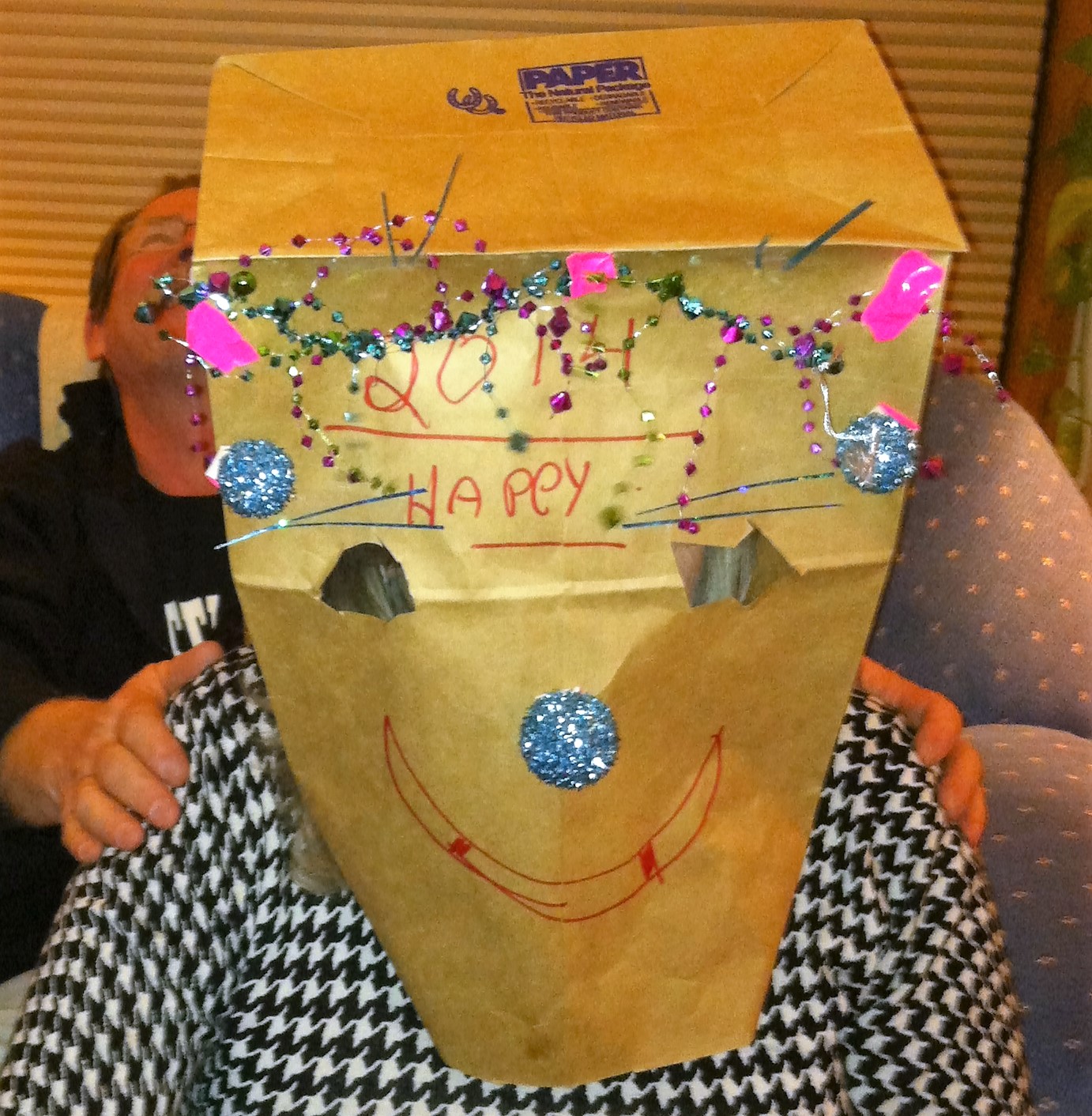
This may be an old New Year’s hat, but it’s a Goody.
I belong to an appendix cancer support group, and one of the non-words I see quite often in posts is scanxiety, a condition related to the anxiety felt about medical scans that are given regularly for an indefinite amount of time after cancer treatment. In the beginning my scans were spaced three months apart; now they are six months apart. I’ve gotten good at coping with the anxiety nowadays (four years post diagnosis) most of the time, but when I get to the day before testing, as I have today, I find my mind casting away from anything productive.
My creativity is gone. I can’t concentrate on writing my novel or even reading someone else’s novel. I want to talk about it, but I don’t want to sound like a hypochondriac. I don’t want to seem negative. I don’t want to be told not to worry, everything will be fine. Even though I know it probably will be.
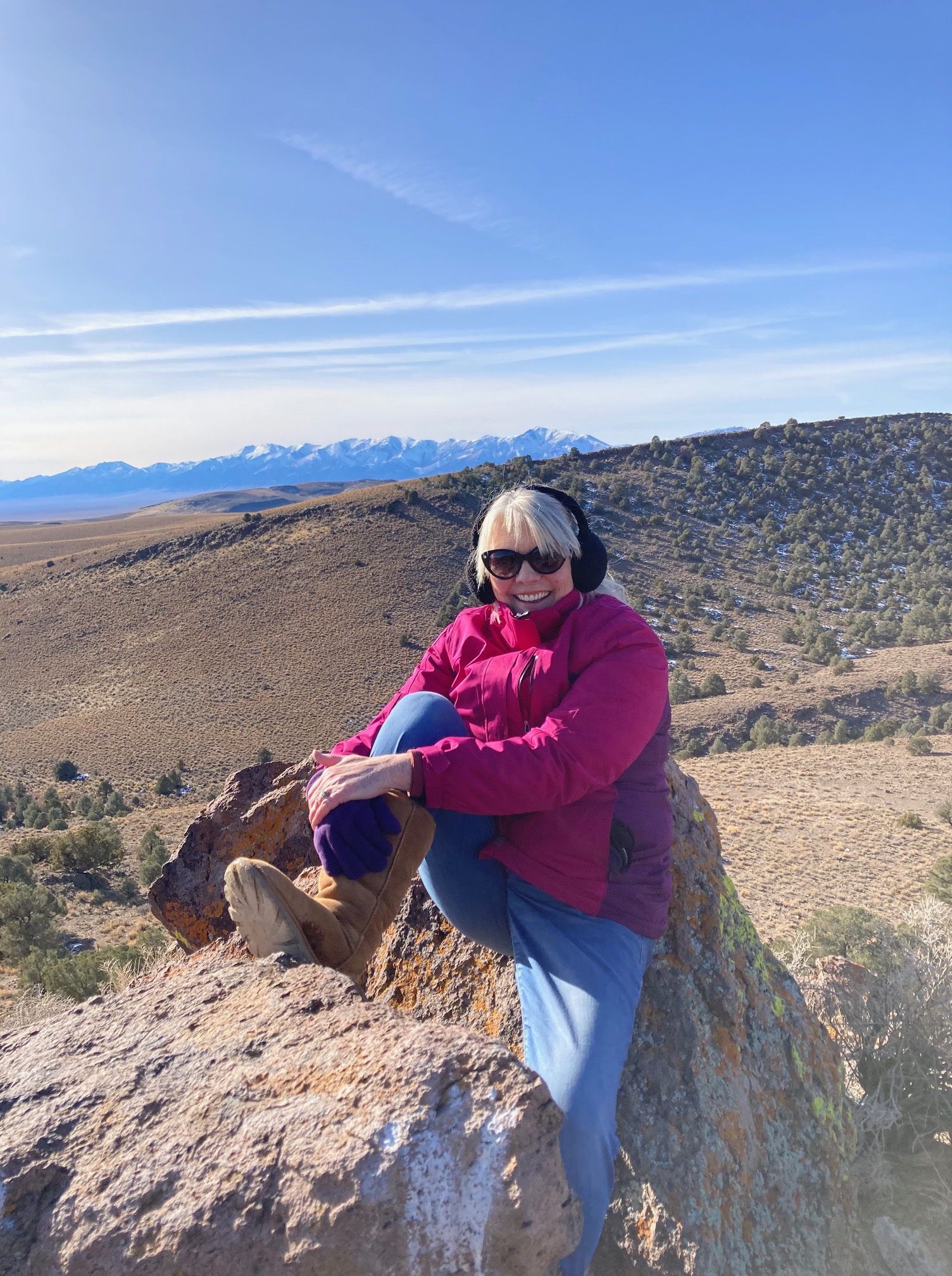
This photo depicts my usual outlook on life, and was taken on my beloved mountain. This is not to say that I don’t love, love, love Wisconsin!
The thing is, I’ve never gotten over that initial out of nowhere diagnosis. I can only say that I feel vulnerable to invasion, or worse, that I feel like an unknowing host. I don’t understand cancer. There are so many different kinds of cancer, so many different treatments, so many different outcomes. Mine, Goblet Cell Adenocarcinoid Cancer of the Appendix, is supposed to be quite rare. It doesn’t seem so rare when I read the stories in my support group.
Sometimes I think I should drop out of the group; it reminds me daily of something I should not dwell upon. I believe in the power of positive thinking, and maybe reading the very real cancer stories, takes some of my shine away. But I also think that I should buck up—you know, be there for those who ask for a prayer or just need to vent and need to know someone out there really hears them.
I rarely participate in any length, usually just a word or two. Others in the group are much better at knowing what to say. Quite a few of them even offer up-to-the-minute cutting edge medical information, where the best hospitals are, how to connect with an appendix cancer specialist, the ins and outs of health insurance, tumor markers, treatment experiences—all sorts of really important information. I can’t help but feel I haven’t found a place of usefulness within the group.
And here I am tonight, inexplicably sad about the way that cancer changed my life and knowing I might be able to get some help from the group if I could just express myself without sounding like an infant. Most of the posts I read are written by or for those of us who are currently in the throes of the worst of the disease—those reeling and just diagnosed, those going in for their 2nd, or 3rd, or 4th surgery. Those who are in palliative care. The loved ones of those recently passed who write to break the news to the group.
And here I am feeling pretty darn good. I am one of the lucky ones. Makes me feel like a phony just wallowing in a selfish bout of survival guilt. And yet. And yet I am sad. Sad that my life changed so drastically since my initial appendicitis attack. The appendicitis that turned out to be hiding cancer.
Four years ago I was a teacher living on a mountain, surrounded by family, friends, students, colleagues, and neighbors that I loved. My four grandchildren all lived within a few miles of me.
That is not to say that my life is not good today, but it has changed dramatically. I miss my old life. I miss my kids. The circumstances of my life after cancer and my second surgery have impacted almost every aspect of my personal life and my career. Not all of it is bad, but some of it is. I’m not going to lie.
Sometimes survival calls for sacrifice, or at least that’s the way I’ve come to wrap my mind around it. Maybe it’s nothing as noble sounding as that. Maybe I just got lazy. Teaching, one of my great passions, had always required great energy, energy that I no longer seemed able to summon. I was eligible for retirement. My husband needed work and found a good position in another state. My tumor marker tests showed increasing evidence of cancer at the cellular level, yet my scans were clear.
I’m not sure what tipped the scale and brought us to this new place. Maybe it was down deep merely an urge to run, something I’d done plenty of times in my earlier years. Grief over my brother’s death, financial hardship, chemo-brain, depression, debilitating chronic health issues, fear of recurrence…all of these things and more must have played a part. I only know for sure that the world changed after my diagnosis.
That’s the thing about cancer. It sneaks up on you. I had no idea that I had cancer until I went in for my post-operative check after my appendicitis surgery. And that’s probably the root of my malaise. If I didn’t know I had it then…
Scanxiety.
I’m grateful for what I have; I still have love and family, however far away some of my loved ones are, and I will be forever grateful for what I have had. Nothing can take that away.
You’ve just been given a cancer diagnosis. Often, this news comes as a complete and unexpected blow to you, as it did for me. Other times, as it may have done for you, it comes after nervous days, weeks, or months of wondering what’s wrong, suspecting the worst, praying that it isn’t, going to doctors, and hoping the cough or the pain or the patch of scaly skin you have is anything—anything—but cancer.
Whichever way it happens, anyone who hears the words, “You have caner,” is in for a universally brain numbing and heart stopping experience. After those words, you know your life is suddenly changed in ways you fear and do not understand.
Here’s what I want you to know: many others have been through this, consequently, you are not alone. There are some simple things you can do to soften the shock, and to construct a small space of comfort to hold onto. You will need to prepare.
In July of 2011, I walked out of my surgeon’s office smiling bravely, barely feeling the ground beneath me, holding my five year old granddaughter’s tiny hand, and wondering if I was imagining what I had just been told. I had gone to the post op appointment feeling giddy. Just having survived and quickly recovered from an emergency appendectomy, I felt I had undergone nothing more than a small hiccup, an interruption that was going away as quickly as it had arrived, leaving me stronger than ever. After all, I had done remarkably well. I was already back to running around with my grandkids a bare two weeks after surgery. No need to cancel summer babysitting plans, I thought.
That was why I took my granddaughter with me, and how she was sitting right next to me when I heard, not, how beautifully I was doing, but, that the lab had tested my appendix. I had appendiceal cancer, a disease I’d never heard of and soon learned was rare, what is called an “orphan cancer” because so few people contract it that it doesn’t garner much research
Perhaps, like me, you went immediately to see a family member, or maybe called a loved one on the phone. You might have already been in a hospital. In my case, I checked my watch and saw that it was about time for my daughter to get off work, and since her office was in the same building as my surgeon’s, I dropped in on her. I could deliver my granddaughter to her there rather than at home.
“It’s strange,” I said. “The doctor thinks I have cancer.” Thinks, I said. Because how could that be? I’d never even heard of appendiceal cancer. It was too soon for tears, I guess, and definitely too soon for me to come up with a kinder way to inform my daughter. I wasn’t my usual self. Not at all.
My daughter looked at me as if I’d just told her I wasn’t her real mother, or something equally stunning. “It’s all going to be fine,” I said. I hugged her, spun my granddaughter in the air, and said goodbye.
Oddly, I then stopped off at the school where I taught, though it was summer break and I was off. My friend, Alicia, whose birthday concert I had missed a couple of weeks earlier due to my appendectomy, was there teaching summer school. The hallways seemed unfamiliar and I didn’t know many of the kids. I felt like a stranger. It was not even fully one hour since I’d heard my diagnosis, yet I believed I had already been transported into a new life. Suddenly, I wasn’t only a grandmother or a wife or a teacher or a writer, I was a woman with cancer.
It is in that fog-like state that I had to make decisions about treatment, and struggled to maintain the life I’d had just the day before, figuring out new ways to make the most of tomorrow. How would my husband take it? What about my brother, who was ill and living with us. I was his caregiver! You may feel things are happening too fast. They are. While you may have to accept that and many other unpleasant aspects of the journey at the beginning, remember, having cancer does not make you into a victim.
The American Cancer Society says that everyone who has been told they have cancer should immediately be referred to as a survivor. They print out new purple “Survivor” t-shirts every year. The ACS does lots of good things: provide rides for people who need to get to treatments, wigs for those who lose their hair, pump a great deal into research for cancer of all types. A part of me loves that they call me a survivor, but another part, the teacher part, perhaps, thinks: The opposite of victim is survivor. I don’t want to be either of those things. I’m also a teacher of the Holocaust, and I can’t help but think of the Holocaust survivors I’ve known or learned about. My survival is something very different from theirs. And then there is this: Some people find the survivor label to be insensitive in regards to the loved ones of patients who died. Did they not fight hard enough? Were they not brave enough? Though I know this isn’t the intent of the label, I wonder about using it. I do wear the purple shirt when I attend a Relay for Life event, but I’m really not sure I should.
All I know for sure is, You Are Not a Victim!
We all do our best. You may or may not have excellent health insurance. You may or may not live near a state of the art cancer center, such as one of our few national cancer centers in the U.S. Even if you do live near such a place, your insurance may not cover it. You have so much to learn, particularly if your particular kind of cancer is rare. My insurance company sent me to a small clinic about an hour away from my rural home that I’d never heard of. I petitioned for (and won) permission to get an expert opinion at The City of Hope in California. My clinic then used City of Hope’s treatment plan, and I began to relax a bit.
Within hours, if not minutes of diagnosis, you and your caregiver (spouse, parent, friend, or adult child who will sign on to go with you on your arduous journey) will be responsible for learning a new language, becoming an expert medical researcher—tech savvy enough to search and set up informational networks for the other important people in your life… and the list goes on.
Make no mistake about it, a cancer diagnosis means you’re going on a journey, perhaps not to Paris (although that’s not out the realm of possibility!). There might be a really good doctor in Paris, one who is the world’s most renowned specialist in your cancer. Your specialist, and I strongly urge you to find one, could be hundreds, or even thousands of miles away. Wherever you travel, either metaphorically or concretely, you will benefit greatly from a well-stocked gear bag.
Coming Tomorrow: The Gear Bag and All of Its Contents
Is this the kind of bag I mean? Well, almost as much fun.
Have you ever been gloomy on a perfectly lovely day? Maybe better to ask, have any of us not? Today began that way, sharply beautiful—a kind of begging to just be outside kind of morning, followed by a mildly warm bursting with life afternoon.
Still, I was gloomy.
My body said go outside, but my heart said no, let’s be gloomy.
My muse said, get up and write, but my mind said no, let’s be gloomy.
If it weren’t for my dogs, I might have pulled the covers over my head. But dogs need walking, so I forced my gloomy heart and mind to come along, promising myself I could crawl back in bed when we got back.
Out walking, we changed course a few times to avoid wildly happy unleashed dogs (Who knows why there were so many loose canines out on this particular day? I pictured them all prying the screens off their open windows with various size paws after their humans left for work, and then jumping out pell-mell to run and roll in the grass. The day was that pretty).
I always change course when I see a loose dog ahead, or one running toward us, not so much because I am afraid of them, but because I fear they may be baited into a fight by my feisty Schnauzer.
Anyway, we found a quiet lane eventually. Diesel and Atticus were taking things slowly, sampling the fresh long grass, sniffing and marking, sniffing and marking. Pandora was playing in my pocket: Coleman Hawkins, “Under a Blanket of Blue.” Lovely.
And then I noticed.
I wasn’t really all that gloomy anymore.
Nice breakthrough.
I was thinking about the writing I would accomplish today. My important novel writing. Wrestling with my protagonist’s problems. Conjuring up a crucial scene to push the plot forward.
We were almost back home when Barry and Laura, two of my neighbors, waved. “Want to go kayaking with us?” they asked.
An invitation, it turned out, that I could not turn down.
I love being in the water, on the water, with the water. I love the quiet splash. The green banks sliding by. The exercise and the rest.
And this would be my first time out this season.
On a day such as this, these are the moments are sometimes given. Learning to spot them and savor them is the trick.
An hour later we were on the river paddling with just the right amount of effort to know our arms were probably morphing into something sleekly beautiful, something very un-middle-aged-women-and-man-arm-like. There we were, three people, a man and two women, just for a little while living in the moment, alive and in nature.
“The goose family is just ahead,” Laura said. “We’ve been watching them grow.”
We came around a bend and came upon two complete families. Two mothers and two fathers standing tall watching us. Two groups of chicks. One group, still downy fluff, but up and about, and maybe a third as tall as their parents. The other group was younger, but there were a lot of them—they were huddled in a perfect circle around the base of a tall shrub, looking like a living Christmas tree skirt.
There wasn’t a house or a boat or even a power line in sight. Just us and the geese.
“I didn’t know separate families lived so near each other,” Barry said. “And I hear they mate for life.”
They mate for life.
Also, and this is maybe the best part, Barry searched through all the downed branches near the river’s edge for trash. He didn’t find much, but what he found, he took with him. Took it home to recycle.
Laura smiled at me. “Barry cleans the river,” she said.
Health is related to writing. All areas of health. And conversely, today my writing is very specifically related to health. The two, I have found, are closely entwined. I wrote very little when my health was at its worst. I did entertain thoughts of writing when first diagnosed—lots of time during recovery and chemotherapy to write that new novel. Some writers, tougher than me, have used similar circumstances in just that way, I’m sure. Writers with full-time day jobs, perhaps especially. When else is a chunk of time that big going to show up, unplanned for, unasked? The time, and privately, I even thought, the added depth of character this new ordeal was going to provide me with, could be put to good use. Hadn’t I been too overwhelmed with responsibilities to focus on my writing of late?
It all made good sense until the surgery came, and then the six months of chemo. I was on one mode, and it wasn’t writer mode. It way surviving the effects of cancer treatment by laying on the couch mode. I couldn’t even read a book. Well, I did write some CaringBridge blogposts that kept my family and friends informed of my progress and helped me sort out my hopes and fears. But the novel never came. For me, it just didn’t pan out. I had time, but no energy, no ability to concentrate, no creative spark.
Today’s short piece is inspired by that connection, with appreciation and gratitude for the gift of health I am experiencing right now. I took a gorgeous long walk this afternoon past the wooded hills and ready-for-harvesting fields of corn near my cottage. I was stepping pretty lively, sucking in the newly changed chill in the air, and smiling my ass off! And now, as directed (Blogging101), I’m writing.
Tomorrow is Froedtert Day. Froedtert is a hospital/medical center in Milwaukee, WI, USA. It’s pronounced ”fray dirt.” I am new to Wisconsin and Froedtert, but not to the fray. In California, where I used to live, I began my cancer journey. Having a rare form of a rare cancer made me feel uncertain during diagnosis and treatment. Had my doctor ever actually treated this before? This type of cancer isn’t call one of the “orphan diseases” for nothing.
Though I was well taken care of, I always had questions that went nowhere. We are monitoring you closely and believe you have an excellent prognosis. I came to accept this answer, but I never stopped scouring the internet for detailed information. There isn’t much out there, at least not that I was able to find.
Enter Froedtert. With final instructions from my California docs to find an oncologist and get some new tests and scans done when I reached Wisconsin, I began my search. One of my husband’s coworkers suggested Froedtert, as his wife had been successfully treated for cancer there. And it was covered by our insurance. Good enough, I thought. Looking over their website at cancer specialists, I couldn’t believe it. An actual, honest to God Appendiceal cancer specialist was listed on staff.
Fast forward. I got an appointment with this man, this very nice, personable, intellectual giant of a doctor, and in less than forty-five minutes had all three years of my accumulated goblet cell specific questions answered, my tests scheduled and all of them carefully explained. Some done religiously in California weren’t needed at this time; others not done regularly, were.
I go in tomorrow for those tests. One short week later, I’ll see my oncologist again, and he’ll suggest a plan for the future. The future! I am nervous in a whole new way, actually excited to get on with it, believing that a veil has been lifted. I’m several chapters into writing that new book. Out of the fray, and hitting pay dirt.
Mahalo!
Welcome to a space for all moms. This is a platform where I write my experiences as a mom in her primes—sharing real-life stories, lessons learned, and the ups and downs of motherhood. My goal is to inspire, support, and connect with fellow moms who are also embracing the journey of raising a family while growing as women.






































 LakeArrowheadLadyWriter