Category Archives: Writing

Escaping Limbo

I have thought a lot lately about the discomfort of being in a perpetual state of waiting for something to happen, of worrying about what the results will be when something finally does happen, and then, wondering if I will navigate any of it well. The word “limbo” is often in my thoughts.
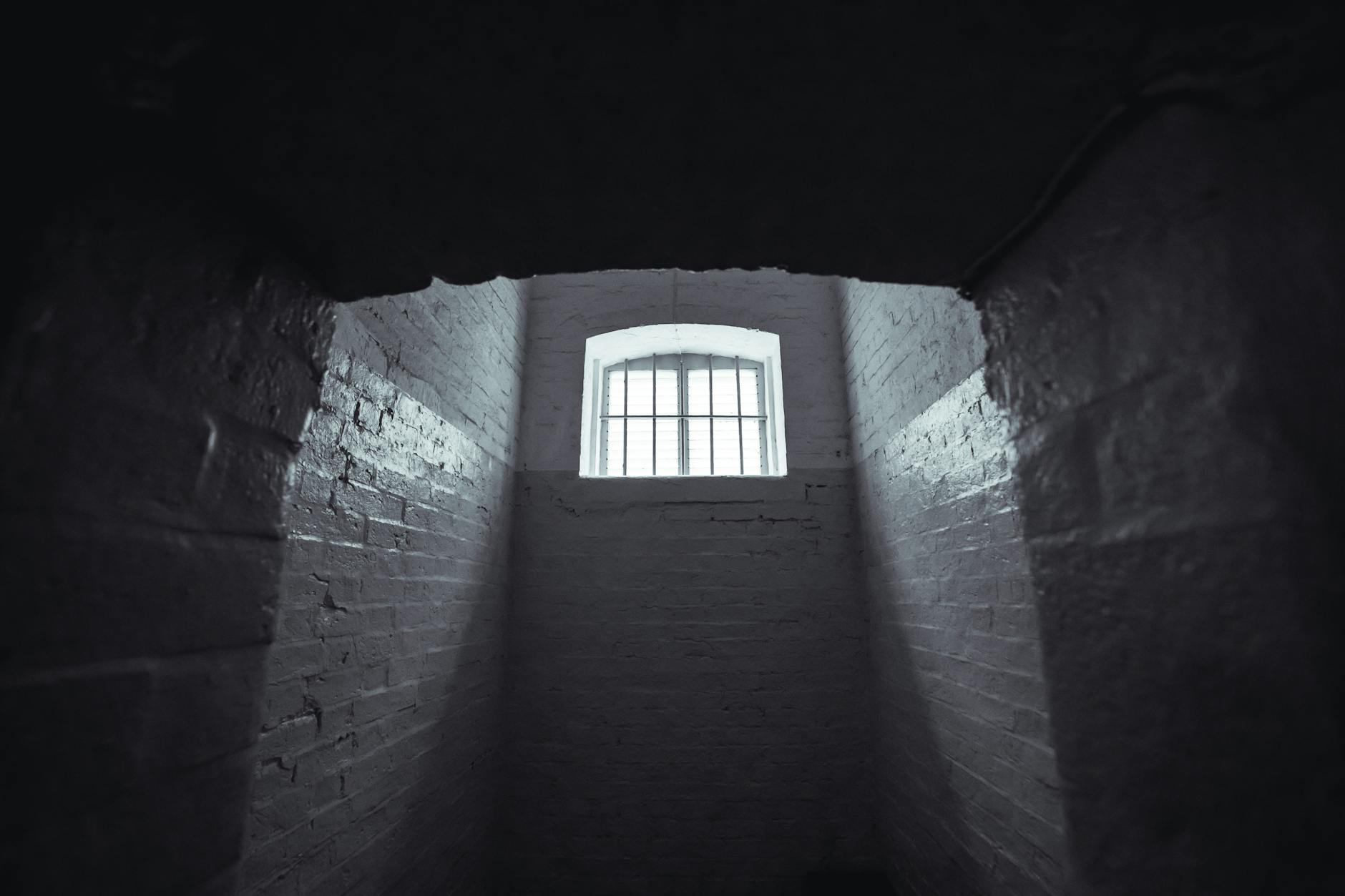
Photo by Jimmy Chan on Pexels.com

2024 brought new health concerns for my husband, and with that a reconsideration of where we should live, since we are currently in a very remote location, three and a half hours by car from the nearest medical center with cardiac care. We responded decisively by putting our house on the market. That decisiveness did not break us out of Limbo, however, as we do not know when or if our home will sell, and we do not know what it will sell for if it does sell. We cannot make plans on where to move until we sell the house. Still, we’re thinking about returning to the Midwest where real estate prices are more reasonable than here in the West and where we can reasonably expect to afford to live in a town with a hospital. But, until we sell, we are in Limbo.

Also, in 2024, I was thrilled to receive an invitation from my dream literary agent to send her my full manuscript, A Fine Suddenness, a World War II historical fiction novel based in Lake Arrowhead, CA. I’ve no idea if she has read it yet. It has been out of my hands for six months now, this after having worked on it pretty consistently for years. Many years. I miss it terribly (it’s an odd thing, really, the attachment I’ve made), and I have no interest in beginning a new novel yet, though at least I am continuing to write. Even so, journaling or posting online, as important and healthy as they are, do not give me the same sense of mission as novel writing does. I wait to hear from the agent, and I do not move forward on a sequel to the book I sent her, nor on some new unrelated novel, because I desperately want her opinion on A Fine Suddenness first. More Limbo.

And 2024, oh my goodness, has been a year of intense worry and anticipation for our nation and the world. We are no longer in the first stage of that particular limbo state, but we are certainly still in a place of transition and uncertainty. So many possible scenarios there, and so little I have control over. More Limbo.

Earliest historical references to Limbo describe a place in-between—not heaven, not hell—a place for deceased unbaptized humans born before the birth of Christ, or who died as infants before baptism, to reside until the second coming of Christ by the Roman Catholic Church, and these begin in the 14th Century. From there, the word limbo (more and more with a lower case “l”) entered usage in less theological contexts: as a place or state of restraint, confinement, neglect, oblivion, uncertainty, or an intermediate or transitional place or state.

Etymology also traces limbo from the English of Trinidad and Barbados limbo “a dance that involves bending backwards under a pole,” related to Jamaican English limba “to bend,” from English limber “flexible” (merriam-webster.com).

Photo by RDNE Stock project on Pexels.com

Which leads us to the dance, or funeral game, which dates back to the mid to late 1800s on the island of Tobago. In the beginning, the game started with the bar at the lowest possible height and the bar was gradually raised, signifying an emergence from death into life (Wikipedia.org). It is possible that the roots of this practice come from the slave experience of being transported across the seas in ships, where the slaves were separated and tried to squeeze through narrow spaces in order to see or touch one another. In some African beliefs, the game reflects the whole cycle of life . . . the players move under a pole that is gradually lowered from the chest level and they emerge on the other side as their heads clear the pole as in the triumph of life over death (Stanley-Niaah, Sonjah “Mapping of Black Atlantic Performance Geographies: From Slave Ship to Ghetto.” Quoted on Wikipedia.org).

The secularization of the dance began in the 1940s where “it became a popular entertainment in Trinidad and was adopted as a physical fitness exercise by American troops,” . . . and is now “considered the unofficial national game of Trinidad and Tobago” (Wikipedia.org). It has become a fun and happy pastime.

Historically, Limbo to limbo, has moved on. Broken free, so to speak. I wonder if my own limbo could progress that way, too. As for human history, perhaps also for me? If I am stuck in the place between heaven and hell right now, will it be possible for me to become limber enough to squeeze myself through the narrow places that block me from reaching the open, even joyful places that still may exist beyond my current ability to see them or experience them?

In order to do that, I would need to understand the constructs of the narrow places. What are they exactly? What are they made of? Are they hard and impervious, like granite? Splintered like rough wood? Flexible and sometimes deadly like serpents? Or are they only real because I make them real in my own paralyzed mind? Maybe I could wish them away, disintegrate them, with new knowledge or some kind of personal epiphany.

Perhaps there is a way. Perhaps not. But I must strive, at least, to remember Helen Keller’s words, these taken from her open letter in response to Nazi book burnings in Germany on May 9, 1933: “History has taught you nothing if you think you can kill ideas. Tyrants have tried to do that often before, and the ideas have risen up in their might and destroyed them. . .You can burn my books and the books of the best minds in Europe, but the ideas in them have seeped through a million channels and will continue to quicken other minds.”

If Helen Keller believed that ideas and hopes have always “seeped through a million channels,” who am I to deny it? Might not a few of those ideas and hopes, and more likely a multitude, have made their way to us now at the dawning of the year 2025? Might not they sustain us, quicken our minds, and help us find a way out of our narrow places and into the light?
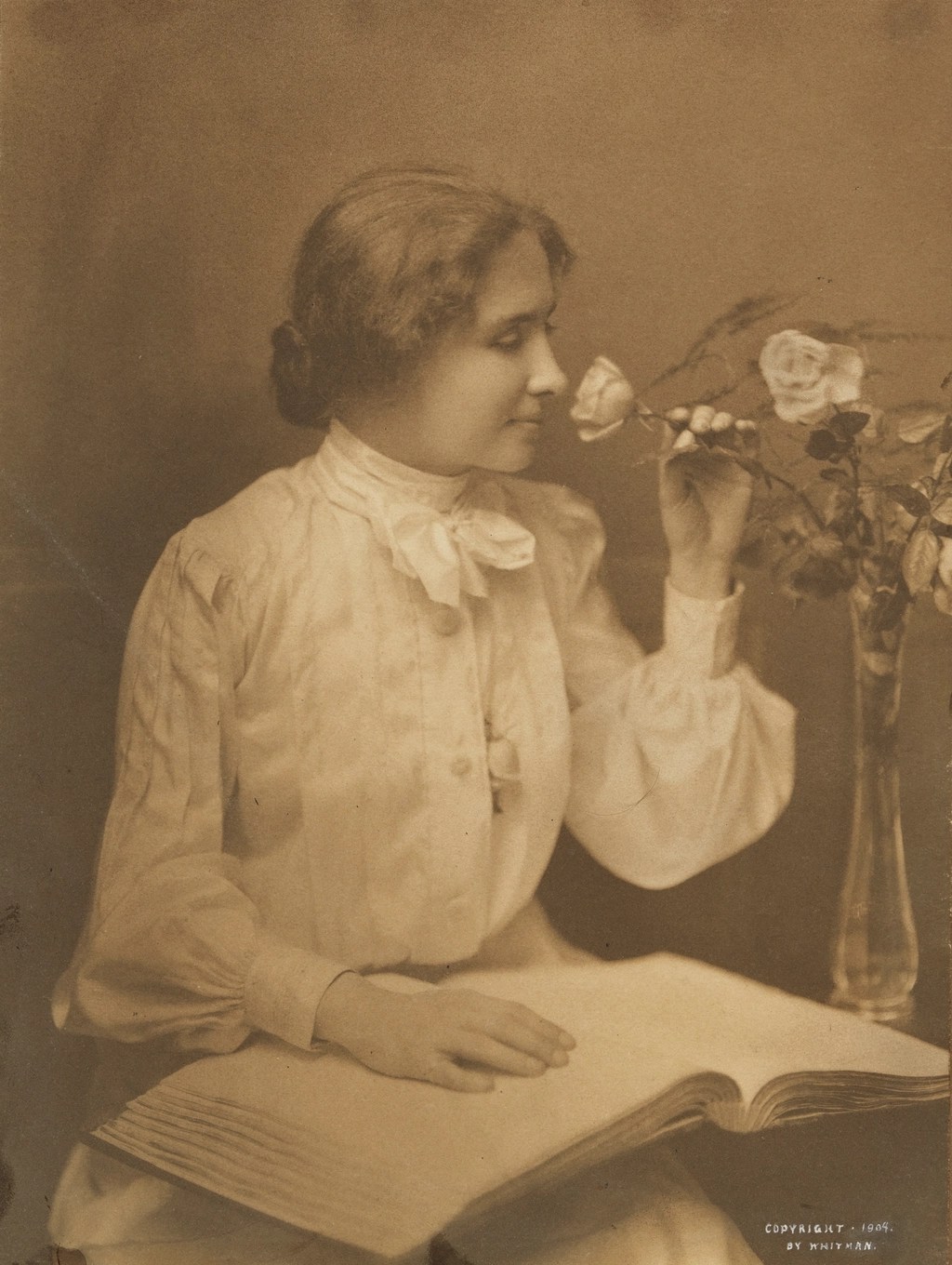
Helen Adams Keller“/ CC0 1.0 from Openverse.

22 Comments

Filed under Advice, Books, Depression, Identity, Lake Arrowhead, Literary Agents, New Year's, Uncategorized, World War II, Writing

Unearthing the Character Behind A Fine Suddenness

Three Months ago, at the beginning of summer, I received an agent request for the full manuscript of my historical fiction novel, A Fine Suddenness. I am told that 3 months is about the time I might begin to expect to hear back from the agent, and so today I am checking my email even more regularly than usual, and I am thinking about the origins of the manuscript.

My Journal

It began in May of 2011 with the glimmer of a character suggested by a signature of ownership in an old red leather-bound book a friend gifted me: The Conqueror, by Gertrude Atherton. My friend Lynn is a librarian, a teacher of history, a seller of used books, and a maker of reclaimed book journals. You can check out her business at brownbagbooks.biz. This book was one of her rescued book journals. The cover was intact, rebound into a smallish wire bound blank journal.

The original inscription inside was simple: Mary Miller 1903. Who was this lady, I wondered? She must have loved her books, I thought, to have signed her name and the year of acquisition on the inside cover, a habit I also have. I usually add the place I acquired the book also, but Mary Miller did not do so. A quick search told me that Gertrude Atherton was a San Francisco author, and The Conqueror had been published in 1902, was about Alexander Hamilton, and was widely acclaimed.

I immediately began writing in Mary’s book-turned-journal, taking on an imagined persona of the unknown lady. It began: “May 8, 1903. Lake Arrowhead, California. I am proposing to tell you a story which I am quite sure you will doubt . . .” Rather quickly it took on the overtones of a ghost story, and I named Mary’s father, described his field of study and stated that her mother had died of influenza when she was a child. All of that came to me very spontaneously. Also, Mary’s husband was dead, but she had a vision of him. So, A Fine Suddenness began as a ghost story. And in some ways perhaps that is what it still is, but not in the way it began.

Eventually, the real Mary Miller, whoever that lady was, disappeared from my mind and became instead a woman who lived in Lake Arrowhead, California during the 1940s—70 years before I read her inscription rather than the actual 108 years. Once I placed Mary in a new time and most certainly a different place than the real Mary had lived, I began to conjure what life was like during World War II on the mountain we shared, not in time, but in place.

All of that pondering gradually grew into a scene of Mary in her yard among her roses, the trees towering in the background. And so, she became real to me, and I wrote her story. She is completely fictional, other than the sense I got from seeing her name, and from the beautiful red and gold embossed cover of a book.

She, I hope, would make her namesake, the real Mary Miller, proud.

24 Comments

Filed under HIstorical Fiction, Lake Arrowhead, Literary Agents, Publishing, Uncategorized, World War II, Writing

Nature Notes

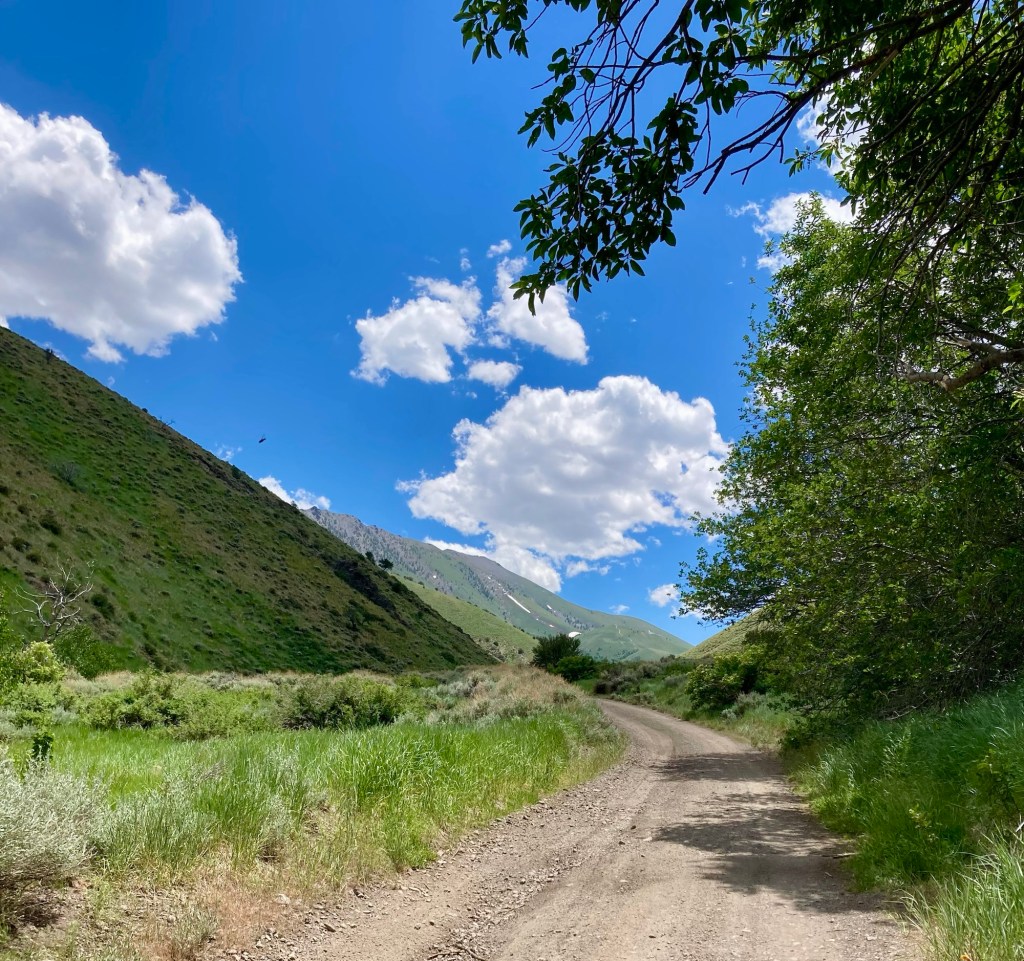
The trail

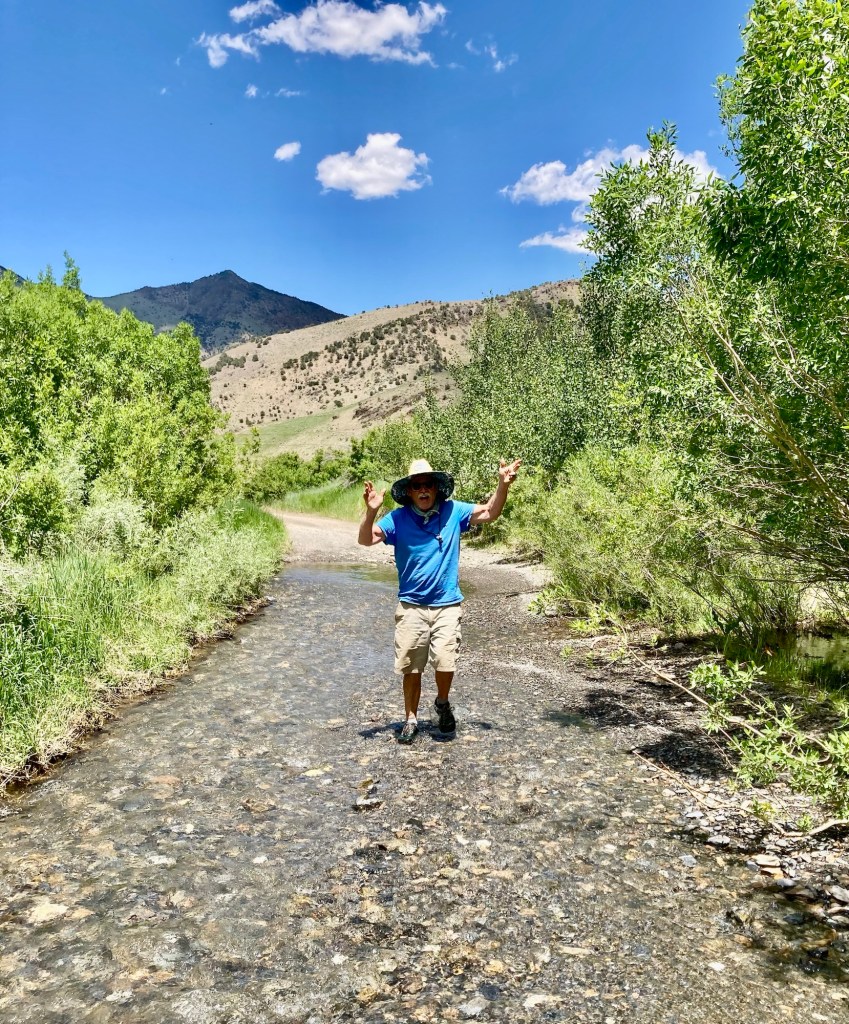
June 24, 2024–Austin, Nevada, USA: Somewhere along Big Creek going up the canyon between Austin Campground and Kingston.

Temperatures: mid to high 80s / Transportation: 2007 Rhino Side by Side

Apology: I read another writer’s blogpost very recently, probably within the past two days, yet I cannot find the post so that I can credit the writer for the idea, which was wonderful, and directly lead me to go out on a nature notes day today. It was one of the happiest days I’ve experienced lately, and that happiness is only dimmed by the fact that I cannot find the original post that inspired me. If that was you, and you read this, please respond so that I can thank you properly!

The Task: Spend time in nature and record everything you notice. Size, shape, color, activity … whatever you observe. *The post that I mentioned above actually provided much more detailed suggestions, but, alas, I cannot find it…

None the less, it was a delightful day!

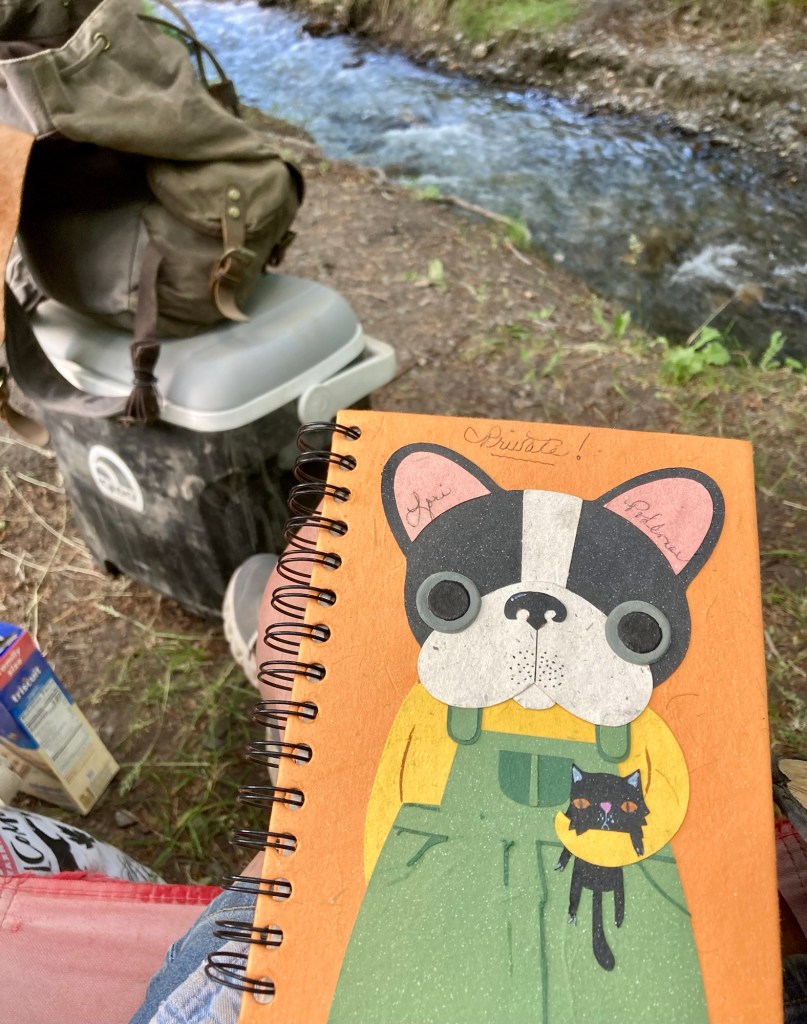
One of my favorite journals. A gift from a young man named Andrew.

My Notes:

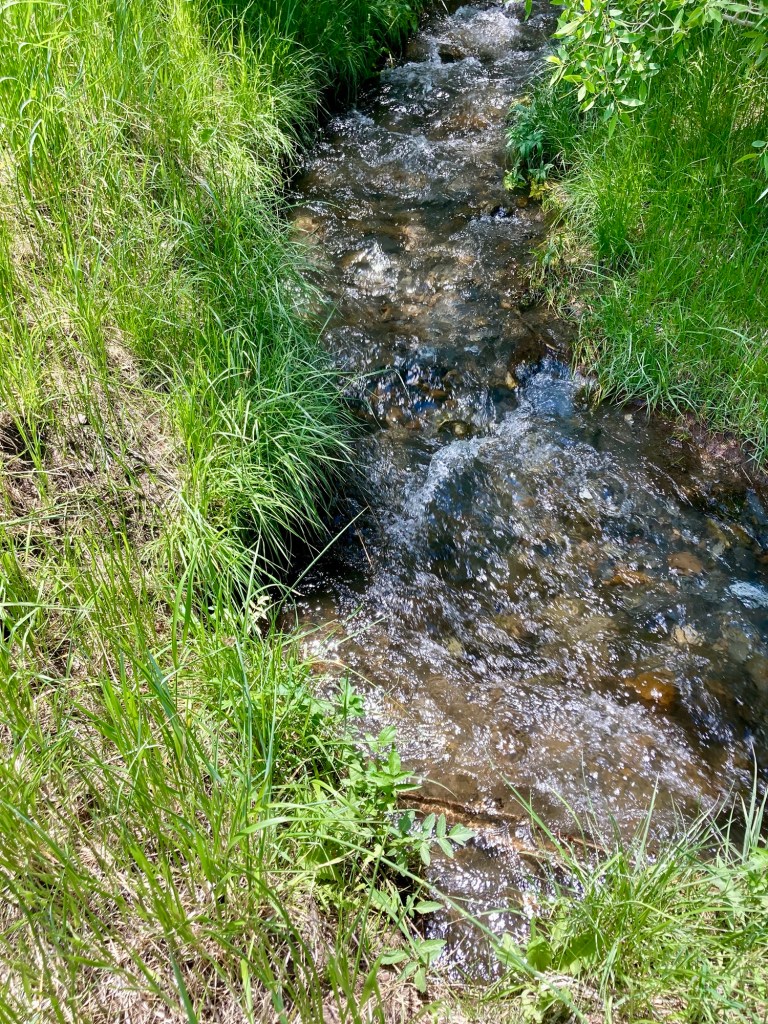
Birdsong—melodic, about 8 beats per measure, sweet and easily heard above the rushing-over-rocks downhill gurgle of Big Creek. The birdsong and watersong complement one another.

Big Creek

We are sitting in red canvas chairs underneath the shimmering coin-sized leaves of five or six trees. These shore trees aren’t known to me. The leaves are similar to the Aspen nearby, but the way the trunks grow together in clumps and their branches reach out bush like is very different from the neatly ordered Aspens. Also, the bark on the spreading trees on the creek bank is a dark gray with knotholes and markings that are dark horizontal slashes – smiles and frowns – and some wide patches, some as long as my arm, that look as though the bark has been cut and peeled off. Is that something people do?

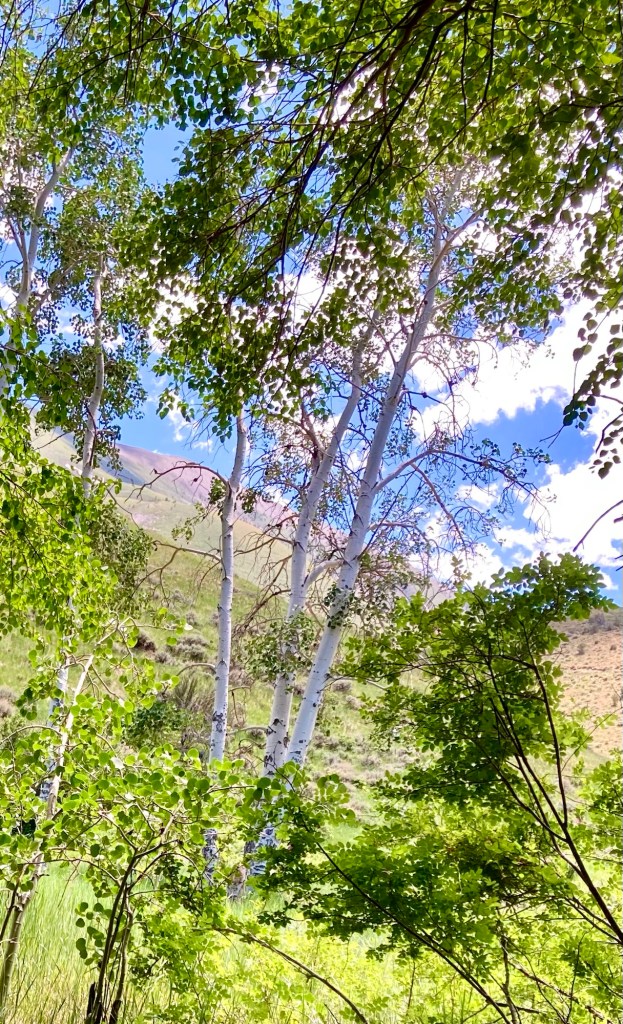
The Aspen grove is about twenty feet away from the water, a small grove. Their bark bright white and peppered with black ink splotches like Rorshack tests. What do you see in the ink blots?

The creek bank is grassy and sun dappled.

Aspens

I can’t spot the singing bird.

The mountains rise up around us. Soft slopes of lime green dotted with dark green dwarf pines here and there. The mountains darken in their march toward Kingston. Each one darker as it rises above its smaller brother to the fore.

Mr. P getting his feet wet

Cornflower blue sky.

White whipped cream clouds.

And still the bird sings and the creek tumbles down, articulate in the way that only water can express.

Life itself.

11 Comments

Filed under Nature Notes, Writing

Identity

“We grow, regress, get stuck, fragment, hide, and find ourselves over and over again.” – Audrey Stephenson, Psychotherapist.

Learn!

Dear Ones,

Today’s readings and my own writing are themselves fragments struggling to find growth. I began by looking at my query status on Query Tracker. Added another rejection to the list. Okay. Next I wrote a short chapter in a new manuscript, one that I do not love in the way that I love the finished one I haven’t found an agent for. It’s hard to fall in love with a new manuscript sometimes. For me, anyway. I am sentimental, perhaps.

To escape, I ventured outside to the laundry room, which is separated from the main house by only a few feet, thinking I would do some productive laundry readying for my work week which begins tomorrow, Tuesday, which is quite wonderful right?–not on Monday, dreaded Monday–but on Tuesday, which I have to be grateful for. And I am. So, a little laundry, and then back to writing, I thought. Until I spotted the giant bug on the laundry room door. Yes, the Mormon crickets are still upon us here. Clearly a sign not to do the laundry.

Then I wrote in long hand–natural left-handed cursive usually brings me back to myself. Maybe even always when I spend enough time there. Today’s topic in my guided journal was Soul Searching: The quest to unlock one’s true self is an ongoing process, because we’re changing all the time (Breathe Journal, c2023. Guild of Master craftsman Publiscations Ltd. http://www.breathemagazine.co.uk. 72-3). Here are two of the prompts given in the journal and my responses:

  1. *Observe every aspect of your surroundings–from the bed you sleep in, to the transport you use. Things around you can shine a light on how you interact with your environment and indicate what you believe about yourself. What do you notice?

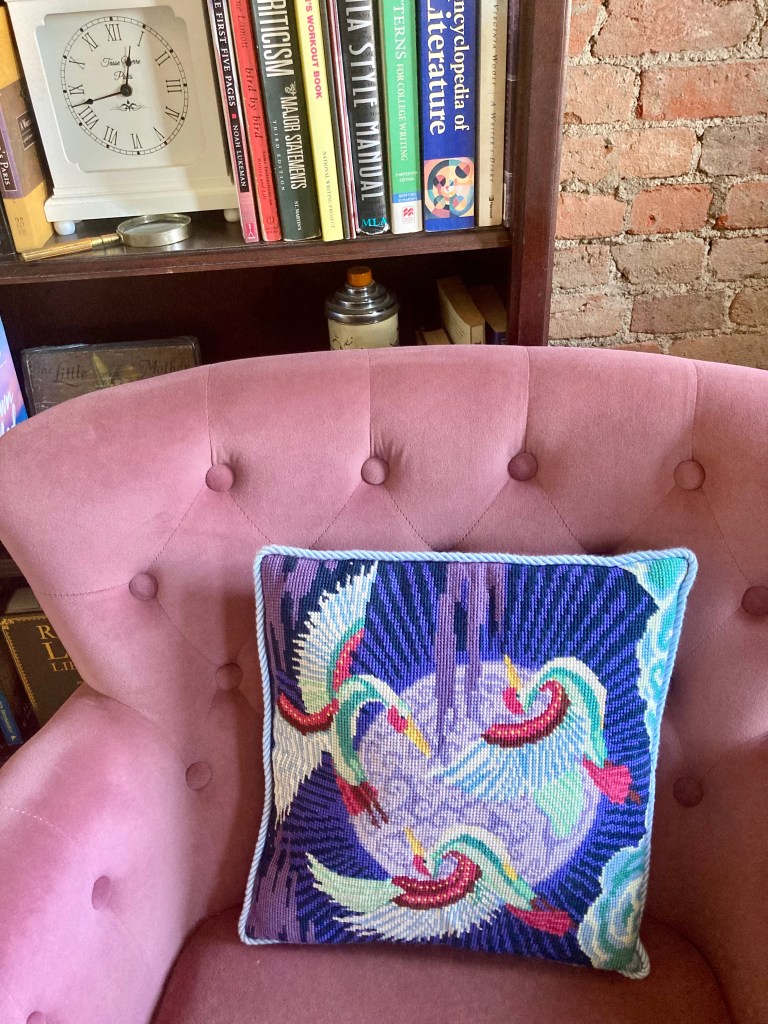
Sue’s pillow

Me: My bed must be clean and bright, soft and matchy-matchy- and made! Looking around me: Polished wood. Sunlight. Windows. Plants. Crystal. Books. Lois’s quilt. Photos. Art. Candles. Sue’s pillow. Baskets. Listening to music…

Lois’s quilt

(After I finished, I noticed I didn’t observe “the transport” I use. I could take a picture of my feet, which is what I try to use the most, but we don’t have a mani-pedi salon in Austin. Then I thought of my dear Jeep, Joni Blue. She’s not new, but she’s paid for, and she’s taken us to many beautiful places. She’s currently outside with the crickets, so I will not be going outside to take her picture.)

2. *Breathe. You will be astonished by how often you hold your breath. Just notice. Drop your shoulders, stretch your neck, allow your abdomen to soften. Breathe. Notice what comes up as you come back to yourself and jot down any thoughts. 

Me: This is one of the best gifts I learned way back in Lamaze childbirth class and years later in yoga–the magic loosening and lightening of the body and mind through the breath. Surpisingly, I still forget to practice it, often until I am panicked. I need reminders.

Time to breathe

For today, perhaps this enough. Two hours of dedicated writing, reading, journaling, and blogging. If it doesn’t feel good enough, perhaps it’s because “we grow, regress, get stuck, fragment, hide, and find ourselves over and over again,” and that’s all part of the progress.

Wishing you growth and rest, a room of your own, and the company of good souls. I’d love to hear what you’re working on, or not working on, or dreaming about. Thank you for reading, following, and commenting on my blog. Fondly, Lori

18 Comments

Filed under Identity, Publishing, Uncategorized, Writing

My Resolutions: A Re-Post from da-AL’s Happiness Between Tails

1 Comment

Filed under Publishing, Writing

Catherine Baab-Muguira on Getting Published with the Help of Edgar Allan Poe

I hope you enjoy this fun and helpful article for Poe lovers, Writers, and most especially Writers who Love Poe! The author’s newsletters can be found on the Substack email newsletter platform: “Poe Can Save Your Life, Darkly inspired self-help for writers and other creators.” She is the also the author of the book, Poe for Your Problems: Uncommon Advice from History’s Least Likely Self-Help Guru.

Click this link:

https://poecansaveyourlife.substack.com/p/how-to-get-a-book-deal-when-youre

This is just a moody shot from a trip to Lake Itaska, Minnesota from a few years back, but I think it has a nice Poe vibe!

1 Comment

Filed under Publishing, Writing

On Writing

I love all of this lovely quote from Sharon Olds on writing, but especially the last sentence :

“I think that whenever we give our pen some free will, we may surprise ourselves. All that wanting to seem normal in regular life, all that fitting in falls away in the face of one’s own strange self on the page……

Reminding myself that no one else would ever see what I wrote—with my ballpoint pen in my wide-ruled spiral notebook—helped me be less censored and less afraid. Later, I could decide to show or not, because whether anyone ever read it was not the most important thing.

Writing or making anything—a poem, a bird feeder, a chocolate cake—has self-respect in it. You’re working. You’re trying. You’re not lying down on the ground, having given up.

And one thing I love about writing is that we can speak to the absent, the dead, the estranged and the longed-for—all the people we’re separated from. We can see them again, understand them more, even say goodbye.”

– Sharon Olds

Writing in Paris

4 Comments

Filed under Writing

Transitions

Photo by Caleb Oquendo on Pexels.com

The last three weeks have been busy with travel, family, grandkids, new friends, and the sudden summer blossoming of our quiet little town. I know a writer needs to live a life in order to write about life, and it’s nothing to feel guilty about. Slacking off a bit can be a good thing. That’s why people go on holiday, right?

But there comes a time…

The blank page usually doesn’t intimidate me much, but today, it did a bit. Perhaps this is because I’m still working on editing my 300+ page manuscript. Shifting from the manuscript to short pieces, often unrelated to the world I’ve been immersed in there, somehow makes me feel as though I’ve stepped off a solid granite mountain and found my feet negotiating the shifting sands of the desert.

I miss my characters, the forest where they live, all of their mistakes and longings—their journey! I miss the routine of our daily time together. It’s sort of like when you were a kid and school let out for the summer. There was the initial lift of spirit, the release from the multitudinous details of navigating between the academic aspects and the social ones, the waking up to a beautiful June morning, knowing it was yours. There’s nothing that quite compared.

At some point though, there may have come nostalgia for the kids who had populated your classroom, the lunchroom, the playground, the sports field, or the band room. Some of them were crushes, past, present, and maybe future. The wheel of time spun like the one on Wheel of Fortune; you never knew where your destiny lay.

There would be some kids you wouldn’t see all summer, some you would never see again (hopefully, those would be the bullies). If you had a teacher you loved, she/he would be getting a whole new class. You would no doubt be replaced by strangers who would occupy all of your teacher’s thoughts, and possibly, heaven forbid, even her heart.

And then would come the nervous excitement of the year to come. Part dread, part eagerness. Close at hand was the tantalizing possibility of meeting someone altogether new, maybe someone cute, or funny, or someone just meant to be your lifetime friend. That’s what wrapping up a long writing project feels like to me. It’s all of that and more.

Hoping all of your milestones, old and new, bring you joy and satisfaction. I’d love to hear your thoughts!

2 Comments

Filed under Writing

Looking for Comps

Photo by Suzy Hazelwood on Pexels.com

     Hello, Readers! I’m putting together my summer reading list, and getting my historical fiction manuscript ready for submission. One part of this process is to read recent books (published within the last few years) that are in some way comparable to mine, so that I can better describe my own manuscript to potential agents, publishers, and booksellers.

     Have you read any recently published fiction set during the 1930s or 1940s? Have you read a novel about a war widow, or a strong woman struggling and coming to grips with some other loss? If so, I’d love to hear about it. My manuscript is set in Lake Arrowhead, California, and the place is integral to the plot, so I’m also interested in any fiction that transports the reader to a specific city, town, or region.

     If any titles come to mind, I’d greatly appreciate your sharing them here. I welcome any and all suggestions. Many thanks!

1 Comment

Filed under Advice, Books, HIstorical Fiction, Lake Arrowhead, Literary Fiction, Publishing, Women's Fiction, World War II, Writing, Writing Advice

I Brake for Ghosts

I Brake for Ghosts
I admit it. Moving to a ghost town during the height of the Covid pandemic may not have been the best choice. It certainly wasn’t the obvious choice. It was one of those decisions cooked up out of hope and desperation, a recipe for survival with a sprinkle of hope thrown in. A very small sprinkle.
Within the space of a few months, most of our income was gone, along with our health insurance. What wasn’t gone was the mortgage… If we didn’t do something quickly, we imagined complete disaster.
What to do. What to do.
How about sell our house and use the profit to move all of our belongings across the country to a tiny town with a lot of history and no place to spend the money we didn’t have?
Our grandchildren lived out West, and I’d been frantic to see them. If we lived closer, I could visit them a lot more (once the pandemic subsided). With this in mind, we started scouring the Internet for affordable homes. Affordable for us meant that we could come up with the down payment and the monthly mortgage would be low.
We couldn’t get as close to the family as we hoped; they lived in areas where real estate had exploded. I know you’re thinking that real estate exploded everywhere. You’re mostly right. But at the beginning of the pandemic there were still a few places within a day’s drive of the kids where the fuse may have been lit, but hadn’t quite caught. These were in small towns, and they were mostly in the desert. Often they were mobile homes or condominiums with HOA’s that would drive our monthly expenses up too high, so most of these were eliminated. There were a few houses. All of them were small and in need of repair, but we weren’t afraid of the work.
We decided to take the leap. We chose the most remote of the locations, mostly because we loved old homes, and this was an old brick home, and the altitude was high, so we would still have snow (yes, to us this was a good thing!). The house was originally built as a parsonage for the handsome Methodist church adjacent to it.
The town was very quiet. It would make an excellent place to write.
And here we are.
It’s been an adjustment. For the first year we probably only spoke to a total of five other people in town. When we had to drive the 112 miles to the nearest town where we could get supplies, it was quite overwhelming to encounter people on the streets, in the stores. In Austin, the only people you saw were in the post office. You might imagine that was because of pandemic precautions, but I don’t think that was it. This is not a town that follows protocol. It is a town, however, that leaves you alone.
A local woman told one of our movers that our house had a ghost. “But don’t tell them,” she said. “They’ll find out soon enough.” I don’t know if anyone else in town thinks we have a ghost. If so, I suppose that could explain the lack of neighborly visits with casseroles in the early days we were here. The ghost lady is known locally, I’ve since learned, for her flights of fancy, so I don’t really think our house has a ghostly reputation. If we do have a ghost, I haven’t met him/her yet. To us, the house has a very serene vibe. Perhaps our ghost is a parson, or one of the parson’s family members. Perhaps he or she is a writer.
No problem. We were busy using up the remainder of the profit from our old house (a 1950-something cottage that we had renovated after we had renovated a 1920-something cottage… there was a 1940-something house in between that only needed a few tweaks) renovating our 1866 parsonage. These things always cost more than expected, even when you are doing the work yourself.
There were unexpected plumbing issues, for example. Do you have any idea how expensive a snake is? Not the slithery kind, you know, the kind the plumber brings to clean out your sewer pipes? They cost a lot. Plus, there was no plumber, at least not within 100 miles.
Then there’s the digging up of old pipes and putting in new ones… There’s the stripping of the drywall, which isn’t really drywall. It’s layers of wood and wallpaper, and even newspaper, which has been covering the brick walls since the house was built. There’s the painting. There’s knocking down the wood structure that was added in front of the house at some point in the last century, presumably to house automobiles. The one that blocked every ray of sunlight from entering the house.
Anyway, lots to do.
And then, gradually, during our second year here, we started venturing out of the house. I joined the church across the road. The Methodist church next door to us is being used for a community center these days, but the Episcopal church has continuously held worship services since its opening in 1878. My husband and I volunteered to paint the doors red, something the priest had been longing to have done and that we were more than well equipped to do, what with all of our home improvement practice. The effect was stunning.
We increased our walking distance each day, seeing a neighbor here and there, experiencing beautiful wild views, wildlife sightings, even stumbling upon a pet cemetery high up in the forest above town. The streets are still quiet and there are only a couple of businesses open, but we appreciate what we have. We’ve found that we love our route to visit the kids, long as it is, because it takes us through parts of the Eastern Sierra. Hopefully, some day soon, we will take the turn that leads to Yosemite.
And every day, I write.

8 Comments

Filed under Uncategorized, Writing