It’s been two weeks since I left Nevada and one week since I arrived at my new Michigan home. All of these days have been solo; I drove alone, I arrived alone to an empty house, I spend my days here alone. There’s a theme building . . . For now!
The Way In
But husband and kitties will be joining me soon.
The Dreaded Cot(I do not love it)
A Lonely Room (but I love it!)
As an introvert, this hasn’t been particularly tough. I love people, but I also love solitude. I just got the internet yesterday, and that’s fun because now I can write and publish my writing more easily. No TV here yet. No furniture to speak of. I have one little lamp table that fit in my car, a folding camp chair, and a cot. That’s it. Everything else will come in the moving van next week. So, what do I do all day?
I clean and I read. Often, at the same time, by listening to audiobooks using the Libby library App. One of the books I’ve enjoyed so far during this extended period of solitude is aptly The Great Alone by Kristin Hannah. It’s a tough book about a tough time and a tough place, but I liked it. Alaska in the 1970s, mental illness, abuse . . . it’s got it all, but it isn’t only that, of course. It’s also a book filled with nostalgia, love, and the awesomeness of nature.
Other books I read either just prior to moving, during the drive, or since my arrival are: We All Live Here, Moyes; Sandwich, Newman; The Secret Book of Flora Lea, Henry; Remain, Spark and Shyamalan; The Missing Half, Flowers and Kiester; and currently, The Island of Sea Women, See. Each book has its merits.
I found both We All Live Here and Sandwich charming and humorous. Both are light, contemporary novels with women protagonists wrestling with life changing events and the love of family.
The Secret Book of Flora Lea took me to one of my favorite historical settings, World War II England, in the countryside and also to London in the 1960s. It’s a delightful book about sisters, families, love, and the importance of stories.
Remain and The Missing Half are mysteries, with Remain being the more entertaining of the two for me. The Missing Half helped pass the time, but Remain’s ghostly love story captivated me at times, including during several memorable scenes that made me shiver.
And now I’m listening to The Island of Sea Women. It’s taken me to a part of the world I know very little about, which I love, because I am learning so much. It’s set in Korea from the story’s beginning in the 1930s and will move through the war years and take me to the present day. It’s about women sea divers (an amazing group of female divers who earn the money for their families while their husbands care for the children), and it’s the story of two friends Mi-ja and Young-sook.
As you can see, I’ve not been alone, not really, for I’ve been traveling through time and place along with the characters created by the authors of these varied and appealing novels, carried away by their stories. It’s a kind of magic really, the way a reader lives both inside and outside of a book—simultaneously in the room, and also somewhere else far away.
I love this line about reading from Stephen Chbosky from his young adult novel, The Perks of Being a Wallflower:
“Sometimes, I read a book, and I think I am the people in the book.”
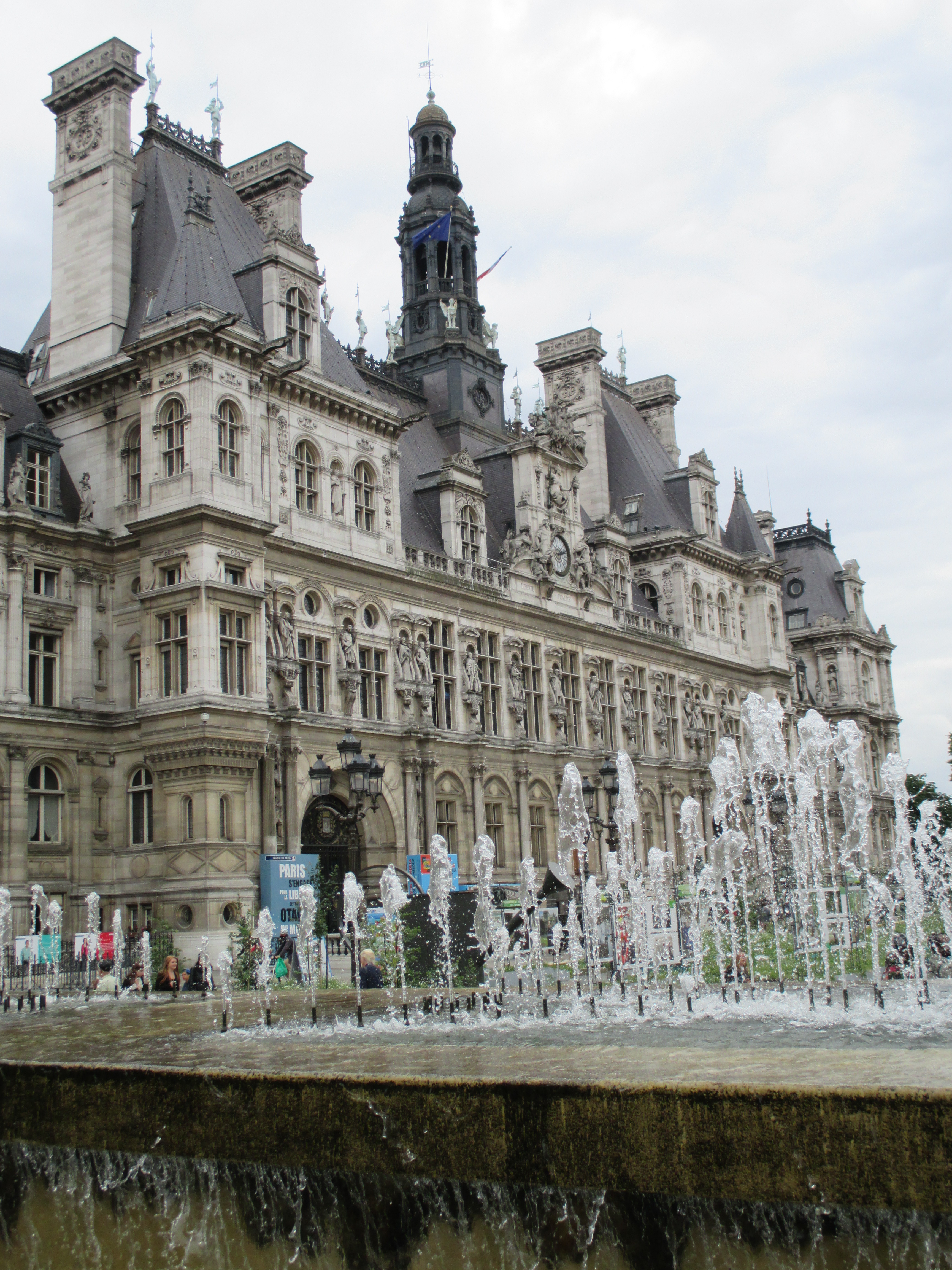
A few days in Paris, Writing . . . Years agoNever forgotten
Instructions for living a life. Pay attention. Be astonished. Tell about it.” ―Mary Oliver
Moving a life forward is an investment in dreams, time, learning, relationship building, and so much more. Moving a writinglife forward is all of that, and I would add it is also, at its best, a life transformed. As Anne Frank so eloquently put it: “I can shake off everything as I write; my sorrows disappear, my courage is reborn.” Writing did not save Anne Frank’s life, but I believe her writing has saved the lives of countless others.
Writers may feel called to the creative life, but that one precious life often must take a back seat to another, more practical life, one that includes a sensible career (aka something with a steady paycheck), perhaps with snatches of scribbling in between the job, chores, and attending to family or societal needs and expectations. The writing life can be a kind of shadow life. It has been for me. Some writers seldom or never mention their craft while engaged in their more acceptable “real” life.
“I love writing. I love the swirl and swing of words as they tangle with human emotions.” —James Michener
It’s hard to explain to nonwriters why a few hours or a whole day spent attending a sporting event or a picnic can create in the writer a kind of panic—a feeling that the time needed to be alone, to read and to write, will never be enough, that time is seeping away, draining their spirit. Spending “free time” in non-creative areas can feel terribly wasted to the writer, while to others, the writer’s avoidance of joining in reeks of selfishness, or delusion. Or perhaps it’s just incomprehensible. Why, people wonder, is writing so important to you? There’s no money in it. And if there is, it’s only available to a few spectacularly talented gifted authors. If you had that gift, surely you’d have been published by now.
The writing life can be an ill-defined series of swells of poetic energy or flow, which is heady and soul lifting. There is nothing quite like those times. Catherine Drinker Bowen says, “For your born writer, nothing is so healing as the realization that he has come upon the right word.” And I have felt that many times. Writing has healed me.
But those transcendent hours or days are for writers seeking an agent or publisher likely to alternate with rejection after rejection after rejection. Writers do much of their writing alone, but if they seek representation and traditional publishing, they must eventually learn the oft times punishing lessons of business.
Soon I’ll be working with a developmental content editor on my completed World War II historical fiction manuscript. I’m excited to be taking this major step forward. It’s been a long journey, and honestly, I’ve loved the myriad lessons and experiences along the way, even the hard ones.
“If a story is in you, it has to come out.” —William Faulkner
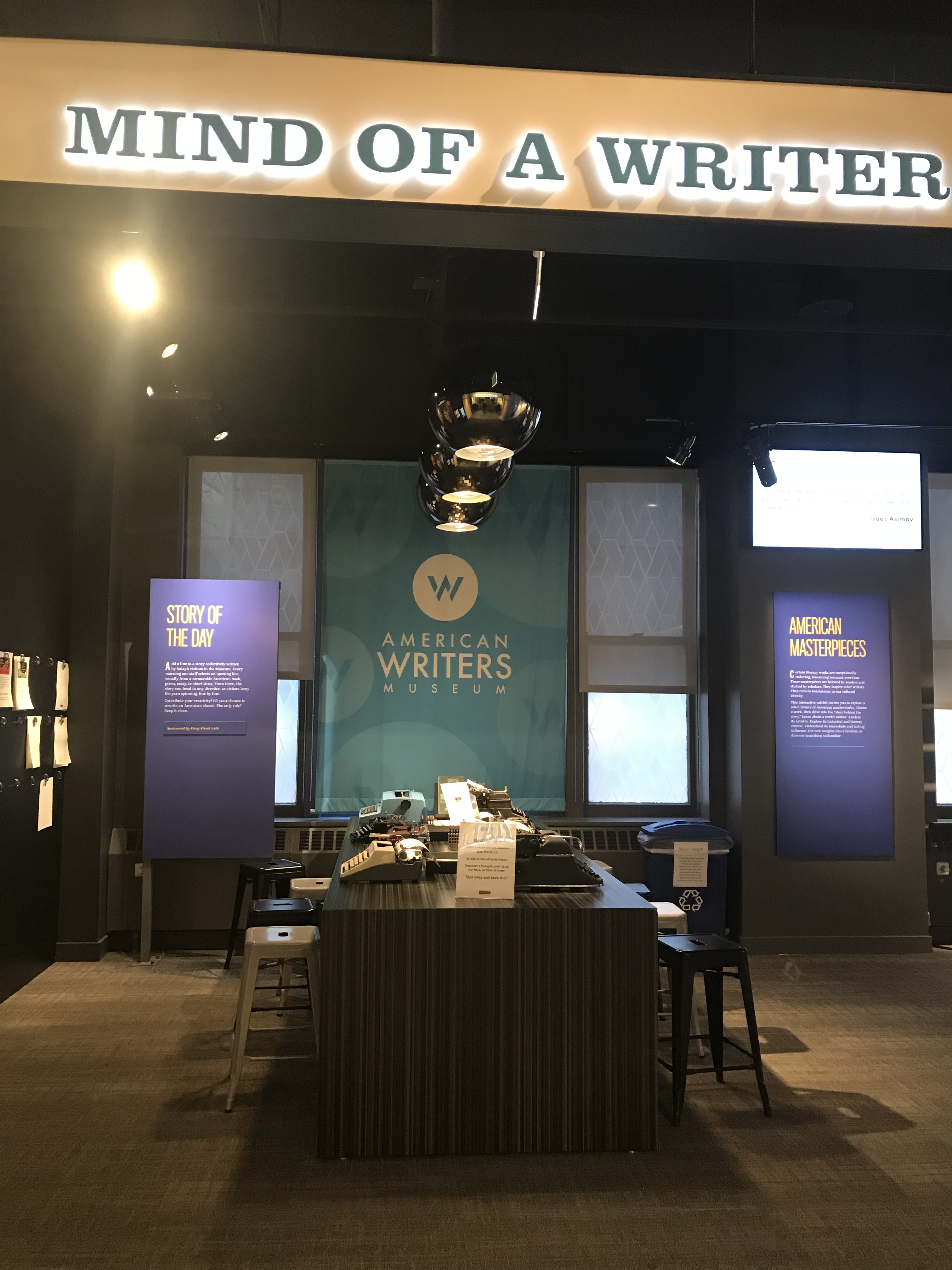
American Writers Museum, Chicago, Illinois
Thank you for visiting! Wishing you a wonderful day, doing exactly what you need and want to do.
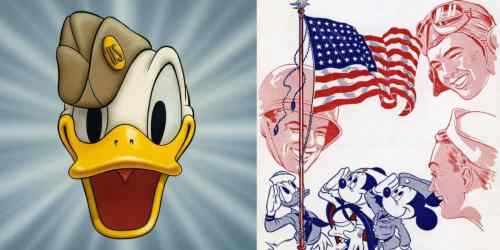
Disney’s Donald Duck, WWII. I can see why Dad chose to imitate this particular character. He was very proud of his Scottish roots!
Some time ago I responded to a fellow blogger, GP, Pacific Paratrooper, a WordPress.com site of Pacific War era information (https://wordpress.com/reader/feeds/4440944/posts/5114548606) about his article, “Disney and WWII,” posted Feb. 12, 2024. The post both tickled my fancy and triggered positive childhood memories, but also, delivered a good dose of regret. I knew so little about my dad’s service, and there was no one living I could ask.
Here is a record of our brief exchange:
Me: My dad was a WWII Marine. I didn’t think it was odd that he could speak to my brother and me in full Donald Duck voice because he just did. He never spoke about why. He did drive us from Wisconsin to California to visit Disneyland when it opened. So much I wish I could ask him now.
GP: May I ask what unit he was in? There might just be a good reason. Disney made training videos, etc. too.
Me: I am ashamed to say that I don’t know his unit.
GP: So many of us have questions we wished we had asked.
As the days passed, I kept going back to GP’s article. I couldn’t reconcile the fact that I had practically no knowledge whatsoever of my father’s service in World War II with who I believed I was: a loving daughter, a lover of history, a teacher of literature, writing, and the Holocaust, a writer of historical fiction, a devoted library worker . . . how was it that I knew so little about my own father’s relationship to such tremendously important world events?
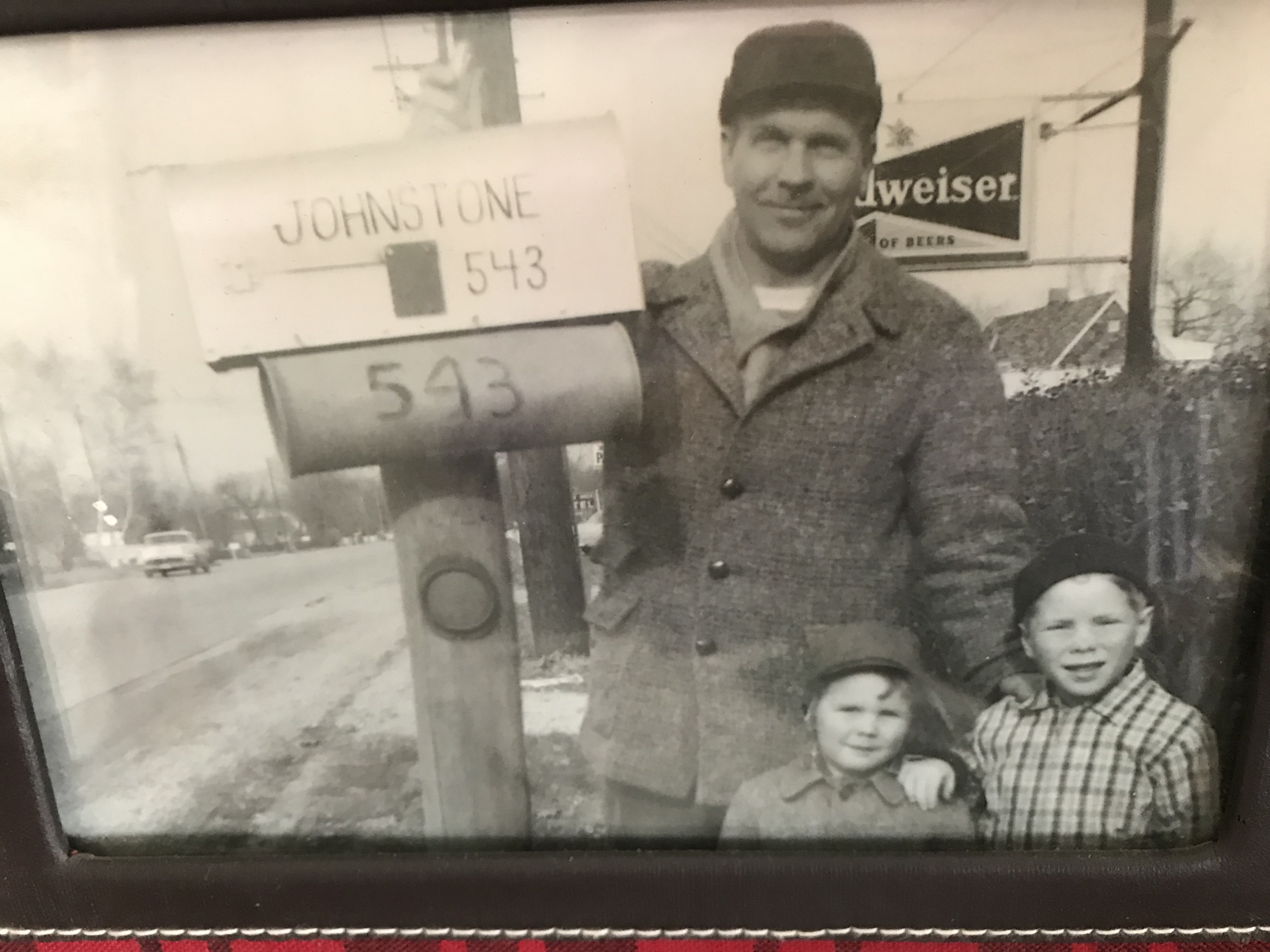
Dad, Lori and Billy. About 1959.We lived next door to a bowling alley, but Lake Michigan was in our backyard!
An online search informed me that I could request my father’s United States Marine Corps Separation Documents and Personnel Records from the National Personnel Records Center at the National Archives, www.archives.gov. I did so, and some months later I received a short stack of copied documents dating back to my father’s voluntary enlistment the day after the Pearl Harbor attack.
I did remember that. It was one of the few stories Dad repeatedly told my brother and me, that he had waited in a line two blocks long in his hometown of Chicago, Illinois to join the Marines the day after Pearl Harbor. It painted a picture of patriotism that stayed with me. I have heard myself repeat it many times throughout my life. My dad, the story revealed, was one of the true heroes of The Greatest Generation.
Here is the rest of the story, as much as I was able to glean from the archives:
Pearl Harbor Attack. World War II Facts.org
When Pearl Harbor was attacked (December 7, 1941), William Harold Johnstone was 21 ½ years old. He had turned 21 on his Flag Day birthday, June 14, 1941. He began active duty on January 5, 1942. He was a high school graduate, and he had completed one year of college. His stated major was Pre Med. Qualified sports listed were track, football, basketball, and swimming. It was also noted that he sang in the church choir. He worked at Montgomery and Ward Co. as a silk screen printer.
I do remember my mom telling me Dad had wanted to be a doctor but that after his war injuries he had never gone back to college. I know he was always interested in medicine. Also, I remember a story about how he swam out and back to a pier or perhaps a buoy some distance off the shore of Lake Michigan and back as a teen, which I gather was somewhat of a feat / badge of honor. Also, he mentioned that at one time he had the nickname “Johnny Rock” — perhaps an homage to both his last name (Johnstone) and his physical fitness. His record shows he was 5 foot, 8 inches tall and he weighed 136 pounds. Not a big man, but strong.
Dad’s father, an immigrant from Scotland, had died when Dad was only four-years-old, so he was raised by his mother, Lorene, and her sister, Mary, along with his older brother, Donald. Tragically, Donald died at age twelve. It was then, my dad told me that he knew he had to give up childish games and work to help his mother and his aunt.
This then, is a portrait of the twenty-one-year-old man who entered the military.
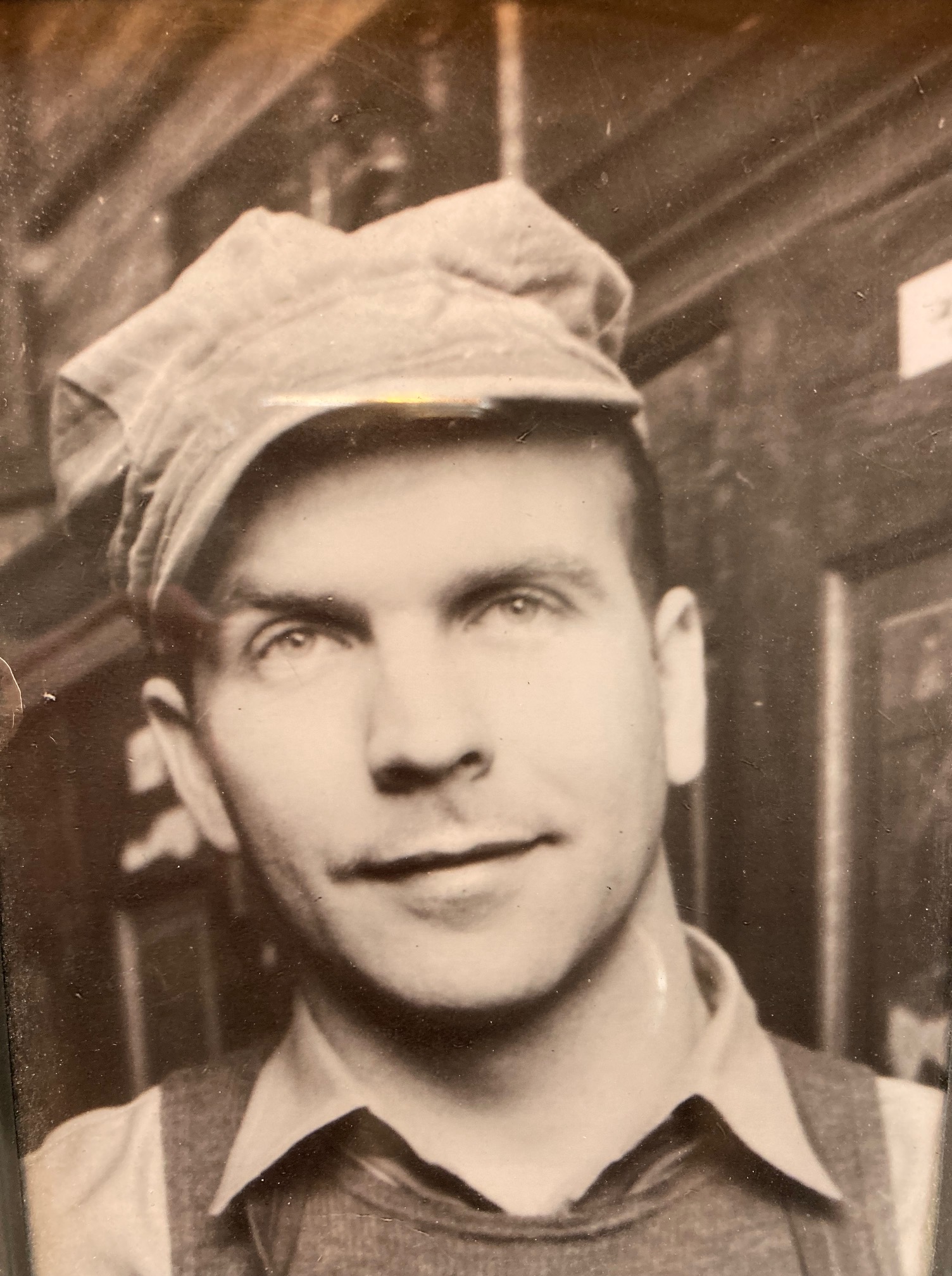
My Handsome Dad
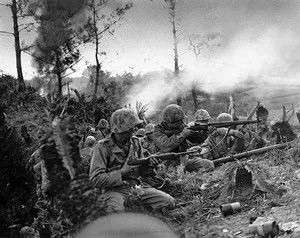
Dad’s original principle military duty early on was Surveyor 227 Rank Private First Class. USMC, 19th Marines Engineer, 3rd Marine Division Fleet Marine Force, Camp Elliott, San Diego, CA.
Later I see him listed as Private 1st Class, 339815, “I” Company, Third Battalion, 22nd Marines, Sixth Marine Division.
After his initial training, it seems Dad shipped out. The reports are difficult to decipher, but they contain notes of his being in Pearl Harbor, Hawaii; Auckland, New Zealand; Guam, Marianas Islands; Guadalcanal Island, Solomon Group; and Okinawa, Ryukyu Islands, Japan. The only detailed reports refer to Guam and Okinawa.
Guam in World War II, National Park Service
Here is Guam:
From James Forrestal, The Secretary of the Navy, Washington
The Secretary of the Navy takes pleasure in commending the First Provisional Marine Brigade for service as follows:
“For outstanding heroism in action against enemy Japanese forces, during the invasion of Guam, Marianas Islands, from July 21 to August 10, 1944. Functioning as a combat unit for the first time, the First Provisional Marine Brigade forced a landing against strong hostile defenses and well camouflaged positions, steadily advancing inland under the relentless fury of the enemy’s heavy artillery, mortar and small arms fire to secure a firm beachhead by nightfall.
Executing a difficult turning movement to the north, this daring and courageous unit fought its way ahead yard by yard through mangrove swamps, dense jungles and over cliffs and, although terrifically reduced in strength under the enemy’s fanatical counterattacks, hunted the Japanese in caves, pillboxes and foxholes and exterminated them.
By their individual acts of gallantry and their indomitable fighting teamwork throughout this bitter and costly struggle, the men of the First provisional Marine Brigade aided immeasurably in the restoration of Guam to our sovereignty.”
All personnel serving the First Provisional Marine Brigade, comprised of: Headquarters Company; Brigade Signal Company; Brigade military Police Company; 4th Marines, Reinforced; 22nd Marines, Reinforced; Naval Construction Battalion Maintenance Unit 515, and 4th Platoon, 2nd Marine Ammunition Company, during the above mentioned period are hereby authorized to wear the NAVY UNIT COMMENDATION Ribbon.
My dad never described any of these experiences to me, and I don’t remember ever seeing that Commendation Ribbon. I hope he was able to talk about it with someone, but I do not know if that was the case. It grieves me.
On Okinawa:
The next specific report in the records begins with a Report of Combat Casualties, which states that William H. Johnstone of the Twenty Second Marines, Sixth Marine Division was Wounded in Action on May 12, 1945 on the island of Okinawa, Ryukyu Islands. Recorded on 13 May 1945. Diagnosis: Wound Fragment Face. Prognosis: Serious.
On 18 May 1945, U.S. Fleet Hospital No. 111 reports William H. Johnstone, Wounds, Multiple. Wounded in action against an organized enemy. Shell struck near patient causing injury.
A U.S. Fleet Hospital letter to my grandmother, written July 1, 1945 reports Dad’s condition as good, and states that he will be returned to active duty in the near future, so it looks like he was hospitalized for approximately a month and a half.
The record states:
In the name of the President of the United States, and by direction of the Commander in Chief, U.S. Pacific Fleet, the Purple Heart is awarded by the Medical Officer in Command, U.S. Fleet Hospital Number One Hundred and Eleven to: William H. Johnstone, Private 1st Class, USMC for wounds received in action against an enemy of the United States on 14 May 1945.
The battle of Okinawa “was one of the bloodiest in the Pacific War, claiming the lives of more than 12,000 Americans and 100,000 Japanese, including the commanding generals on both sides. In addition, at least 100,000 civilians were either killed in combat or were ordered to commit suicide by the Japanese military (Battle of Okinawa | Map, Combatants, Facts, Casualties, & Outcome | Britannica).
Battle of Okinawa, Brittanica
I do remember seeing the Purple Heart. My father gave it to my brother. Unfortunately, it was lost during my brother’s divorce, and it was never returned to the family.
I would like to thank GP and his Pacific Paratrooper WordPress blog for getting me started on this mission of discovery. Without his article on Disney in the Military and my memories of a loving father amusing my brother and me with an array of his silly Donald Duck performances, I doubt that I would have been able to share this information with my children and grandchildren. So, thank you, GP!
About sixty years ago on Flag Day, two little girls got up early in the morning and went to work in the kitchen, making cupcakes. These little girls had met when their moms rented apartments next door to one another after their marriages ended, and the girls had become fast and, it has turned out, life-long friends.
Cheryl was the host. I was staying at her house for an extended visit, as I did most holidays and summer breaks from school.
My mom had moved away from Cheryl’s town and taken my brother and I with her, but my dad remained. He lived in a men’s only residence in downtown Kenosha, Wisconsin, about 19 blocks away from Cheryl’s house, so I could never stay with him, but I was lucky to have Cheryl and her dear mom, Marion, welcome me in whenever I could come. Marion was an X-ray technician at St. Catherine’s Hospital and left the house before dawn most mornings to work, so Cheryl and I were on our own.
My hosts, a few years later
The cupcakes turned out well, and we set out. It was my dad’s birthday, and we were going to surprise him with the cupcakes. As often happens in life, the spirit was willing, but the flesh was weak. As we walked, we were tempted to eat first one, then two, and then ultimately all three of the cupcakes we planned to share with Dad.
Oops!
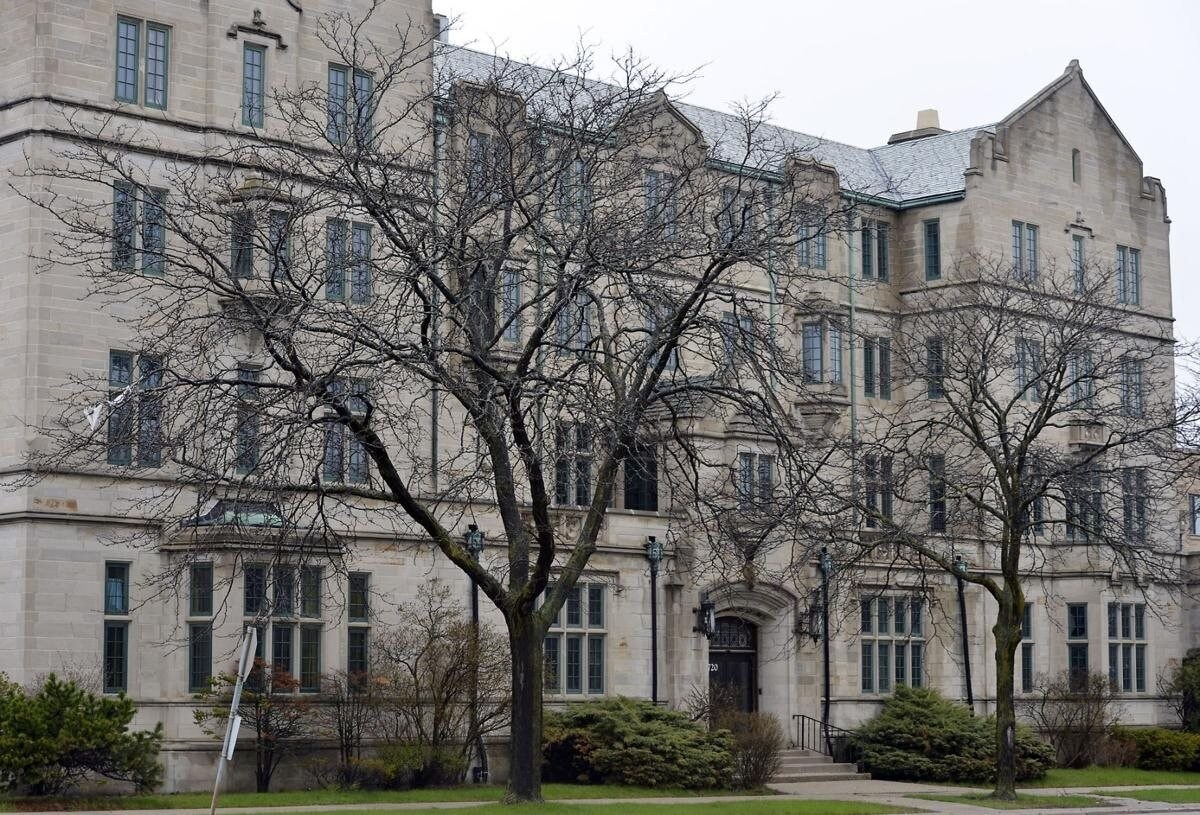
We mustered on, and eventually arrived at the imposing building where Dad resided, standing at the front desk of the huge lobby, two little chocolate-smudged waifs, empty handed, tired and thirsty. The attendant rang Dad’s room and he came down.
The former Kenosha Youth Foundation building (now Residences at Library Park) where my rented a room for many years. I believe it was in the front, left, on the upper floor.
We got the surprise part of our visit right. Dad had certainly not expected us to walk so far at our young age, unattended. I honestly don’t remember exactly how old Cheryl and I were that summer, but I remember being small in the distant way adults remember such things.
“Happy Birthday, Dad! We made you cupcakes, Dad, but we got hungry.”
It’s a story my dad always told with affectionate tenderness.
All these years later, that Flag Day is on my mind, along with so many other thoughts and feelings that I believe must be expressed. These are complicated times. . .
My father was a World War II United States Marine Corps veteran, something my brother and I were always aware of. We knew the Marine’s Hymn, and we knew he had learned to talk like Donald Duck while he was in the service, but he was a quiet man who never spoke to us of his battle experiences. Other than his Purple Heart, we never saw a uniform, a gun, or any military artifacts in our home while he lived with us, nor did I find any among his possessions after he died.
Dad was playful and sentimental with us, teaching us about nature and camping and the stars. On his Flag Day birthdays, he enjoyed the simple things—cake and ice cream, tea or coffee, a home-made dinner. He did not use profanity, never used derogatory terms when referring to other people, and abstained from smoking and alcohol, all of which were somewhat unusual among his peers. He believed in staying fit, mind and body.
Dad and Cheryl on one of our many blue tent camping trips.
For many years, while living at the Kenosha Youth Foundation, he walked across the lawn, past its statue of Abraham Lincoln, into the beautiful old library where he read several daily newspapers, and enjoyed reading non-fiction books, mostly medical titles, as I recall. He continued a daily walking regimen all his life.
My Dad
This gentle man died long before the current resident of our White house launched his political campaign, so I cannot say for certain how he would feel about sharing his birthday with him, or whether he would support his policies. Dad was a Republican so I imagine this last decade would have been a challenge for him, certainly in different ways, but perhaps just as powerfully as it has been for me. Dad’s nature was the very opposite of this president. I like to think he would not have voted for him or supported him.
These are the musings of a daughter, his only living child, as the president of United States of America is set to preside over a huge military parade in Washington D.C. for the Army’s 250th birthday. And as National Guard troops and U.S. marines are staked out in the city of Los Angeles against the wishes of the governor and mayor. As ICE agents conduct raids, sweeping up suspected undocumented immigrants. As many of our government agencies are gutted, our history is being rewritten, and kindness and love and We the People seem forgotten.
But also, as over 2000 gatherings of everyday citizens in America and around the world will be protesting.
I will be among them.
I hope he would be proud, but I do not know.
What I do know is that even if he wasn’t proud of my participation, or he didn’t want me to attend because he feared for my safety, he would not try to stop me. He believed in all of the freedoms he fought so hard for in World War II. And I know that no matter what, he would hug me and tell me he loved me as he always did, throughout the many mistakes, successes, and milestones, large and small, of my life.
And if we could spend his birthday together this Flag Day, I know he would smile and tell the story of the little cupcake girls who visited him on his birthday.
An early picture of our old house, before renovation.
One of the most enjoyable writing exercises I’ve done lately comes from a biographical poetry template based on a poem by George Ella Lyon. I came across it on Jeannine Quellette’s brilliant Substack, Writing in the Dark. The exercise is familiar to me in a distant way, as though perhaps I’d done it before but lost it. Or perhaps it suited me perfectly this past week because I have been contemplating writing memoir and fictionalized biography, so it seems as though I always had it—a poem about beginnings, and the echoes still heard, the lessons still being learned.
Green grass, Blue water, the whoosh of wind and wings
Flocks of seagulls
I am from Lilies of the Valley, Bleeding Hearts, Lake Michigan’s endless sand and waves
I’m from World War II, Ramblers, and Divorce
From Rachel and Frederick and William and Lorene
From Rae and Bill
I’m from long car rides and listening to albums on the stereo
From Mr. Wonderful and Stop Crying and What did you learn in school today?
I’m from no church, lost pets, and rented houses.
From a mother who scoffed at religious people
And a father who blamed organized religion
For the world’s woes.
But I’m also from Christmas trees and baking cookies, from bunnies and Easter baskets.
And I’m from the hand-written prayers I found in my father’s bedside table when he died.
I’m from Chicago and Kenosha
From Illinois, Wisconsin, and Minnesota
From Scots called Johnstone, and Swedes called Nelson
From ground beef casseroles, navy bean soup, and sour cream raisin pie
From Great Aunt Mary who broke up with her beau when he jumped into a fountain,
Never to wed, who lived with her sister Lorene’s family and then mine until The Divorce when she
Was sent back to Chicago to an old folk’s home
And Mother was hospitalized
I am from women who sewed and worked in libraries
and who cooked and cleaned other people’s houses.
And from men who sought love and adventure and worked on farms and in factories.
I am from Midwestern barefoot summers and sea glass and wandering the West
Restless and yearning for polished maple tables and a place to call home.
RLP, 2025
If you would like to write your own “I Am From” poem, here is the template. Use it as a springboard. Jump in and adjust it to suit. I hope the writing brings you joy, or something like joy, which is sometimes as simple as finding a way to express the inexpressible past.
Blessings! And please share your poems in the comments!
Kenosha, Wisconsin
Template: I Am From
I am from ________________ (specific ordinary item)
From ____________ (product name) and _____________ (product name)
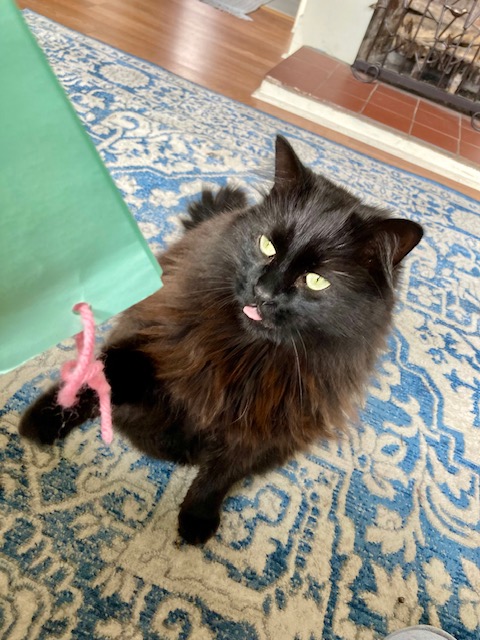
This is not my kitty. It’s a sweet expression though, and I love kitties.
I woke up this morning acutely aware of several things. None of them were good, considering the state of current affairs, but, for me, the first breath of consciousness each day brings the unwelcome reminder that I no longer have any teeth (on the top of my jaw anyway. This may or may not be called the “crown” of my gums . . . I have asked Mr. Googly, but I’m still not sure). Also, I only have 13 teeth left on the bottom, which, hey, I’m grateful for so that’s why I state it only as an aside and not as part of my general complaint. Anyway, this is what waking up means to me.
I am aware that this is not an appealing topic.
Well, some people love me. But sometimes I get sad anyway.
I am an American woman with ill-fitting dentures that I take out at night. Most nights. Some nights I just leave them in.
But you aren’t supposed to leave them in. Why? Something about giving your gums a rest and not letting bacteria build up. According to The American College of Prosthodontists (ACP), the association that represents the specialty of prosthodontics: “Yes, you can wear your dentures at night, but it is preferred that they be removed. You should remove your dentures at night, and this will give your gums and bone a chance to relax from the pressure of the denture during the day. If you need to wear your dentures for social reasons or to prevent your jaws from over closing, you should find time during the day to properly clean your mouth and your prostheses. You should never wear your dentures 24 hours a day without performing proper oral hygiene. Dentures should be cleaned at night and stored in water during the night.”
So, that’s a no, yes? My guy in Fallon said to take them out . . . (he never mentioned unless I needed to keep them in for “social reasons” or to avoid over-closing jaws) . . . more on that later.
So, I usually take them out. Then—I wake up in the morning feeling like my face is a sad stretch of the Pacific Coast Highway after a torrential downpour. Part of me is washed away.
That’s me on the left. All smiles. Brand new teeth.
By now, some readers might be thinking (in addition to oh dear lord please stop), what about implants?
When I inquired about the cost of implants, I was given the “ballpark” figure of $40,000. “It’s like buying a car,” my Fallon guy said. Indeed. And I would be the first person to say that I’d much rather have a complete set of permanent teeth than a new car. Absolutely! But that’s false equivalency; it isn’t a choice between teeth and a car. Not at all. There’s no money for either of those things. I was lucky to be able to scrape the money together for the dentures, which came to something closer to $4,000 (including the cost of the extraction of my “unsavable” natural teeth). I drive a car that I bought used 10 years ago for much less than $40,000 and have managed to pay off. So I’m not in the market for a new car, and implants were never going to happen.
This breaks my heart, and it also angers me. Why is dental care so difficult to attain? Is it because of a general American lack of concern for healthcare for its citizens overall? Is it because I am lazy and do not deserve teeth? I mean, I have a job. I’ve always had jobs, but some of them (at peak important dental crisis periods), didn’t include dental insurance. If I had been born into a wealthy family, or perhaps if I had been born in a different country, would I still have my teeth? I don’t know. Certainly, lifelong, consistent dental care could have saved me some of my dental losses. I remember having a tooth pulled when I was in my twenties that could have been saved if I’d had the money for a root canal and a crown.
I’d like to hear about the experiences of people from other places. Is this something that happens to many of my peers, but I just don’t know about it because it is humiliating, and no one dares speak of it? And what about people who lose their teeth to accidents or illness? What recourse do they have?
More big smiles. Happier days.
I know there are people suffering much more in places that are much worse. I know that many people of my parents’ generation wore dentures for much of their adult lives, and I don’t remember hearing much grumbling about it, perhaps another reason that their designation as The Greatest Generation is so apt. My parents survived The Great Depression, they fought in World War II (Dad was a Marine in the Pacific) or supplied the troops (Mom worked in an airplane factory), they ballroom danced like athletes, swinging with The Big Bands, and they never complained. Perhaps part of the saying about keeping a stiff upper lip comes from their ability to hide their discomfort about dentures? I don’t know, but I admire them for it.
Does that mean I should just embrace my toothlessness? I mean, my parents weren’t crying about it. And if I should embrace my loss, how, exactly, do I do that?
I miss my teeth. I miss my smile. Like Elf, I love to smile. Smiling is my favorite.
Also, I can’t eat numerous foods that I love. This includes crispy raw vegetables and taco shells and chewy candy—the obvious things—but also many others like pizza or sandwiches or good crusty bread. Believe me, dentures do not allow it.
Again, I could be wrong. According to The American College of Prosthodontists, “Most patients need to learn how to use dentures properly and as a result, it takes a little time to get used to them. After a while, you should be able to eat fairly normally, but it may take more time to get comfortable with harder foods or sticky foods. Using a small amount of denture adhesive (no more than three or four pea-sized dabs on each denture) may help stabilize the dentures and help hold them in place while you learn how to get comfortable with them and may make the learning process easier.”
“Fairly” is one of the key words in that paragraph. Fairly normally seems to include scrambled eggs, overcooked vegetables, soup, cooked cereals such as cream of wheat, mashed potatoes (a high point), and pudding. Oh! and thank goodness, ice cream is still an option.
Perhaps I struggle with eating because my dentures are particularly ill-fitting compared to others. This I don’t know. What I do know is that they fall out, they move around, and they whistle occasionally (something I could never accomplish before, that, no, I am not grateful for).
I also know that the denture adhesives help a bit, but the downside of using them includes the overflow stickiness that can make it impossible to move parts of my lips at times. True, I use more than the American College of Prosthodontists’ advised “three or four pea-sized dabs.” That’s because three or four pea-sized dabs do absolutely nothing!
Also, said stickiness, which isn’t sticky enough to stop the dentures from moving around during everyday activities like talking and eating, is somehow too sticky to allow its removal at the end of the day. The only way to get most of the adhesive off I’ve found is to scrape my gums and the roof of my mouth vigorously with one dry paper towel after another until I am sore and gagging and my husband has left the room.
I would be remiss if I didn’t also mention that many dental adhesives contain zinc, and though a certain amount of zinc is recommended, and is usually sourced from a regular diet, digesting extra zinc via the adhesive breaking down and being swallowed can mean that the denture wearer using adhesives with zinc may experience health issues. Excess “oral zinc can cause copper deficiency, and zinc contained in dental adhesives may thus cause hypocupraemia.” [Prasad R, Hawthorne B, Durai D, McDowell I. Zinc in denture adhesive: a rare cause of copper deficiency in a patient on home parenteral nutrition. BMJ Case Rep. 2015 Oct 9;2015:bcr2015211390. doi: 10.1136/bcr-2015-211390. PMID: 26452740; PMCID: PMC4600814]
The good news here is that I’ve just done a search and discovered there are many varieties of dental adhesive currently on the market that are zinc free. This was a welcome surprise! Examples include: Secure Waterproof Denture Adhesive – Zinc Free, Extra Strong 12 Hour Hold Super Poligrip, and Effergrip Zinc Free Denture and Partials Adhesive Cream Extra Strong Denture Adhesive Cream, Zinc Free.
This bit of happy news, you might hope, will conclude my treatise on the sorrows and lessons of dentures, but I would be remiss if I did not mention . . ..
Intimacy in the bedroom at night on the rare occasion my spouse and I are both awake past eight o’clock. I think this must be one of the unmentionable “social reasons” cited by the American College of Prosthodontists. Alas, my post-natural-teeth desirability rating has fallen. I was never a supermodel, but I was the woman who never went without mascara or lipstick, who shaved her legs every day, and did everything possible within my budget to remain healthy and attractive.
Perhaps I’m being punished for my “vanity.”
I lost my teeth because I tried too hard?
I don’t think so. Mostly because it was never vanity to begin with. It was insecurity. Or, it was being a woman and knowing how women were judged. It may have been many things, but whatever sad mid-century thing it was, it was certainly never vanity.
But, hey. I’ve been up for hours now. I’ve put myself back together. Therefore, the only things I have left to worry about for the rest of today are: The state of current affairs. My missed visit to my family. Medical bills. Owing the IRS. More stray kittens needing to go to the veterinarian. The car that suddenly broke down.
Never mind.
I’m going to make a nice dinner and have a glass of wine. Some nice, homemade, soft and easy-to-chew food. Maybe soup? And a chilled Chardonnay. Definitely, a chilled Chardonnay.
After all, what do I have to worry about? What do any of us?
I have thought a lot lately about the discomfort of being in a perpetual state of waiting for something to happen, of worrying about what the results will be when something finally does happen, and then, wondering if I will navigate any of it well. The word “limbo” is often in my thoughts.
2024 brought new health concerns for my husband, and with that a reconsideration of where we should live, since we are currently in a very remote location, three and a half hours by car from the nearest medical center with cardiac care. We responded decisively by putting our house on the market. That decisiveness did not break us out of Limbo, however, as we do not know when or if our home will sell, and we do not know what it will sell for if it does sell. We cannot make plans on where to move until we sell the house. Still, we’re thinking about returning to the Midwest where real estate prices are more reasonable than here in the West and where we can reasonably expect to afford to live in a town with a hospital. But, until we sell, we are in Limbo.
Also, in 2024, I was thrilled to receive an invitation from my dream literary agent to send her my full manuscript, A Fine Suddenness, a World War II historical fiction novel based in Lake Arrowhead, CA. I’ve no idea if she has read it yet. It has been out of my hands for six months now, this after having worked on it pretty consistently for years. Many years. I miss it terribly (it’s an odd thing, really, the attachment I’ve made), and I have no interest in beginning a new novel yet, though at least I am continuing to write. Even so, journaling or posting online, as important and healthy as they are, do not give me the same sense of mission as novel writing does. I wait to hear from the agent, and I do not move forward on a sequel to the book I sent her, nor on some new unrelated novel, because I desperately want her opinion on A Fine Suddenness first. More Limbo.
And 2024, oh my goodness, has been a year of intense worry and anticipation for our nation and the world. We are no longer in the first stage of that particular limbo state, but we are certainly still in a place of transition and uncertainty. So many possible scenarios there, and so little I have control over. More Limbo.
Earliest historical references to Limbo describe a place in-between—not heaven, not hell—a place for deceased unbaptized humans born before the birth of Christ, or who died as infants before baptism, to reside until the second coming of Christ by the Roman Catholic Church, and these begin in the 14th Century. From there, the word limbo (more and more with a lower case “l”) entered usage in less theological contexts: as a place or state of restraint, confinement, neglect, oblivion, uncertainty, or an intermediate or transitional place or state.
Etymology also traces limbo from the English of Trinidad and Barbados limbo “a dance that involves bending backwards under a pole,” related to Jamaican English limba “to bend,” from English limber “flexible” (merriam-webster.com).
Which leads us to the dance, or funeral game, which dates back to the mid to late 1800s on the island of Tobago. In the beginning, the game started with the bar at the lowest possible height and the bar was gradually raised, signifying an emergence from death into life (Wikipedia.org). It is possible that the roots of this practice come from the slave experience of being transported across the seas in ships, where the slaves were separated and tried to squeeze through narrow spaces in order to see or touch one another. In some African beliefs, the game reflects the whole cycle of life . . . the players move under a pole that is gradually lowered from the chest level and they emerge on the other side as their heads clear the pole as in the triumph of life over death (Stanley-Niaah, Sonjah “Mapping of Black Atlantic Performance Geographies: From Slave Ship to Ghetto.” Quoted on Wikipedia.org).
The secularization of the dance began in the 1940s where “it became a popular entertainment in Trinidad and was adopted as a physical fitness exercise by American troops,” . . . and is now “considered the unofficial national game of Trinidad and Tobago” (Wikipedia.org). It has become a fun and happy pastime.
Historically, Limbo to limbo, has moved on. Broken free, so to speak. I wonder if my own limbo could progress that way, too. As for human history, perhaps also for me? If I am stuck in the place between heaven and hell right now, will it be possible for me to become limber enough to squeeze myself through the narrow places that block me from reaching the open, even joyful places that still may exist beyond my current ability to see them or experience them?
In order to do that, I would need to understand the constructs of the narrow places. What are they exactly? What are they made of? Are they hard and impervious, like granite? Splintered like rough wood? Flexible and sometimes deadly like serpents? Or are they only real because I make them real in my own paralyzed mind? Maybe I could wish them away, disintegrate them, with new knowledge or some kind of personal epiphany.
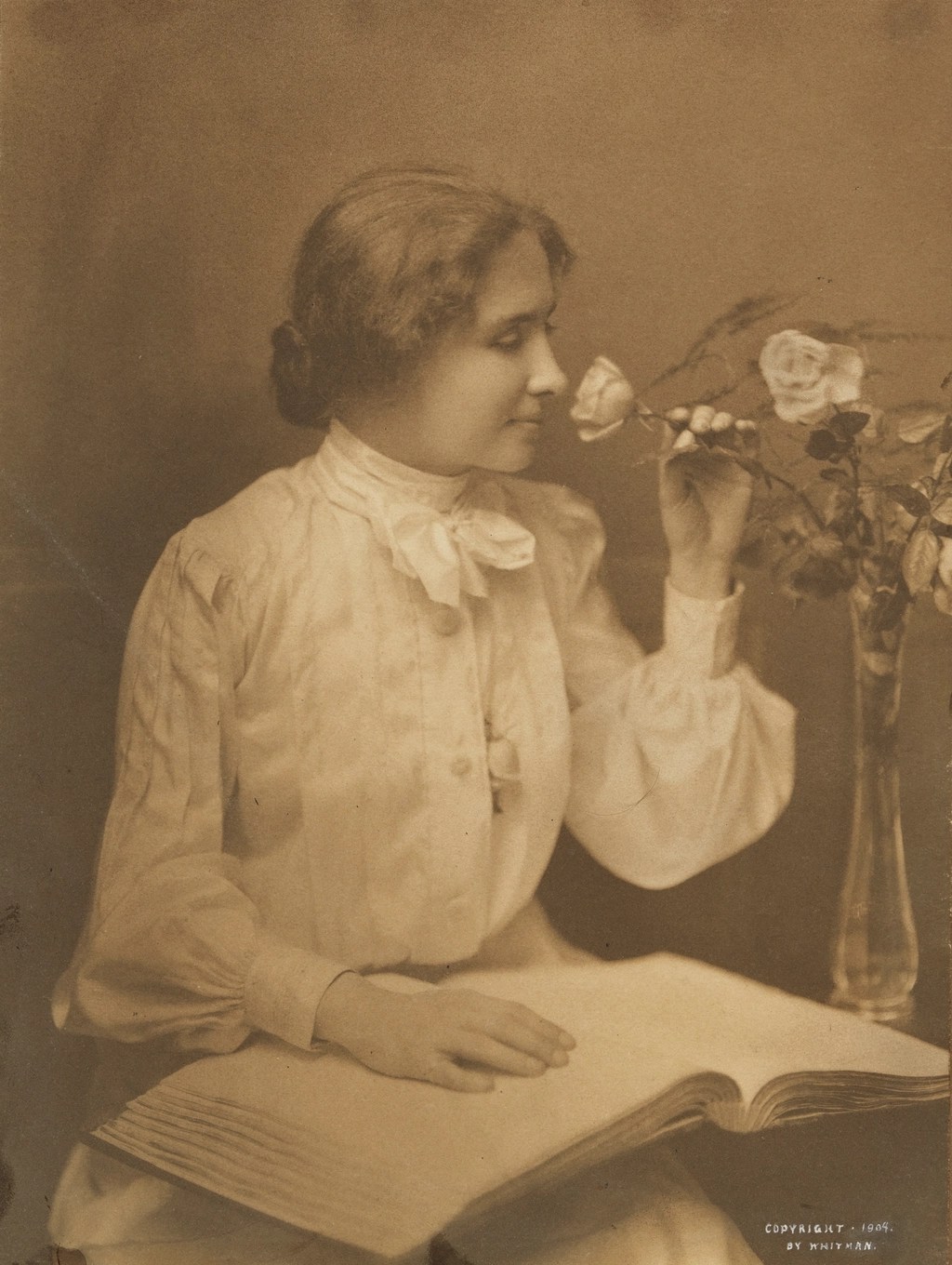
Perhaps there is a way. Perhaps not. But I must strive, at least, to remember Helen Keller’s words, these taken from her open letter in response to Nazi book burnings in Germany on May 9, 1933: “History has taught you nothing if you think you can kill ideas. Tyrants have tried to do that often before, and the ideas have risen up in their might and destroyed them. . .You can burn my books and the books of the best minds in Europe, but the ideas in them have seeped through a million channels and will continue to quicken other minds.”
If Helen Keller believed that ideas and hopes have always “seeped through a million channels,” who am I to deny it? Might not a few of those ideas and hopes, and more likely a multitude, have made their way to us now at the dawning of the year 2025? Might not they sustain us, quicken our minds, and help us find a way out of our narrow places and into the light?
Three Months ago, at the beginning of summer, I received an agent request for the full manuscript of my historical fiction novel, A Fine Suddenness. I am told that 3 months is about the time I might begin to expect to hear back from the agent, and so today I am checking my email even more regularly than usual, and I am thinking about the origins of the manuscript.
My Journal
It began in May of 2011 with the glimmer of a character suggested by a signature of ownership in an old red leather-bound book a friend gifted me: The Conqueror, by Gertrude Atherton. My friend Lynn is a librarian, a teacher of history, a seller of used books, and a maker of reclaimed book journals. You can check out her business at brownbagbooks.biz. This book was one of her rescued book journals. The cover was intact, rebound into a smallish wire bound blank journal.
The original inscription inside was simple: Mary Miller 1903. Who was this lady, I wondered? She must have loved her books, I thought, to have signed her name and the year of acquisition on the inside cover, a habit I also have. I usually add the place I acquired the book also, but Mary Miller did not do so. A quick search told me that Gertrude Atherton was a San Francisco author, and The Conqueror had been published in 1902, was about Alexander Hamilton, and was widely acclaimed.
I immediately began writing in Mary’s book-turned-journal, taking on an imagined persona of the unknown lady. It began: “May 8, 1903. Lake Arrowhead, California. I am proposing to tell you a story which I am quite sure you will doubt . . .” Rather quickly it took on the overtones of a ghost story, and I named Mary’s father, described his field of study and stated that her mother had died of influenza when she was a child. All of that came to me very spontaneously. Also, Mary’s husband was dead, but she had a vision of him. So, A Fine Suddenness began as a ghost story. And in some ways perhaps that is what it still is, but not in the way it began.
Eventually, the real Mary Miller, whoever that lady was, disappeared from my mind and became instead a woman who lived in Lake Arrowhead, California during the 1940s—70 years before I read her inscription rather than the actual 108 years. Once I placed Mary in a new time and most certainly a different place than the real Mary had lived, I began to conjure what life was like during World War II on the mountain we shared, not in time, but in place.
All of that pondering gradually grew into a scene of Mary in her yard among her roses, the trees towering in the background. And so, she became real to me, and I wrote her story. She is completely fictional, other than the sense I got from seeing her name, and from the beautiful red and gold embossed cover of a book.
She, I hope, would make her namesake, the real Mary Miller, proud.
Photo generated using AI (which I never expected to use…a story for another day)
I finished several books recently, one of which I had been reading for months in between other, less hefty titles. The hefty one is an older release (c1987), WWII historical fiction, Marge Piercy’s Gone to Soldiers. A wonderful book—rich in authentic detail—an amazing amount of research had to have gone into this devastating and sweeping novel. Having written two (as yet unpublished) WWII era novels, myself, I am beyond impressed with everything Piercy brings to life here.
Gone to Soldiers tells the stories of ten men and women who served in America, Europe, and the Pacific in vastly different ways: a war correspondent, an intelligence office for the OSS, a Japanese code breaker, a Women’s Airforce Service Pilot, an artist who fights with the Resistance in France, a woman who leads Jewish children to safety over the Pyrenees, a Marine struggling to stay alive in the Pacific, a Jewish teen from Paris sent to America before France fell, and her American cousin.
I have read a lot of WWII and Holocaust related fiction and nonfiction over the years, but somehow I missed this one. My brilliant friend, Sandy, sent me a copy, and I am so glad she did. It is not an easy book to read. Many of the scenes are incredibly vivid and tragic. Some of them were known to me from other sources, but a couple of them depicted battles or situations of which I was not aware.
I was particularly affected by the scenes in the Pacific, I believe, because my father served in the Pacific theatre, but talked about it so little that I never had a clear picture of what he went through. This book made me more aware of the horror he faced and makes me want to know more about his service.
I recommend Gone to Soldiers for its unblinking portrayal of the realities of war, ignorance, prejudice, love, and loss. It is an important book for men and women who seek to understand and remember our shared history—to mourn and honor those lost, to refuse to fall back into dangerous patterns of racism, prejudice, and misogyny, and to continue to work toward the vision of a safe, equitable, and free land for everyone.
“TODAY THE GUNS ARE SILENT. A GREAT TRAGEDY HAS ENDED. A GREAT VICTORY HAS BEEN WON. THE SKIES NO LONGER RAIN DEATH – THE SEAS BEAR ONLY COMMERCE – MEN EVERYWHERE WALK UPRIGHT IN THE SUNLIGHT. THE ENTIRE WORLD IS QUIETLY AT PEACE.”
GENERAL DOUGLAS MACARTHUR
Radio address to the American people from the USS Missouri, following the Japanese surrender ceremony, September 2, 1945 (FROM WWW.NPS.GOV)
Tatiana De Rosnay’s Historical Fiction Novel, Sarah’s Key, A Review
Sarah’s Key tells the intertwined stories of two fictional inhabitants of Paris; Sarah, a ten-year-old girl caught in the terror of Nazi-occupied France, an innocent Jewish child desperate to protect her little brother, and Julia, the journalist destined to discover Sarah’s story sixty years later. Though Sarah and Julia are fictional characters, the situations of the story are sadly all too real.
Before reading Sarah’s Key, I hadn’t known of the Velodrome d’Hiver roundup, which was ordered by Nazis, and carried out by French police officers, but as with all events relating to this terrible time of human history, the story is by equal measure unimaginably catastrophic and yet characteristically illustrative of the horrors of the systematic application of the NAZI party’s stated objective to eradicate Jews in what they termed “A Final Solution to the Jewish Question” at the Wannsee Conference on January 20, 1942.
The Velodrome d’Hiver roundup in Paris, France is one example of the implementation of that horrific policy.
Here is a brief summary of the real events:
“Beginning in the early hours of July 16 [1942], French police rounded up thousands of men, women, and children throughout Paris. By the end of the day, the police had taken 2,573 men, 5,165 women, and 3,625 children from their homes. The roundup continued the following day, but with a much smaller number of arrests.
Approximately 6,000 of those rounded up were immediately transported to Drancy, in the northern suburbs of Paris. Drancy was at that point a transit camp for Jews being deported from France. The rest of the arrestees were detained at the Vélodrome d’Hiver (Winter Cycling Track), an indoor sporting arena in Paris’s fifteenth arrondissement.
After five days, Jews incarcerated at the Vél d’Hiv were transferred to other transit camps outside Paris. At Drancy, Pithiviers, and Beaune-la-Rolande, French police guarded these men, women, and children until transport to concentration camps and killing centers in the east. At the end of July, the remaining adults were separated from their children and deported to Auschwitz.
Over 3,000 children remained interned without their parents until they were deported, among adult strangers, to Auschwitz as well.
German authorities continued the deportations of Jews from French soil until August 1944.
In all, some 77,000 Jews living on French territory perished in concentration camps and killing centers—the overwhelming majority of them at Auschwitz.”
De Rosnay’s novel expertly weaves the stories of her two heroines, as one suffers through the event and the other learns of it in a surprisingly intimate way many years later. This book reminds me of the importance of historical scholarship—true scholarship that doesn’t shy away from the painful realities of the past—and of the absolute necessity of bearing witness to the suffering of the innocent—as a way to honor them, of course, and also as a way to teach each new generation the lessons that seem so easy to forget, so fragile, and always under attack. We need to hear the stories. We cannot be allowed to forget.
Sarah’s Key is one of those books that takes us on an unforgettable journey, touches our hearts and souls, and joins us to the hearts and souls of others who were forced from this world before their natural times, and in terrible ways. It is both deeply dark and sweetly hopeful. A strange truth about literature, and part of its magic, is that you can enjoy it even while it is hurting you. Sarah’s Key is worth it.
Welcome to a space for all moms. This is a platform where I write my experiences as a mom in her primes—sharing real-life stories, lessons learned, and the ups and downs of motherhood. My goal is to inspire, support, and connect with fellow moms who are also embracing the journey of raising a family while growing as women.
































 LakeArrowheadLadyWriter
Books Get Me Through The Great Alone
It’s been two weeks since I left Nevada and one week since I arrived at my new Michigan home. All of these days have been solo; I drove alone, I arrived alone to an empty house, I spend my days here alone. There’s a theme building . . . For now!
But husband and kitties will be joining me soon.
As an introvert, this hasn’t been particularly tough. I love people, but I also love solitude. I just got the internet yesterday, and that’s fun because now I can write and publish my writing more easily. No TV here yet. No furniture to speak of. I have one little lamp table that fit in my car, a folding camp chair, and a cot. That’s it. Everything else will come in the moving van next week. So, what do I do all day?
I clean and I read. Often, at the same time, by listening to audiobooks using the Libby library App. One of the books I’ve enjoyed so far during this extended period of solitude is aptly The Great Alone by Kristin Hannah. It’s a tough book about a tough time and a tough place, but I liked it. Alaska in the 1970s, mental illness, abuse . . . it’s got it all, but it isn’t only that, of course. It’s also a book filled with nostalgia, love, and the awesomeness of nature.
Other books I read either just prior to moving, during the drive, or since my arrival are: We All Live Here, Moyes; Sandwich, Newman; The Secret Book of Flora Lea, Henry; Remain, Spark and Shyamalan; The Missing Half, Flowers and Kiester; and currently, The Island of Sea Women, See. Each book has its merits.
I found both We All Live Here and Sandwich charming and humorous. Both are light, contemporary novels with women protagonists wrestling with life changing events and the love of family.
The Secret Book of Flora Lea took me to one of my favorite historical settings, World War II England, in the countryside and also to London in the 1960s. It’s a delightful book about sisters, families, love, and the importance of stories.
Remain and The Missing Half are mysteries, with Remain being the more entertaining of the two for me. The Missing Half helped pass the time, but Remain’s ghostly love story captivated me at times, including during several memorable scenes that made me shiver.
And now I’m listening to The Island of Sea Women. It’s taken me to a part of the world I know very little about, which I love, because I am learning so much. It’s set in Korea from the story’s beginning in the 1930s and will move through the war years and take me to the present day. It’s about women sea divers (an amazing group of female divers who earn the money for their families while their husbands care for the children), and it’s the story of two friends Mi-ja and Young-sook.
As you can see, I’ve not been alone, not really, for I’ve been traveling through time and place along with the characters created by the authors of these varied and appealing novels, carried away by their stories. It’s a kind of magic really, the way a reader lives both inside and outside of a book—simultaneously in the room, and also somewhere else far away.
I love this line about reading from Stephen Chbosky from his young adult novel, The Perks of Being a Wallflower:
“Sometimes, I read a book, and I think I am the people in the book.”
Exactly.
Share this:
33 Comments
Filed under Authors, Books, Commentary, Fiction, HIstorical Fiction, Home, Identity, Literary Fiction, Nature, Personal History, Reading, Uncategorized, Winter, World War II
Tagged as Book Review, Books, Fiction, Introvert, Michigan, Moving, Nevada, Reading, Writing