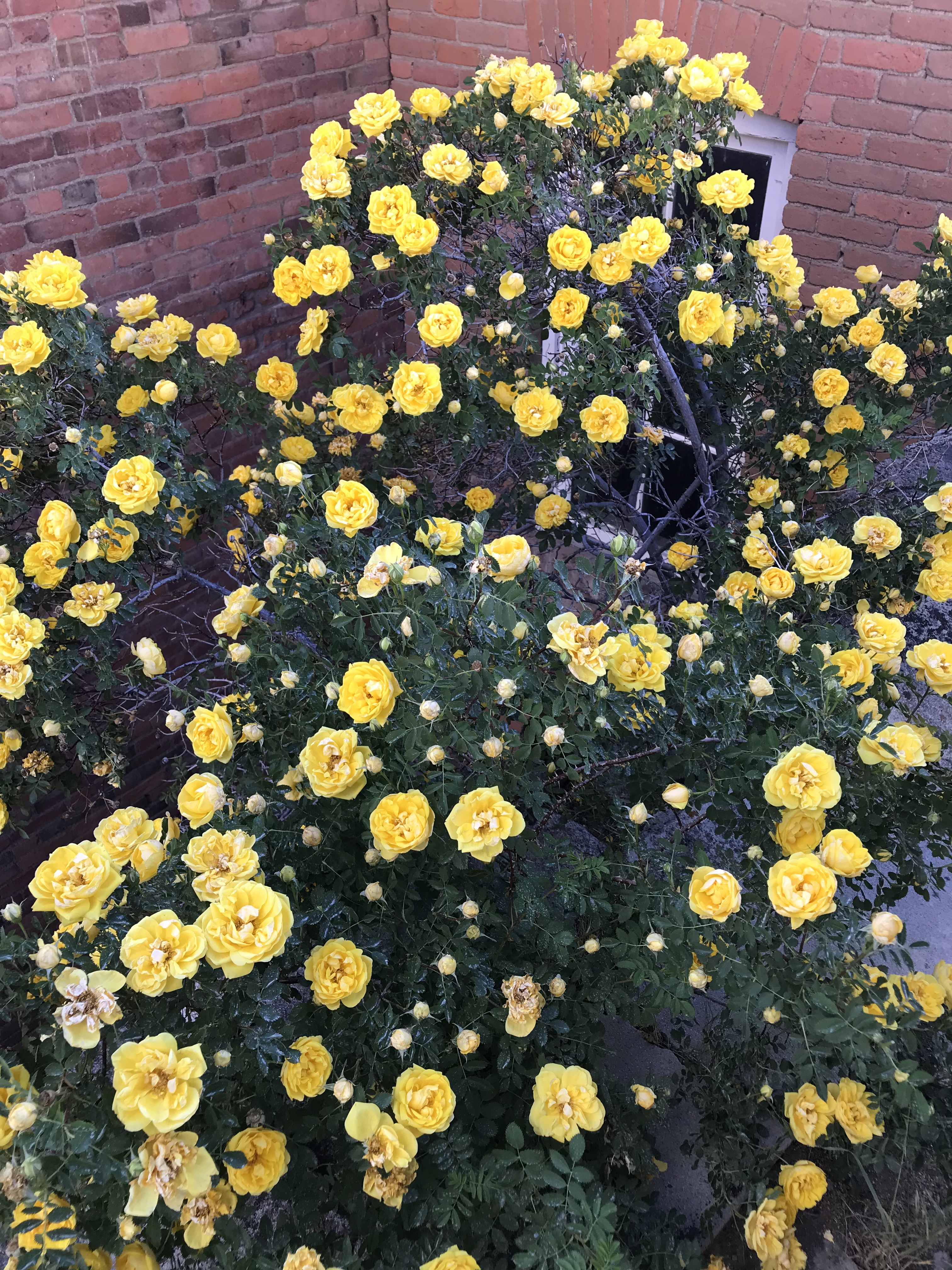
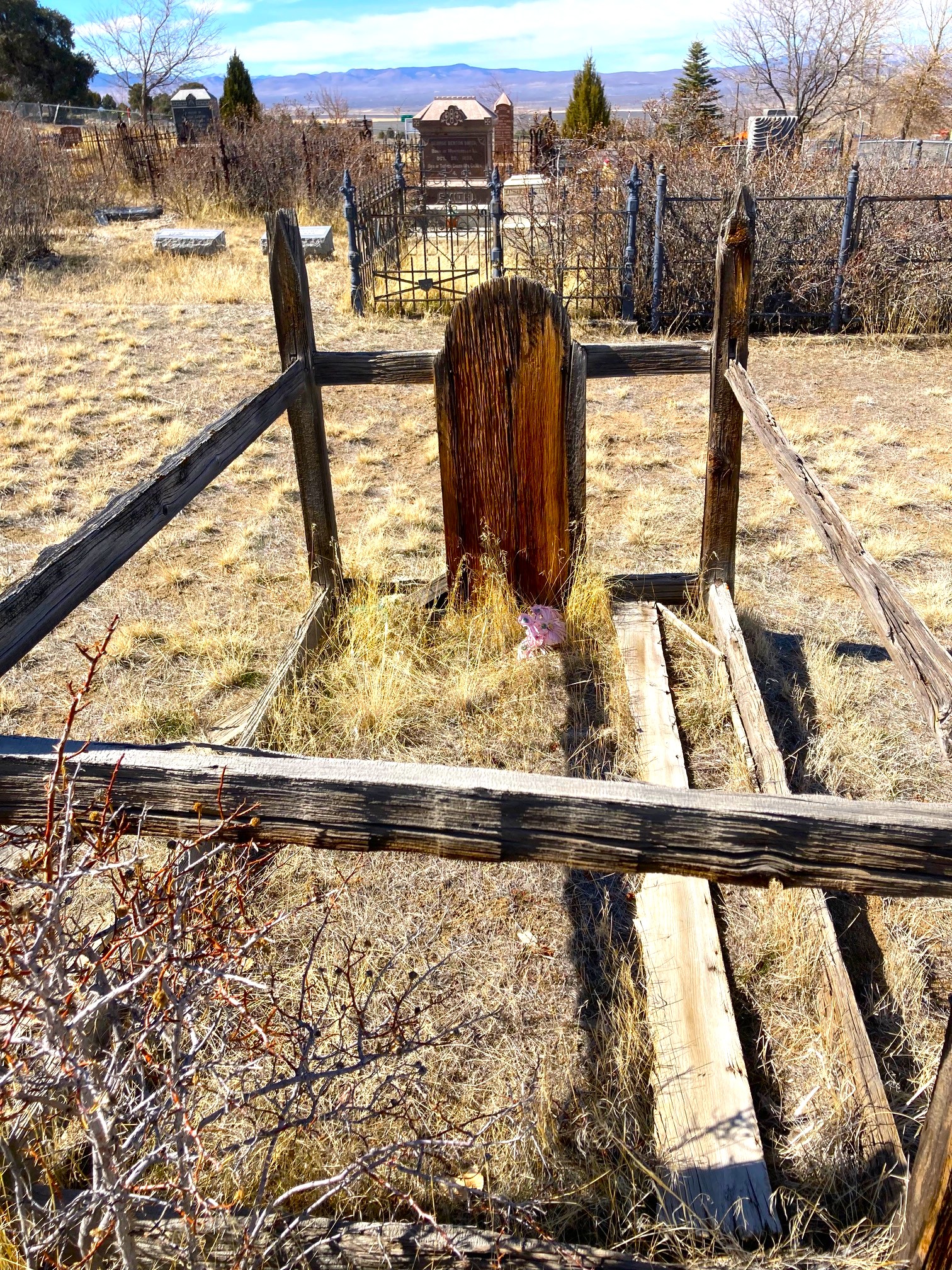
Austin, Nevada. Yesterday. A Walk Through the Cemetery. The thorny branches covering the grave will burst into bloom this summer. I find that comforting.These are the same type of wild roses. This is the June bloom in our yard.
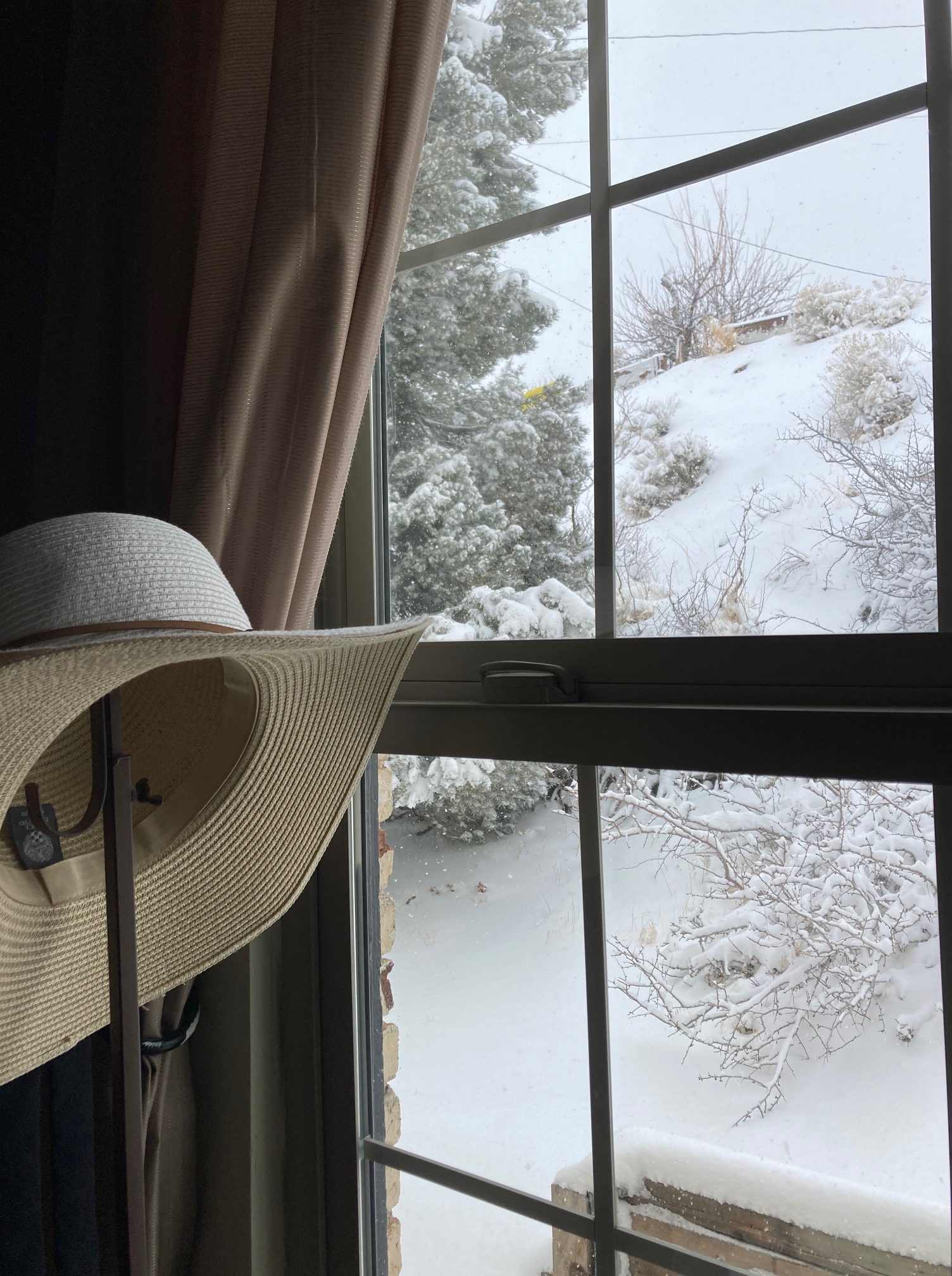
Yesterday, Austin, Nevada was bathed in sunshine and warm temperatures. Today Austin is buried in snow. It’s mostly awesome, not really a misfortune or doom, and we knew it was coming. Thank you, meteorologists!
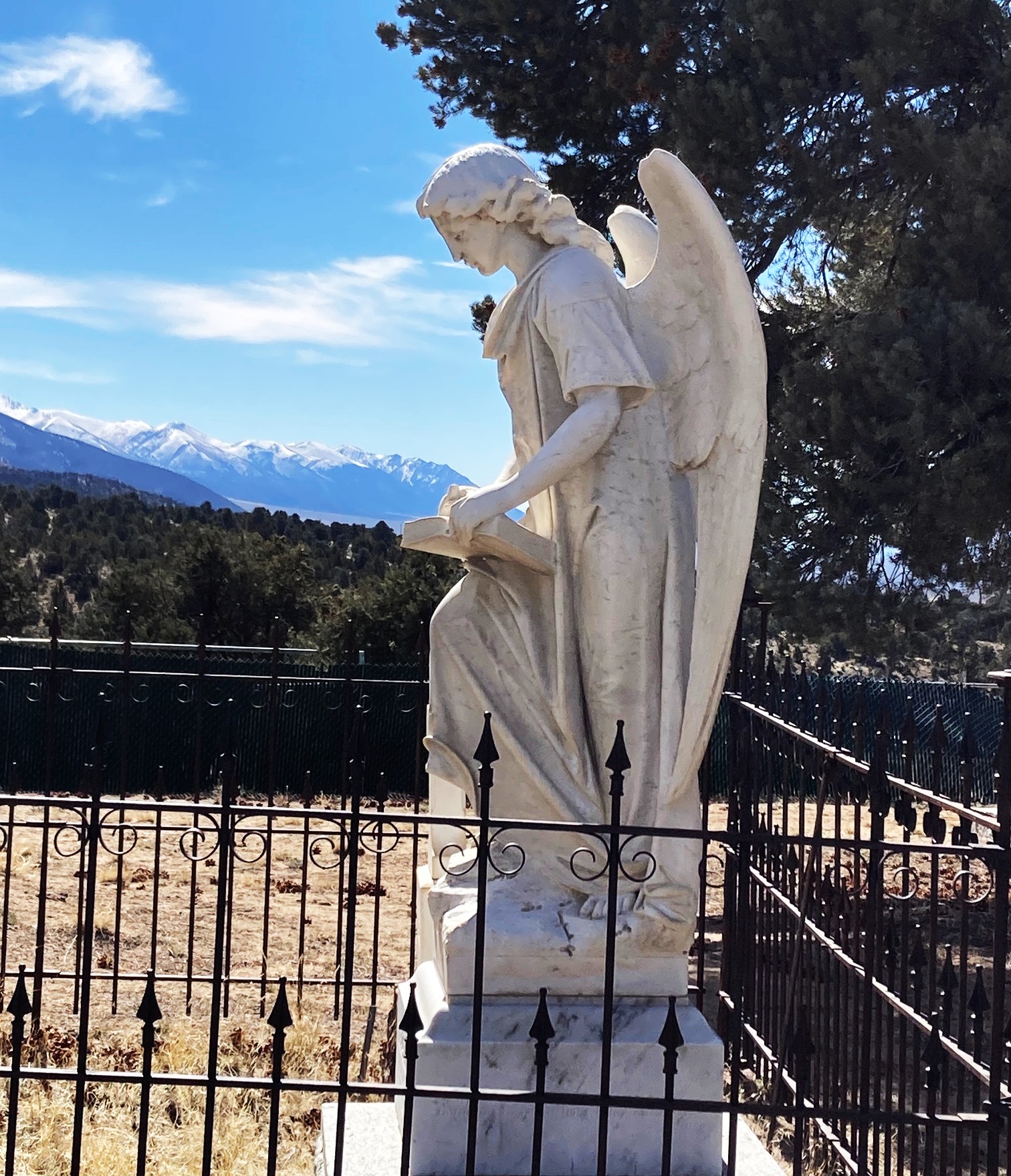
Austin History, March 1, 2025Austin YesterdayNearer My God To Thee, Nearer to Thee
We needed snow. We had a dry winter.
Today
As the snow continues . . .
Weather is life. No doubt this is the reason it is so often the topic of small talk. It’s life.
Weather is also death. I fear for our friend who left town just as the snow started, heading west on Highway 50 directly into its path.
And it affects all of us. Humans and nonhumans alike.
Here then is a tiny presentation of the weather in Austin, Nevada, USA, over a two-day period. Life and death. Ironic juxtaposition that the photos with elements of death are awash in sunshine? It was not intended. And that is telling.
It stopped snowing for a bit. But it’s starting again.
Whatever the weather where you are, I hope you are safe and always, always, rolling with the changes. Happy Spring–Soon!
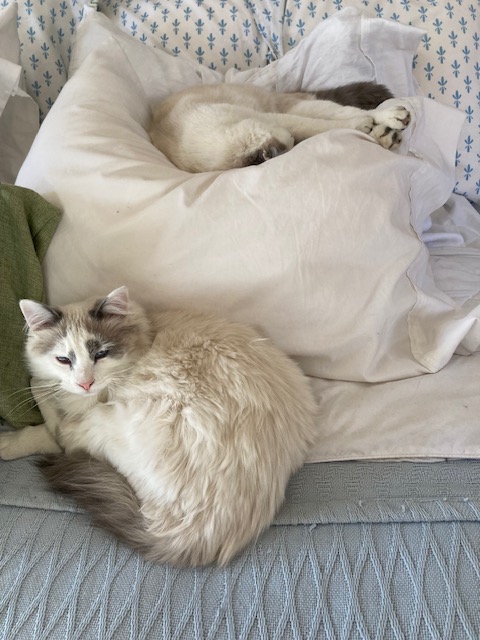
Double Decker Comfort: Tanner takes the top. Gremlin below.
Sometime late last winter, or perhaps it was early spring, a beautiful feral cat began coming into our carport. She was fluffy, blue-eyed, and her body was entirely white except for a gray tail. We nicknamed her Snow White (It was just a nickname. After all, we weren’t keeping her. She wasn’t our cat.) Snow White was clearly hungry, so we fed her. We had three beautiful cats of our own. We had adopted two gorgeous long-haired brothers from Kindred Kitties in Kenosha, Wisconsin a few years before (on purpose!), Jack (pure black) and London (pure gray), and we had Annabelle Lee, a calico Manx stray that had burst into our kitchen through the cat door a year earlier on Halloween and never left. We had plenty of cat supplies and food to share. Snow White never got too close to us or to our cats, but she came often and ate a lot.
It wasn’t long before we realized why she was so hungry. One day we spotted her walking along the white picket fence in the front of our house, tail up. Following her, in perfect formation, were four little kittens, each of them a variation of her white and gray. Two were fluffy like their mom, two were sleek. She brought them straight into the carport. She ate, she nursed them, and then they left. This established a daily ritual which alarmed us because oh my goodness we couldn’t afford to have five more cats and to get them fixed and vaccinated—and oh no how can we take on this responsibility but how can we not—and wow, aren’t they just the most charming and adorable little things . . . ever?
Then one of the kittens got sick. The tiniest and most delicate of the bunch. While the other kittens played after eating, she would sit immobile, her blue eyes weepy, her nose runny, and her fur appearing sticky and dirty. Right about this time Snow White took off, leaving all four of her kittens with us. She stayed away, but the kittens stayed in the carport. Three of them looked healthy, but the tiniest was clearly getting sicker by the day. I made up a washing solution of warm water and peroxide, and Mr. P began washing her with a soft washcloth. She was too weak to resist. We also gave her softened food and cream (which I was told later never to do, but it did seem to revive her). She began to respond to the treatment and soon seemed to appreciate Mr. P’s ministrations.
Tiny Gremlin in the Carport
You may be wondering why I wasn’t washing her, too. It’s because I am a horrible coward. I couldn’t go near her without crying. There is something horribly weak about me. It is the worst part of me, the thing that I am probably most ashamed of. I cannot bear to see innocent creatures suffer. Or even think about it. This is the real reason I do not eat meat.
Mr. P knows this about me. He also cares deeply about animals, but he can somehow separate that feeling from his appetite, and when it comes to helping, he is stronger and can push through the sadness. And I knew he would. Now, if he weren’t here when this happened, would I gather up the courage to take care of the baby? Yes. I know that I would. This I am sure of. I am so grateful though, that I was not alone this time.
We were by then calling the littlest one Gremlin—even though she wasn’t our kitten (Self-Delusional R Us) . . . and we had dubbed the others Tanner, Cole Porter and Annette Bening. Cole Porter and Annette Bening were the two sleek, shiny ones. Cole appeared to be wearing a tuxedo and Annette a matching gown. They were an elegant duo. Mr. P dubbed the other one Tanner because though he was mostly ivory with some gray, he had an interesting area of light beige running in a cap pattern on the top of head and wrapping around the bulk of his back. So now we had four growing kittens in our carport, all of them with names.
As Gremlin’s health improved, we noticed that Annette Bening began to develop Gremlin’s original symptoms. She was heartier than Gremlin had been though, and not as easy to get close to. We thought she would be okay. She wasn’t. The next morning, I found her as I walked to church. Annette had probably died during the night. She was dead at the bottom of the stairs that led from the front yard to the street below. I hesitated going on to church, but then continued on. I cried to my priest when I got there, and she said a prayer for sweet little elegant Annette, who never had a chance to grow up.
This was very hard on us. We decided we would take the remaining three kittens to the veterinarian 70+ miles away in Eureka, and we would get them whatever health care they needed, plus we would get them all fixed. It was a big expense, but one that made us feel immeasurably better. The vet said they were big enough for the operations, and all three came through fine. They were given medications too, in a series, and they all were doing well after that. We learned that only Tanner was a male. Cole Porter and Gremlin were both female.
We set about trying to get our original cats and Annabelle to accept the newly adopted siblings into our home. It wasn’t easy. They are still not the best of friends, but it’s better.
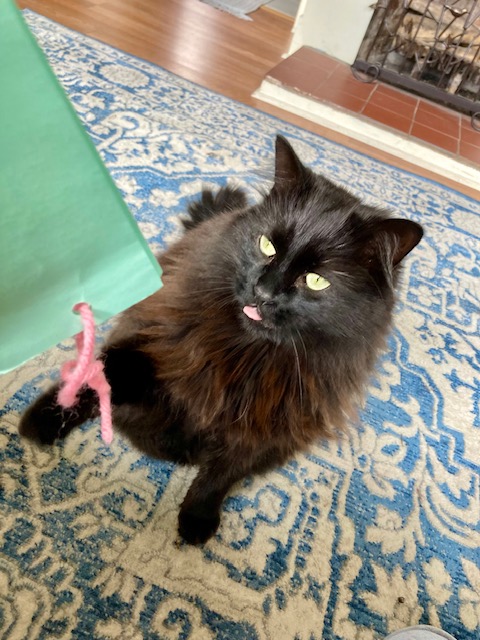
Jack: Ugh. Kittens.
London: On My Bed? Really?
I wish this were the end of the saga of Snow White’s kittens, but it’s not, quite. We lost Cole Porter shortly after her surgery. She was outdoors when Mr. P and I took three tiny new kittens who had shown up (one of them tumbling out of a thorny bush and right into my arms) over to our dear friend’s special kitty house. Our friend, who is one of God’s sweetest helpers, had kindly offered to take in the new foundlings. Unbeknownst to us, Cole Porter had been hiding in the wheel well of our car. We didn’t knock on the hood or honk the horn before driving out of the carport, as we should have done. Cole Porter must have been terrified, and she hung on for several blocks. Then we heard a thump and to our horror we saw a kitty fly out into the snow on the side of the street.
Cole Porter was dead. And we had stupidly caused it.
Our little town has been home to many feral cats over the years, with very little human interference. There is no county catch-and-release effort to spay and neuter them here. Kind souls do what they can for the cats, but there is often not enough money, or even any money, for private citizens to handle the costs of really addressing the problem. Other folks focus their efforts on getting rid of the cats—trapping them and taking them out into the desert and dumping them, or using them as bait for their hunting dogs, or simply shooting them. These occurrences are too horrible for me to even contemplate. It is hard to even write the words. As I admitted, I have an aching weakness when it comes to suffering.
Annabelle Lee: Queen of Roof
The town needs help and organized, kind, positive planning. As it is, more kittens are being born all the time. Not from “our” cats, but from those who weren’t “lucky” enough to have their mommy drop them off in our carport, or the homes of the other kind souls in town with the means to get them fixed. The people need help, the kitties need help, and all of the veterinarians who work to help animals every day need help, too. Vets work hard, and their work takes a huge toll on them. Imagine spending your days doing everything you can to help animals, and seeing their fear, loneliness, and suffering, and often not being able to change their situations. Euthanizing far too many.
It has been “confirmed (using stronger statistical methods than previous studies of suicide among veterinarians) that suicide is more likely among veterinarians than among the general population — 1.6 times more likely for male veterinarians and 2.4 times more likely for female veterinarians.”
(September 4, 2019 by Randall J. Nett, MD, MPH; Tracy Witte, PhD; Elizabeth G. Spitzer, MA; Nicole Edwards, MS; and Katherine A. Fowler, PhD. CDC NIOSH Science Blog. blogs.cdc.gov)
This sad statistic doesn’t surprise me, the woman who can’t bear the sound of an animal crying.
No Crying Here: This is the Life
“Veterinarians have to deal with what one scholar called the ‘caring-killing paradox.’ A veterinarian, for example, might provide wellness visits for a kitten. They weigh the little kitten, give vaccinations and provide advice. Months later, if the kitten contracts feline leukemia virus, the focus of the care changes. After end-of-life discussions with the pet parent, the vet must euthanize the patient they once cared for… Veterinarians also witness a range of emotions from pet parents. The loss of an animal companion can bring profound grief. And veterinarians see the tearful last minutes between a person and their pet, followed by the outpouring of sadness after the animal has passed… They also see pets who have been abused and mistreated. Veterinarians are learning how to recognize signs of animal abuse. All 50 states now have laws that make animal cruelty a felony, and veterinary forensic pathology is taught at conferences. Law enforcement supports veterinarians reporting abuse, as studies have linked households with animal abuse to other forms of domestic violence. The profession is becoming increasingly aware of these stresses. In autumn 2021, the AMVA held their first-ever roundtable discussion to address veterinary suicide prevention. Several goals of the roundtable was to increase veterinarians’ ability to recognize symptoms and to vocalize resources available, such as suicide prevention hotlines, to those in crisis. Trauma and stress lead to mental health struggles among veterinarians and the profession is becoming increasingly aware of the issue.”
It should also be mentioned that veterinarians have access to drugs used for euthanasia. This has been shown to be another reason for the high number of suicides among the profession.
This is a longer than usual post for me. I hope that you have stayed with me. I am passionate about animals . . . about caring for the voiceless, and I have often been too quiet about it. In a world graced with the beauty of all God’s creatures, bright and beautiful, great and small, and the many fine people who devote their lives to helping them, mine is an insignificant voice. But earnestly, with love and hope, I ask that all of us do what we can to help the voiceless, and to appreciate and thank those who are working to better their lives. For we all share this miraculous planet. Together.
I headed home from my holiday travels at the end of December, heart-filled with the love of family. I was tired, but happy in the distinct way grandmothers know well. I had just been given a multitude of irreplaceable moments with my best beloveds . . . Tiny hands holding mine, some still so small, and some growing too fast. Also bigger hands and hearty hugs. Teens and twenty-somethings updating me on their lives. Strong, beautiful, and grown. Smiles. Laughter. Storybooks shared. Snowman crafts. Game playing. Sleepy cuddles. All of it so cherished.
After tearful goodbyes, I checked in for my flight and went in search of a new journal at the airport gift shop, thinking I could begin it on January 1st. Last year, returning from my Christmas trip, I had purchased one there, and it had been a terrific addition to my writing life. Alas, this time nothing spoke to me, probably because I already had it in mind that I wanted a guided journal like the one I used in 2024 (The Breathe Journal 52 Week Guided Planner) and they didn’t have anything similar.
Once home, my usual routines resumed, but with more than the usual spark of wonder and worry that a new year brings. This was not going to be just any new year. Apprehensive, sad, and often angry, too, I knew that I was going to have to work hard to maintain my usual optimism and good will. Honestly, my optimism was at one of the lowest levels I have ever known. Somehow, I was still hanging on to my feeling of good will in all my daily encounters. My genuine love of the people I see during the course of a regular week’s activities lifts me up. But when I was at home reading the news, I was feeling helpless and exceptionally low.
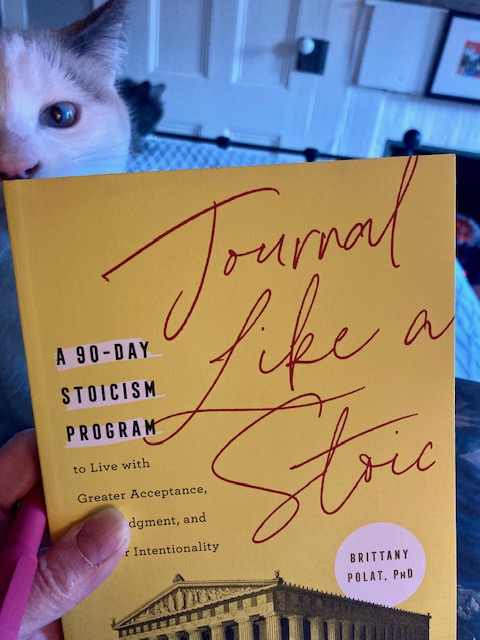
Mr. P and I stuck to our walking schedule, which we know is a nonnegotiable necessity, and I was happy to return to my library job and to church on Sundays. These things always help. Still, I knew I needed to get more writing in, and was stuck—am stuck—as far as my historical fiction manuscript goes, so I searched online for a new journal. I found and ordered Journal Like a Stoic: A 90-Day Stoicism Program to Live with Greater Acceptance, Less Judgment, and Deeper Intentionality by Brittany Polat, PhD.
By the time the journal arrived, we were more than halfway through January, and I was physically unwell. I am only into my third day of using it, but I would say it is helping me in the way that almost any honest attempt at writing truthfully from my heart and mind can do. It focuses my mind with reading, questions me with depth, and sets a task before me. I like it.
From the book: “Stoicism is a philosophy of life in the fullest sense. As a framework for daily living, it can guide us in every decision we make, from our career choices to what’s for dinner tonight. What’s more, it helps ground us when we’re living through what feels like unprecedented times.”
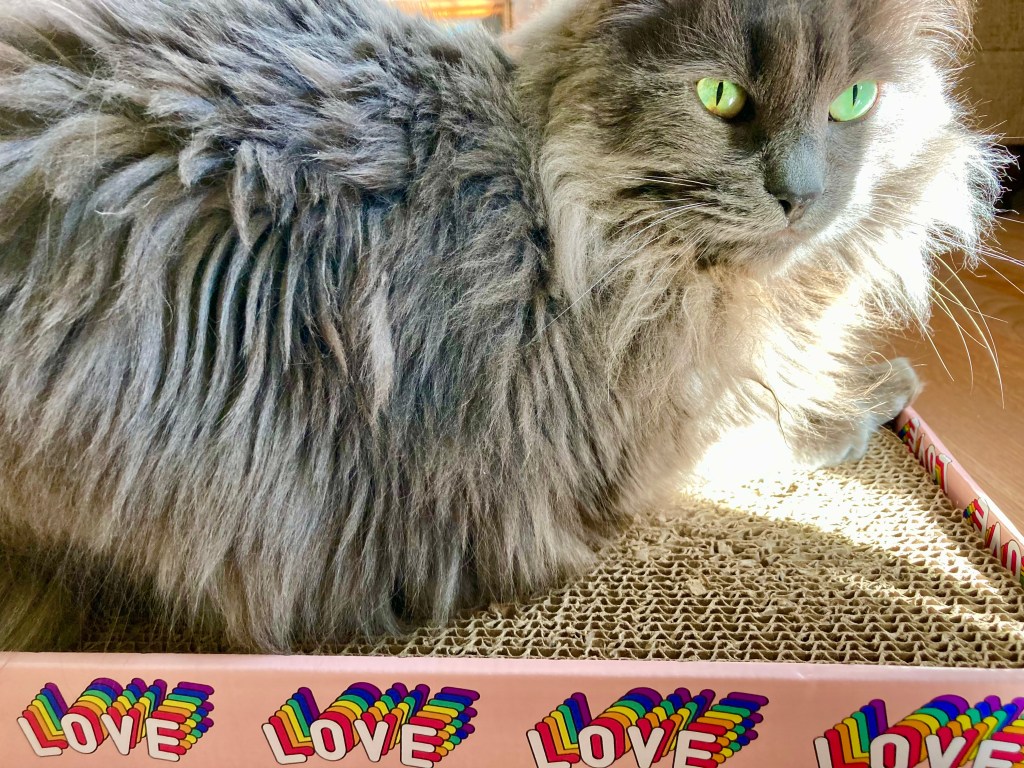
The kitty is also interested in stoicism.
The three disciplines of stoicism are logic, ethics, and physics. The four virtues of stoicism are wisdom, justice, courage, and temperance. All these things I can get behind, believe that I mostly already embrace them. I say mostly, because I am ignorant when it comes to physics, and historically slack when it comes to temperance. Still! I am in. I will faithfully read and respond to the prompts in the book. I will write honestly.
I plan to continue with the other things in my life that sustain me: my love of friends, family, community, church, library, nature, reading, art, music, cooking, and pets (to name a few). And I will write the occasional blog post! I love connecting with all of you!
Cheers
To us! To a year of introspection and growth, and to a lifetime of love-motivated action and purpose. God Speed.
Just before Christmas, Mr. P and I drove to the Hickison Petroglyph Recreation Area, which is located a short drive from our home over the Austin Summit on Highway 50, “The Loneliest Road in America.” I love nature and history, as well as walking and exploring new (to me) places, and this little day trip exceeded my expectations. As soon as we arrived, I was surprised that I had not heard much about the place in the four-plus years we have lived in Austin. Only one person had ever mentioned the spot to me, and that was a traveler who stopped in to see our historic general-store-turned-library and told me he had camped there the night before. I imagine the locals have all been there, and they have been good at telling us about other wonderful places to explore in the area, so it mystifies me that no one thought to suggest this historically and scenically stunning spot to visit.
Therefore, I will do so. If you travel Highway 50, be sure to make this one of your stops!
Some history:
“The Hickison Petroglyph Recreation Area provides public access to petroglyphs created by prehistoric people living near Hickison Summit at the north end of the Toquima Range and the south end of the Simpson Park Mountains in the U.S. state of Nevada. . . In the general vicinity of Hickison Summit are multiple prehistoric hunting and living sites dating to 10,000 B.C. as well as more recent sites such as mining camps and ranches.
Trails used by mid-19th century explorers John C. Fremont and James H. Simpson pass through the area as do the routes of the Pony Express and the Overland Stages. At the time of the earliest prehistoric sites, the Great Basin contained large lakes, including Lake Toiyabe and Lake Tonopah in the Big Smoky Valley west of the summit. As the climate became drier, the lakes evaporated, and the former lake dependent cultures were replaced by hunter-gatherers. When the first European-Americans arrived in about 1850, Western Shoshone people lived in the region” (https://en.wikipedia.org/wiki/Hickion_Petroglyph_Recereation_Area).
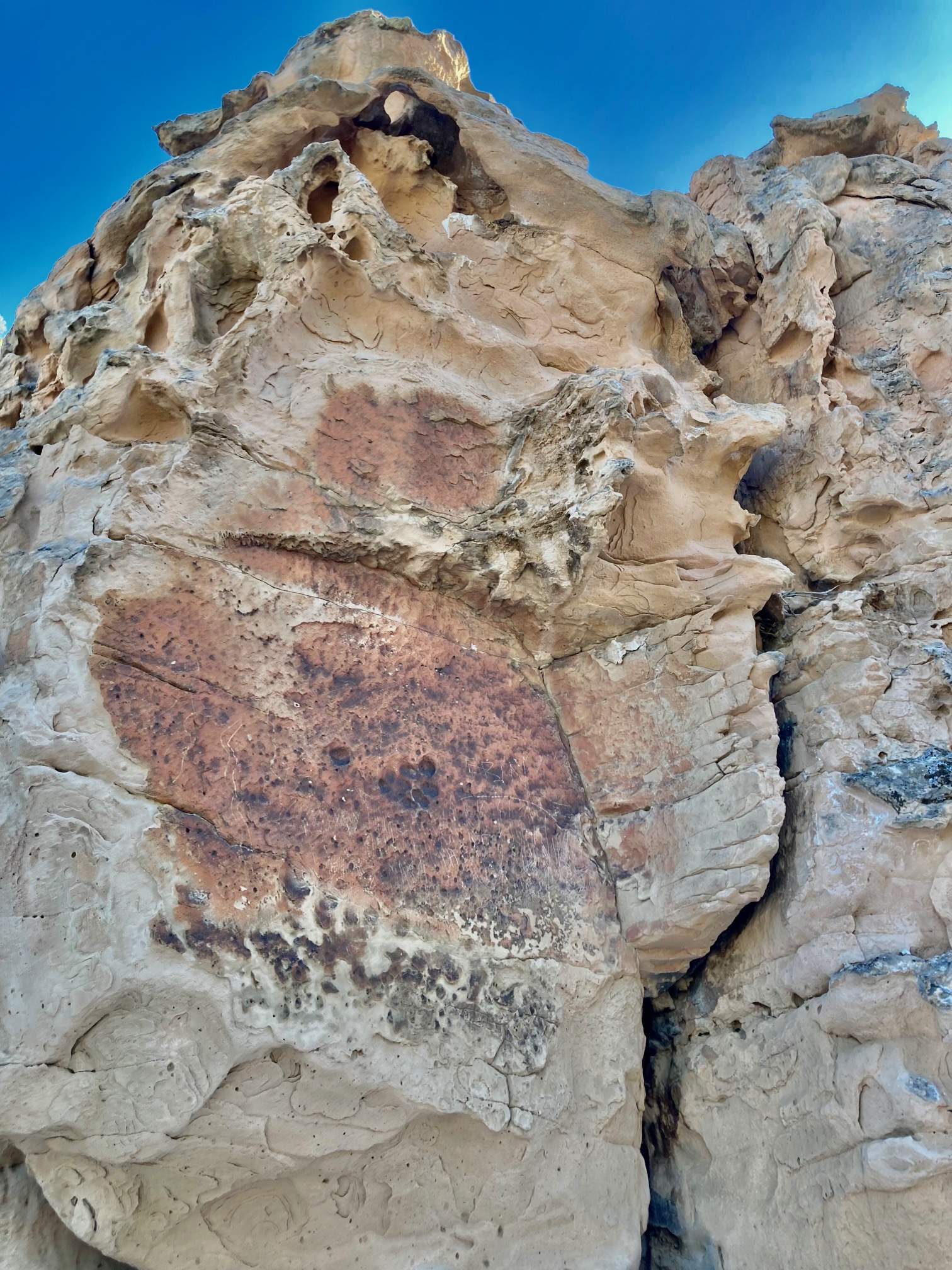
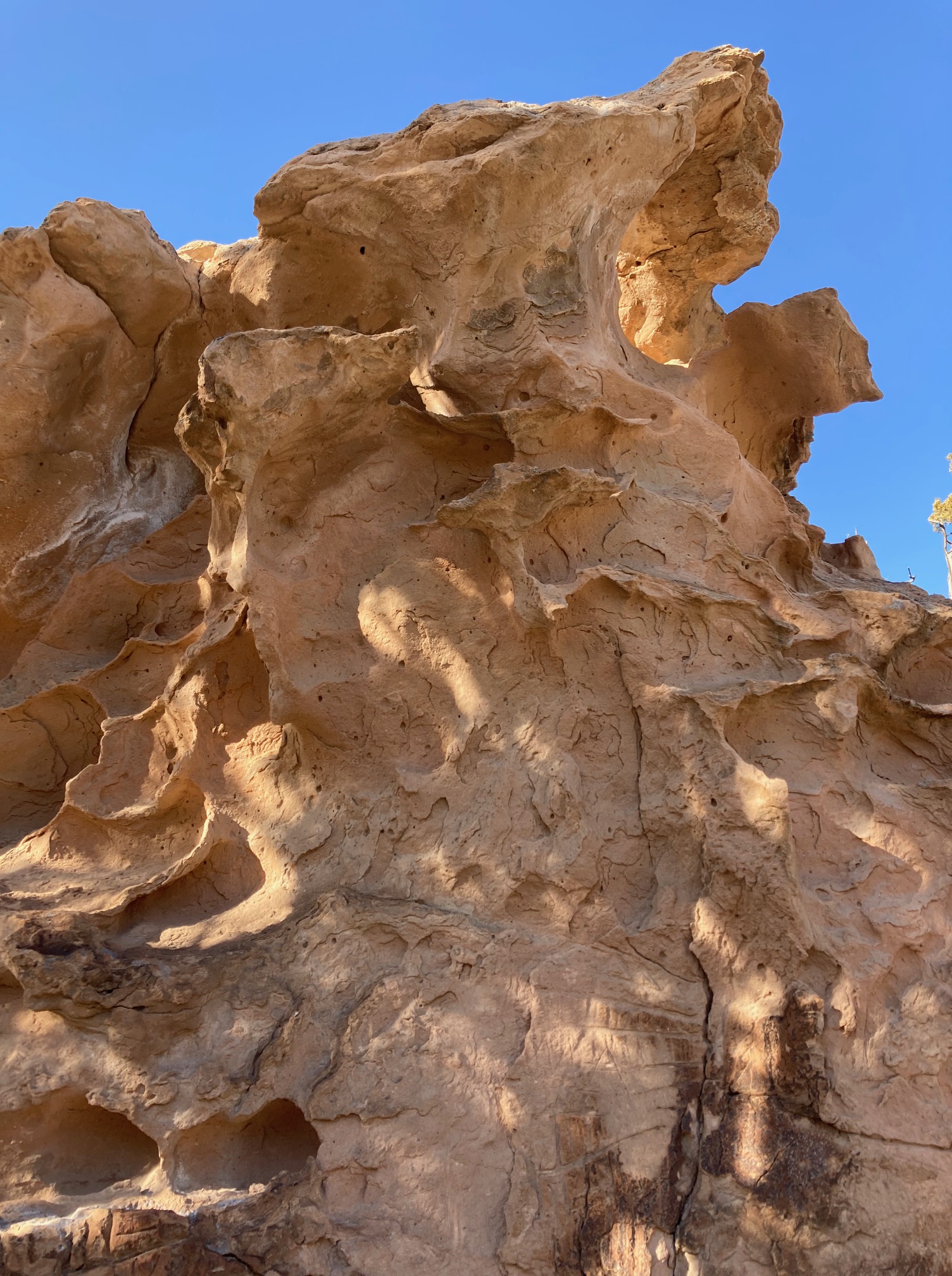
Wow, right? My dear friend, Cheryl, just informed me that when you see faces in things, it’s called pareidolia. I definitely see a face here, and a neck as graceful as Audrey Hepburn’s.
Here is the proposed text for the marker plate, State Historical Marker No. 137, from the Nevada State Historic Preservation Office:
The summit is named after rancher John Hickison because the road to his ranch passed over the summit. About one-mile northwest lies Hickison Summit, a natural pass between two low buttes. Passes and canyons were common Native American hunting locations for funneling and ambushing bighorn sheep and deer herds. Archaeological sites in the region reveal a dominance of bighorn bones and horn, reflecting the bighorn’s importance to Native Americans as food and raw material for tool production. The bighorn lacked resistance to diseases introduced by domestic sheep in the nineteenth century, and this resulted in catastrophic bighorn population declines through the West. Prehistoric native American petroglyphs, images and designs are carved into rock surfaces and are interpreted along a short hiking trail. Archaeologists hypothesize that the meanings for these designs include ceremonial, female puberty markers, ritual hunting magic symbols, and rock art or simply graffiti.
On the day we went, there were no interpretive booklets available, and other than a lone camper, no other people, so we didn’t learn as much as we would have liked. Still, it was stunning, and felt somehow sacred. The park was silent and isolated enough that all the years of this century easily fell away, and then echoes of past centuries offered themselves to our quieted minds. I was saddened, too, as I often am, thinking of how much is lost in the mists of history. What a stunning sight it must have been, all those herds of bighorn sheep and deer, and what a shame that diseases introduced by newcomers decimated the population even unto today.
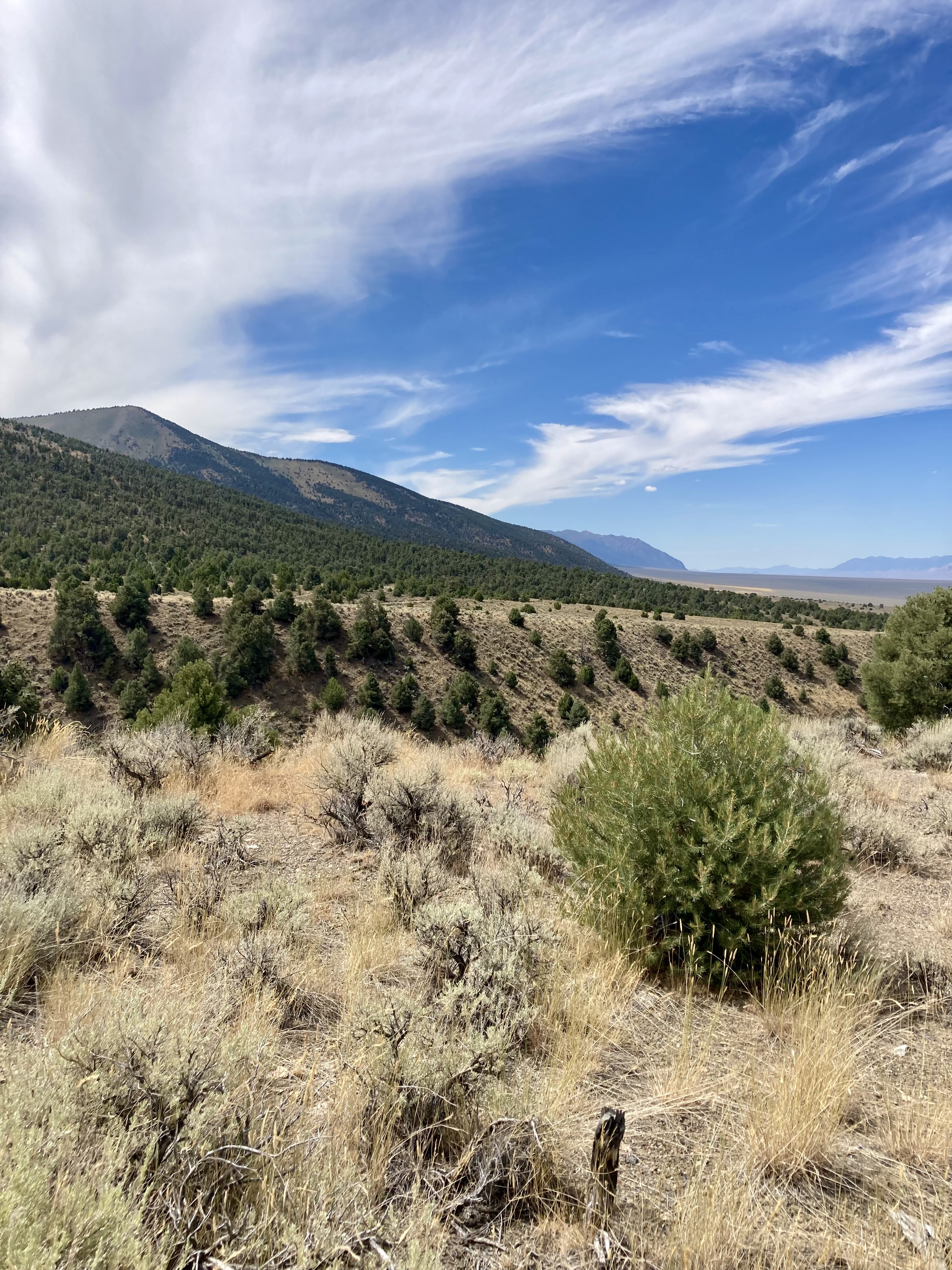
Standing here, looking across the Great Smoky Valley to the Toiyabe Mountains, blue in the distance, I felt connected to all those who came before me. . . human, bird, mammal. . . all.
Such an amazing planet. Such an amazing gift to live here. Sending love and best wishes for a healthy, joyful, and adventurous 2025. Happy New Year!
This past week I read Tom Booth’s charming picture book, This is Christmas, at our December library story time. Of the seven young children in attendance, none of them thought they’d ever seen a chipmunk in our town/area. I have only lived here for four years and am no expert on the local wildlife, but I have spotted a few (very few) chipmunks. Never a squirrel though. This is the only squirrel-free zone I’ve ever lived in, and I can tell you it’s a bit unnerving. I can only surmise that the trees are too small (mostly pinion pine), the spaces in between them too distant, and the rain too infrequent to sustain squirrels. . . I’ve read that the forest in our mountain range, the Toiyabes, is referred to as a dwarf forest, because it’s in the shadow of the great Sierra Nevadas. That could be why I haven’t seen squirrels here, but I don’t really know. But I digress.
Anyway, here in Austin, Nevada, which is located in the center of the state and sits at 6,555 feet elevation, the mammals I’ve noticed include: some humans (not a lot!), many feral cats (a few of which now live inside my house, so they are not quite so feral these days), a plethora of mule deer, occasional groups of antelope and wild horses in the valley below, maybe two bunnies, and perhaps a dozen chipmunks.
So when I spotted these tracks in the snow on one of the trails outside town on today’s walk, I had to take a picture to show my library friends. Definitely, chipmunk prints, right?
Tiny and perfect little lightfooted creature prints compared to Mr. P’s boot.
So I came home and asked Mr. Googly what chipmunk prints look like and they look just like my picture, I think . . . but I guess they could be mouse prints, too, and come to think of it, I have seen a few mice over the past few years (sadly, they have usually been the victims of the aforementioned feral/not-so-feral cats).
Regardless! We had a lovely trail ride today, and the prints charmed us. I’ll definitely report my finding to my little library patrons and tell them to keep a sharp eye out for chipmunks.
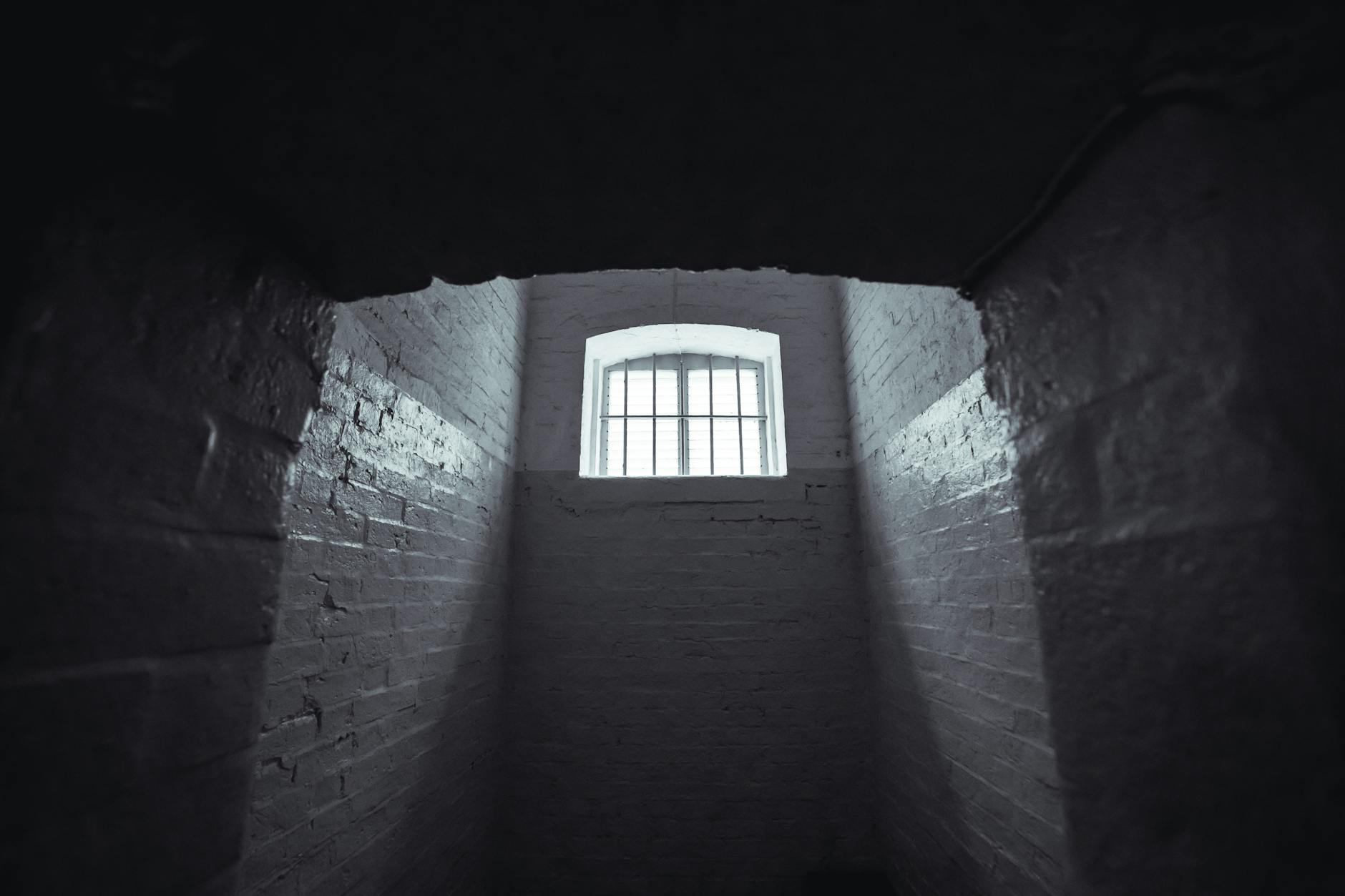
I have thought a lot lately about the discomfort of being in a perpetual state of waiting for something to happen, of worrying about what the results will be when something finally does happen, and then, wondering if I will navigate any of it well. The word “limbo” is often in my thoughts.
2024 brought new health concerns for my husband, and with that a reconsideration of where we should live, since we are currently in a very remote location, three and a half hours by car from the nearest medical center with cardiac care. We responded decisively by putting our house on the market. That decisiveness did not break us out of Limbo, however, as we do not know when or if our home will sell, and we do not know what it will sell for if it does sell. We cannot make plans on where to move until we sell the house. Still, we’re thinking about returning to the Midwest where real estate prices are more reasonable than here in the West and where we can reasonably expect to afford to live in a town with a hospital. But, until we sell, we are in Limbo.
Also, in 2024, I was thrilled to receive an invitation from my dream literary agent to send her my full manuscript, A Fine Suddenness, a World War II historical fiction novel based in Lake Arrowhead, CA. I’ve no idea if she has read it yet. It has been out of my hands for six months now, this after having worked on it pretty consistently for years. Many years. I miss it terribly (it’s an odd thing, really, the attachment I’ve made), and I have no interest in beginning a new novel yet, though at least I am continuing to write. Even so, journaling or posting online, as important and healthy as they are, do not give me the same sense of mission as novel writing does. I wait to hear from the agent, and I do not move forward on a sequel to the book I sent her, nor on some new unrelated novel, because I desperately want her opinion on A Fine Suddenness first. More Limbo.
And 2024, oh my goodness, has been a year of intense worry and anticipation for our nation and the world. We are no longer in the first stage of that particular limbo state, but we are certainly still in a place of transition and uncertainty. So many possible scenarios there, and so little I have control over. More Limbo.
Earliest historical references to Limbo describe a place in-between—not heaven, not hell—a place for deceased unbaptized humans born before the birth of Christ, or who died as infants before baptism, to reside until the second coming of Christ by the Roman Catholic Church, and these begin in the 14th Century. From there, the word limbo (more and more with a lower case “l”) entered usage in less theological contexts: as a place or state of restraint, confinement, neglect, oblivion, uncertainty, or an intermediate or transitional place or state.
Etymology also traces limbo from the English of Trinidad and Barbados limbo “a dance that involves bending backwards under a pole,” related to Jamaican English limba “to bend,” from English limber “flexible” (merriam-webster.com).
Which leads us to the dance, or funeral game, which dates back to the mid to late 1800s on the island of Tobago. In the beginning, the game started with the bar at the lowest possible height and the bar was gradually raised, signifying an emergence from death into life (Wikipedia.org). It is possible that the roots of this practice come from the slave experience of being transported across the seas in ships, where the slaves were separated and tried to squeeze through narrow spaces in order to see or touch one another. In some African beliefs, the game reflects the whole cycle of life . . . the players move under a pole that is gradually lowered from the chest level and they emerge on the other side as their heads clear the pole as in the triumph of life over death (Stanley-Niaah, Sonjah “Mapping of Black Atlantic Performance Geographies: From Slave Ship to Ghetto.” Quoted on Wikipedia.org).
The secularization of the dance began in the 1940s where “it became a popular entertainment in Trinidad and was adopted as a physical fitness exercise by American troops,” . . . and is now “considered the unofficial national game of Trinidad and Tobago” (Wikipedia.org). It has become a fun and happy pastime.
Historically, Limbo to limbo, has moved on. Broken free, so to speak. I wonder if my own limbo could progress that way, too. As for human history, perhaps also for me? If I am stuck in the place between heaven and hell right now, will it be possible for me to become limber enough to squeeze myself through the narrow places that block me from reaching the open, even joyful places that still may exist beyond my current ability to see them or experience them?
In order to do that, I would need to understand the constructs of the narrow places. What are they exactly? What are they made of? Are they hard and impervious, like granite? Splintered like rough wood? Flexible and sometimes deadly like serpents? Or are they only real because I make them real in my own paralyzed mind? Maybe I could wish them away, disintegrate them, with new knowledge or some kind of personal epiphany.
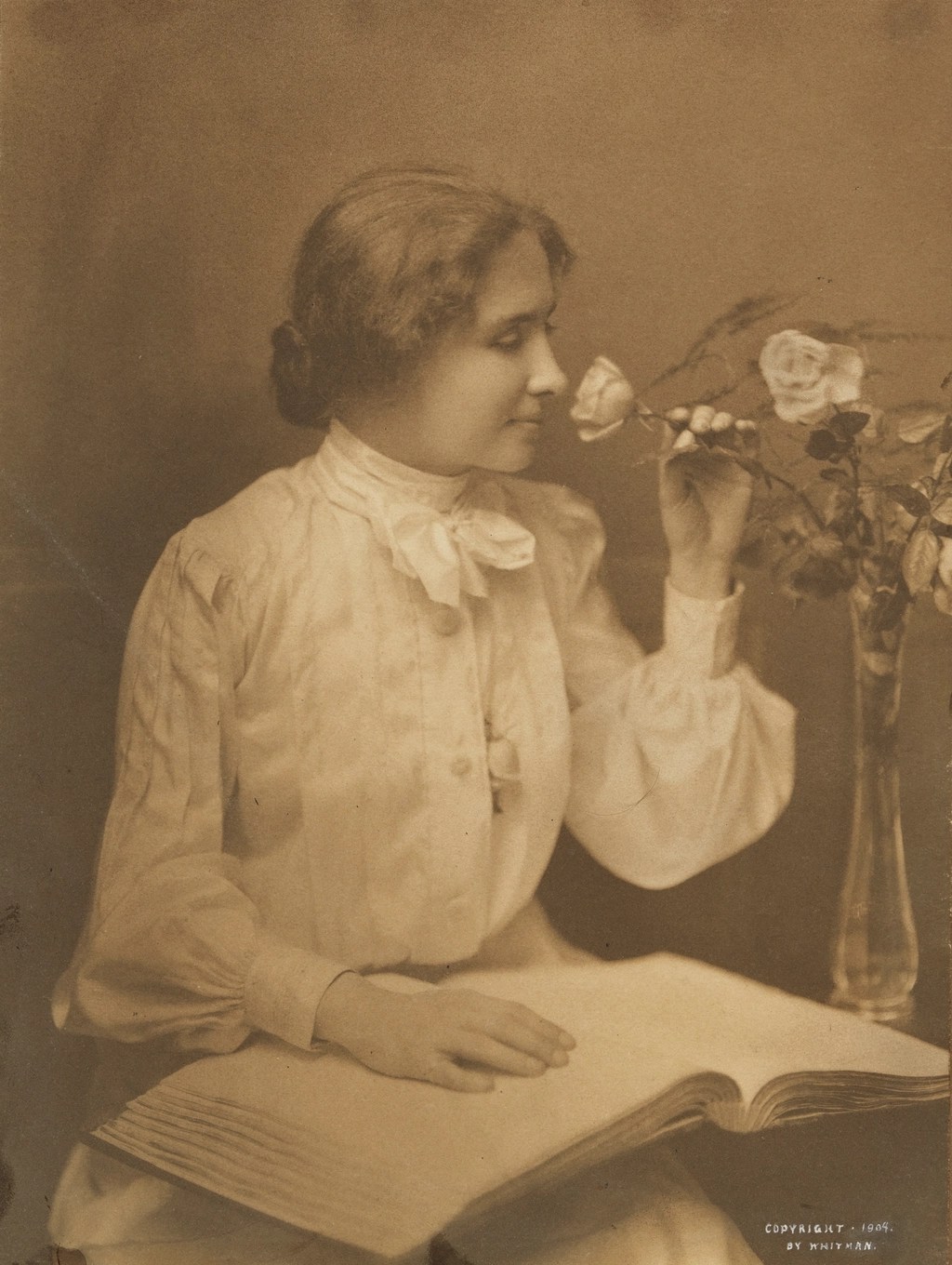
Perhaps there is a way. Perhaps not. But I must strive, at least, to remember Helen Keller’s words, these taken from her open letter in response to Nazi book burnings in Germany on May 9, 1933: “History has taught you nothing if you think you can kill ideas. Tyrants have tried to do that often before, and the ideas have risen up in their might and destroyed them. . .You can burn my books and the books of the best minds in Europe, but the ideas in them have seeped through a million channels and will continue to quicken other minds.”
If Helen Keller believed that ideas and hopes have always “seeped through a million channels,” who am I to deny it? Might not a few of those ideas and hopes, and more likely a multitude, have made their way to us now at the dawning of the year 2025? Might not they sustain us, quicken our minds, and help us find a way out of our narrow places and into the light?
The American Writers Museum is located in Chicago, Illinois. My Photo.
Saturday afternoon. Wondering what to write. Obviously, lots to comment on if I were to verge into current events, but I don’t want to do that. I want to find one good thing to write about—something good for writers, since this will be a post on my writer website.
Perhaps something about writing into your pain, both as a way to expunge it, and as a way to find a path through it. A way that perhaps can teach you something about what you really think, or want, or can make possible, and if you can do this, then so can anyone else. It can be healing.
So, let’s see what comes up in a five-minute timed writing. Just a furious spilling of whatever comes up. It must be nonstop and unedited. Ready?
If I ask you to do it, I must do it, too. . . (sad writer nervously sets timer). . .
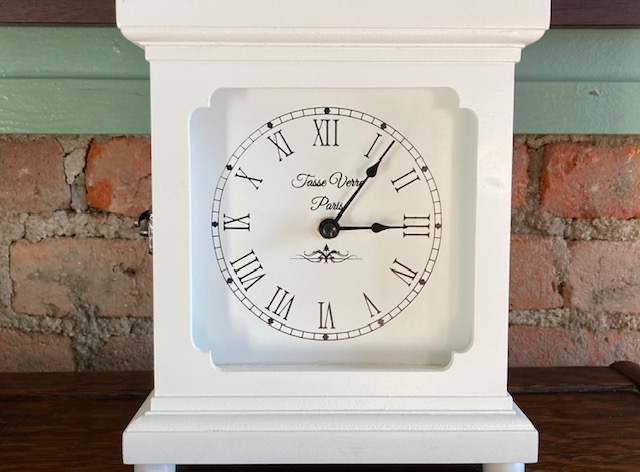
My Clock
Begin!
The first thing I want to say is that I am sad and I wish that things were different. I wish I had gotten busier being successful so that I would have more options now. Now that I want to change things and move and find a yoga class and travel more and eat wonderful vegetarian food in beautiful restaurants and have a home big enough to have a guest room with an extra bathroom and I want to have a place right near my daughter and grandchildren but I cannot afford to live there and it’s because I never figured out a way to make enough money when I was young and never knew how to save money or grow money and money is the only thing that seems to make freedom work in America.
I have always been a dreamer. I have always been a worker, too, and I thought I could be a dreamer and just keep working and that things would consistently get better over time. By get better, I think I meant that I would be able to afford health care and all those things I mentioned above. I also expected that people would want to love each other, help each other, and understand each other. Teachers and librarians and ministers and social workers would always be revered. A college education would be attainable and who wouldn’t want to go to college?
And it would be a great equalizer, because a lifetime of learning and studying history and art and literature, science and geography and math … all of this could illuminate anyone who wished it … and why wouldn’t everyone wish it?
But I was wrong. And I am filled with regret about so many of the choices I made that probably made things worse, but my mind is vague about what those things were and why they were so wrong when obviously I was doing the best I could at the time. But it was never enough. I’ve never been enough.
And I miss my kids. And I want to live in a little house near water where I can walk every day and admire the ducks and the geese, I miss Canada geese, and where I can stop in a little coffee shop and write on my laptop. Which I do not have. But I have a desk computer, and I have a lot of journals and paper is still affordable and I can write longhand, which is better in some ways for me anyway, So why can’t those things happen?
My Photo. The Drawing of Our House is by Derek Zacharias.
I know that the outrageous cost of housing in this country is not my fault. I don’t know who is at fault for that, but there’s a part of me that blames the people who made better choices than I did or who were born into “better” families… And it does me no good to think that way.
Bitterness is knowingly biting into the peel of a grapefruit, chewing it slowly, perversely enjoying it, even though as a child your mother cut the sections loose for you, sprinkled the pink fruit with sugar, and centered your portion with a cherry. That’s the way I like my grapefruit still, that, or in a grapefruit martini with a sparkly sugared rim.
I don’t want to be bitter. I want to find a way back to optimism. It’s just so hard. I miss my kids. The holidays I so love to celebrate are nearly upon us, and I don’t have a way to enjoy them with my family all together. I come and go always somewhere where I am half happy or half as happy as I fantasize, I would be if everyone I love would be there together at the same time. But the drive to Arrowhead from here is much harder than I thought it would be, and since we now know that it’s more expensive here because we regularly leave and stay far away in the city when we have a healthcare need, such as my husband’s recent helicopter trip to Reno and subsequent stay in the hospital there. The hotel bills for me to stay near him during his procedure. All the money spent on gas and restaurants.
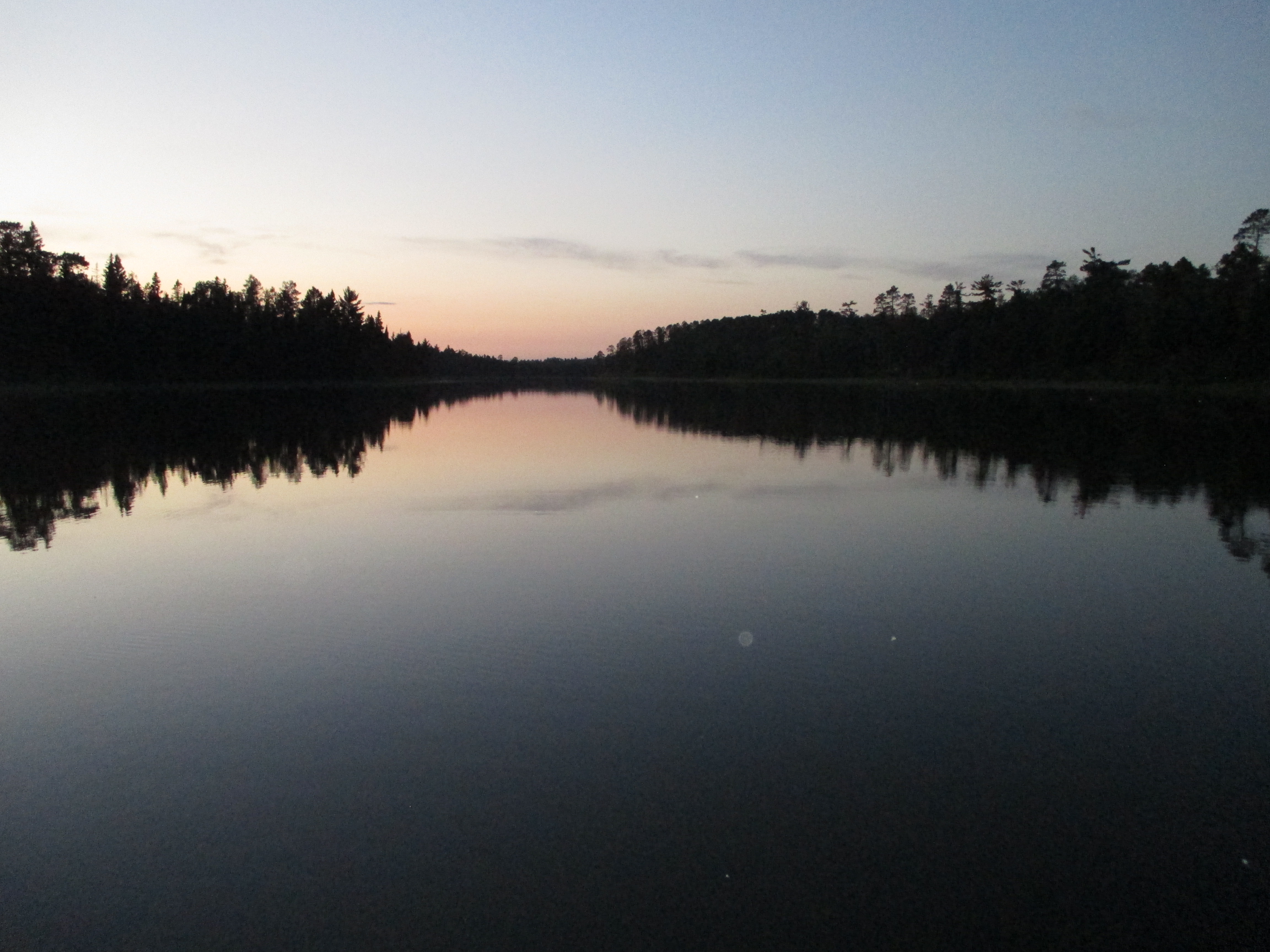
Lake Itaska, Minnesota. My own photo.
Moving to Minnesota seems the only semi-practical solution. At least there will be doctors nearby. We still won’t have a lot of money to pay doctor bills, but at least we won’t have to spend extra money just to get to the place where the medical facilities are located. And the houses in Minnesota that are outside the Twin Cities range in price of course but some of them are much more affordable than anything in the West. We can’t afford anything here near healthcare.
I will still have to fly to see my kids of course. The flights may cost slightly more from St. Paul, Minnesota to California than they do from Reno, Nevada, but that’s the only way I can go. I don’t know how I will afford it, but perhaps I can get a part-time job again like I have here (never as lovely as this job here, I don’t think… I’ve been so lucky in that way). My library position is the reason I’m able to buy plane tickets, and it is a complete joy. But I believe whatever happens, moving again offers the only glimmer of hope.
Time.
And there you are. Or there I am. Do I feel better? Maybe a bit, and I’ll take it! Next a walk. A walk after a writing session helps all the thoughts flow better and meet one another and mix and calculate. Also, writers need to take care of the body that carries them around and allows them to experience many of the things that feed them as creatives.
I believe I’ll go for a walk now.
Wishing you lots of “free to worry” (and resolve) writing time—and all the healing you need and all the hope.
Jiminy Cricket from Pexels Free Photos, Disney.
P.S. I came back from my walk and edited my freewrite just a tad. It’s what we writers do!
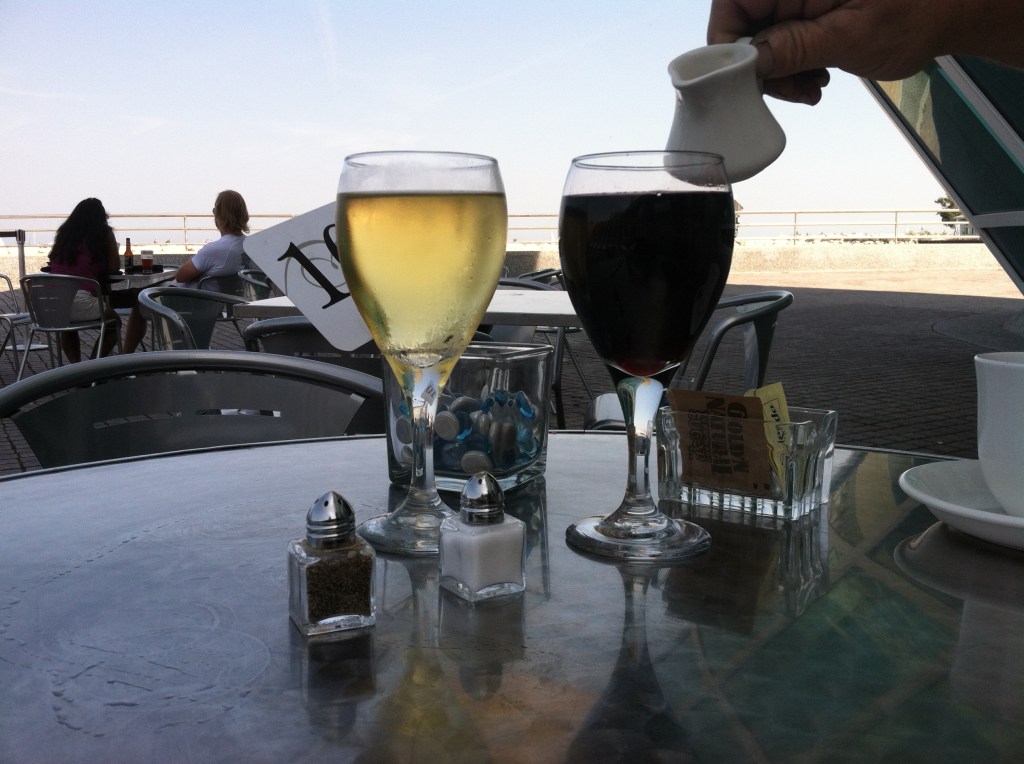
Suddenly the leaves turn red, yellow, and orange; the night temperatures dip into the thirties, and I enjoy sitting in my front yard both in the morning and the early evening. Ahhh . . . those morning coffees and evening wines . . .
The steeple front, right, is on the old Methodist church, now our community center. The steeple across the canyon (you may have to zoom in if the image is too small) is on St. George’s Episcopal church, where I attend. Sunday services have never stopped at St. George’s since the church opened in 1878.
Just a month ago it was much too hot to sit here for any length of time. It is an unusual yard, not yet shaded, one that we created by tearing down an old carport that covered the entire front of our old parsonage for sixty years. This reclaimed space has an incredible view of two one-hundred-plus-year-old church steeples and an impressive hillside on this, the northern end of our section of the Toiyabe Mountains, but no large trees yet. We have planted an oak, a cottonwood, and a blue spruce there, but they are small still.
In October, we venture out on the mountain trails, we get supplies ready for the long winter to come, and we sit in quiet reverie, grateful for nature’s hush. Enjoying the splendor. Soon, it will be too cold to sit out here without a coat. Soon, there will be more time inside, tending the fire, cooking large pots of soups and stews, reading, and writing.
This gradual gathering of the special autumn light, the relish we feel as we take it in, and our own eventual inner-directed shift is a very great gift as the seasons change, I believe.
Mostly Marigolds! Some of my favorites.
Here is a poem of great beauty by John Keats on the season:
“To Autumn”
Season of mists and mellow fruitfulness,
Close bosom-friend of the maturing sun;
Conspiring with him how to load and bless
With fruit the vines that round the thatch-eves run;
To bend with apples the moss’d cottage-trees,
And fill all fruit with ripeness to the core;
To swell the gourd, and plump the hazel shells
With a sweet kernel; to set budding more,
And still more, later flowers for the bees,
Until they think warm days will never cease,
For summer has o’er-brimm’d their clammy cells.
Who hath not seen thee oft amid thy store?
Sometimes whoever seeks abroad may find
Thee sitting careless on a granary floor,
Thy hair soft-lifted by the winnowing wind;
Or on a half-reap’d furrow sound asleep,
Drowsed with the fume of poppies, while thy hook
Spares the next swath and all its twined flowers:
And sometimes like a gleaner thou dost keep
Steady thy laden head across a brook;
Or by a cider-press, with patient look,
Thou watchest the last oozings, hours by hours.
Where are the songs of Spring? Ay, where are they?
Think not of them, thou hast thy music too,—
While barred clouds bloom the soft-dying day,
And touch the stubble-plains with rosy hue;
Then in a wailful choir the small gnats mourn
Among the river sallows, borne aloft
Or sinking as the light wind lives or dies;
And full-grown lambs loud bleat from hilly bourn;
Hedge-crickets sing; and now with treble soft
The redbreast whistles from a garden-croft,
And gathering swallows twitter in the skies.
Written September 19, 1819; first published in 1820. This poem is in the public domain.
Three Months ago, at the beginning of summer, I received an agent request for the full manuscript of my historical fiction novel, A Fine Suddenness. I am told that 3 months is about the time I might begin to expect to hear back from the agent, and so today I am checking my email even more regularly than usual, and I am thinking about the origins of the manuscript.
My Journal
It began in May of 2011 with the glimmer of a character suggested by a signature of ownership in an old red leather-bound book a friend gifted me: The Conqueror, by Gertrude Atherton. My friend Lynn is a librarian, a teacher of history, a seller of used books, and a maker of reclaimed book journals. You can check out her business at brownbagbooks.biz. This book was one of her rescued book journals. The cover was intact, rebound into a smallish wire bound blank journal.
The original inscription inside was simple: Mary Miller 1903. Who was this lady, I wondered? She must have loved her books, I thought, to have signed her name and the year of acquisition on the inside cover, a habit I also have. I usually add the place I acquired the book also, but Mary Miller did not do so. A quick search told me that Gertrude Atherton was a San Francisco author, and The Conqueror had been published in 1902, was about Alexander Hamilton, and was widely acclaimed.
I immediately began writing in Mary’s book-turned-journal, taking on an imagined persona of the unknown lady. It began: “May 8, 1903. Lake Arrowhead, California. I am proposing to tell you a story which I am quite sure you will doubt . . .” Rather quickly it took on the overtones of a ghost story, and I named Mary’s father, described his field of study and stated that her mother had died of influenza when she was a child. All of that came to me very spontaneously. Also, Mary’s husband was dead, but she had a vision of him. So, A Fine Suddenness began as a ghost story. And in some ways perhaps that is what it still is, but not in the way it began.
Eventually, the real Mary Miller, whoever that lady was, disappeared from my mind and became instead a woman who lived in Lake Arrowhead, California during the 1940s—70 years before I read her inscription rather than the actual 108 years. Once I placed Mary in a new time and most certainly a different place than the real Mary had lived, I began to conjure what life was like during World War II on the mountain we shared, not in time, but in place.
All of that pondering gradually grew into a scene of Mary in her yard among her roses, the trees towering in the background. And so, she became real to me, and I wrote her story. She is completely fictional, other than the sense I got from seeing her name, and from the beautiful red and gold embossed cover of a book.
She, I hope, would make her namesake, the real Mary Miller, proud.
Photo generated using AI (which I never expected to use…a story for another day)
August in Austin, Nevada… Waiting on Queries, Minding the Library, and Marveling at Nature.
Much of the country (and the entire Northern Hemisphere) is hot. It’s August, a time we refer to as “the dog days of summer.” -Days so hot that even the friskiest of canines refuse to venture out in the blazing sun, barely raising themselves for any reason. A slamming screen door, tri-tips on the grill, Junior home from summer camp . . . all excruciatingly exciting otherwise, barely elicit a thump of the tail during the grip of a heat wave.
We miss you, Atticus!
Dog Days have always been about dogs, right?
I guess not! I was surprised when I looked up the origin of the phrase. According to Dictionary.com, “The dog days, in the most technical sense, refer to the one- to two-month interval in which a particularly bright star rises and sets with the sun, shining during the daylight hours and staying hidden at night. This star is known by three names: Sirius, the Dog Star, and Alpha Canis Majoris. Apart from being the most prominent star in the constellation Canis Major (Latin for “Greater Dog”), this heavenly body is responsible for the origin of the expression dog days, a phrase that has endured through millennia.”
Dog Star or not, August is hot. We head higher up in the hills to cool off. I wrap ice cubes up in my scarf and wrap it around my neck. We play with the hose…
When I’m in the library, I keep the air conditioner set at 65 beautiful bone-chilling degrees Fahrenheit. I check my email compulsively, waiting on agent query replies for my manuscript, and one in particular. I had a fantastic literary agent contact me and request a full reading of said manuscript back at the end of June. I am so honored she asked! In the meantime, I’m getting more reading done (loved I Cheerfully Refuse by Leif Enger), and have had some great getaway weekends. Soon I will be back in Lake Arrowhead for a few days. So much to be grateful for!
And then there are the cats. Somehow, perhaps because we no longer have a dog, all manner of cats, along with their little kittens, and a small number of mule deer, have made our yard, our driveway, and our carport, if not their full time home, at least part of their daily rounds. A few of the kittens now come in through the cat door to look around the house, lounge on the sofa, or eat out of the resident cats’ (Jack, London, and Annabelle Lee) bowls. The mule deer, thankfully, cannot fit through the kitty door, but they do come into the carport at times, which unnerves the visiting cats, their kittens, and our own cats. We even had a near catastrophe last week when a deer wandered in, not noticing Mr. P was in there– and then spooked when he saw him and bolted, running over poor London, our sweet gray long-haired cat. London took a solid hit and was knocked senseless for a time. It was horrifying! Thankfully, he suffered no permanent damage and was back to himself the next day.
London
Two of the four baby kittens who showed up early in the summer got sick. Mom eventually left them with us, and we’ve done our best to nurse them back to health. Happily, they are doing much better, but of course, now we are thoroughly hooked.
Gremlin, the tiniest and most ill of the babies, now thankfully, on the mend.
Welcome to a space for all moms. This is a platform where I write my experiences as a mom in her primes—sharing real-life stories, lessons learned, and the ups and downs of motherhood. My goal is to inspire, support, and connect with fellow moms who are also embracing the journey of raising a family while growing as women.











































 LakeArrowheadLadyWriter