“You should write because you love the shape of stories and sentences and the creation of different words on a page. Writing comes from reading, and reading is the finest teacher of how to write.” ― Annie Proulx
“One of the few things I know about writing is this: spend it all, shoot it, play it, lose it, all, right away, every time. Do not hoard what seems good for a later place in the book, or for another book; give it, give it all, give it now. The impulse to save something good for a better place later is the signal to send it now. Something more will arise for later, something better. These things fill from behind, from beneath, like well water. Similarly, the impulse to keep to yourself what you have learned is not only shameful, it is destructive. Anything you do not give freely and abundantly becomes lost to you. You open your safe and find ashes.” -Annie Dillard
One way I manage my writing is with the free online Query Tracker (QT) service, which makes it easy for writers to search for literary agents. I love that I can narrow my search to suit my particular manuscript—by genre and length—and also by providing links to the agents’ respective agencies, where I can read extensively about the agency itself, what authors it represents, and much more. Locating an updated list of literary agents currently accepting queries and providing an organized space to keep track of who I submit to and when is immediately helpful.
Have you used Query Tracker? I’ve been using it for several years now, and I find it very useful. In the beginning I used it to research agents, looking for professionals who represented my genre of fiction. Gradually, I felt ready to send out queries and began the laborious process. I also keep a paper file where I jot down notes about the various agents’ manuscript wish lists and guidelines, as well as the dates I submitted to them. That is my messy but personalized backup, and I intend to continue the practice, but it’s also extremely helpful to use the free online Query Tracker.
Over time, I’ve found that I also greatly appreciate the features for recording the date I get a response (if ever), and the type of response. Agents request different content. Some accept only a query letter. Some want a certain number of sample pages along with the query (the number of pages varies). Some request a synopsis. Most of them have a loosely specified timeline given for responding to queries, with many of them stating that if you don’t hear from them within that time frame, it counts as a pass on your manuscript. If you get a response asking for more pages, or the full manuscript (Hallelujah!), there’s a place on QT for you to record that information as well. You can organize the submission chart alphabetically by agent or agency or by date submitted. This is just a quick overview.
Photo by Lori Pohlman
In my case, after sending out over 80 deeply researched and personally tailored queries to agents, with a couple of requests for more material that sadly didn’t bring an offer of representation, I went back to the drawing board. I revised the manuscript again on my own and then had the whole thing professionally edited. That accomplished, I felt ready to start submitting again, but this time I decided to submit the manuscript to small publishers that accept submissions without agent representation. I’ve read there is a better chance of getting traditionally published going this route.
Query Tracker has a search engine for publishers as well, so it was easy for me to search for publishers, again by genre and length, to research those who published my genre, and to begin submitting again. Currently I have 7 submissions out with these small presses, one of which contacted me within a few days. It’s currently under review there, but it could be some time before I hear anything, so I’m keeping the other submissions out there, and will continue sending out more.
It’s still early days in this process, but with the new year just hours away, I’m energized about new possibilities! I’d love to hear about your writing life journey—not only the path to publishing, but about all aspects of this beautifully messy creative life we share. With Love!
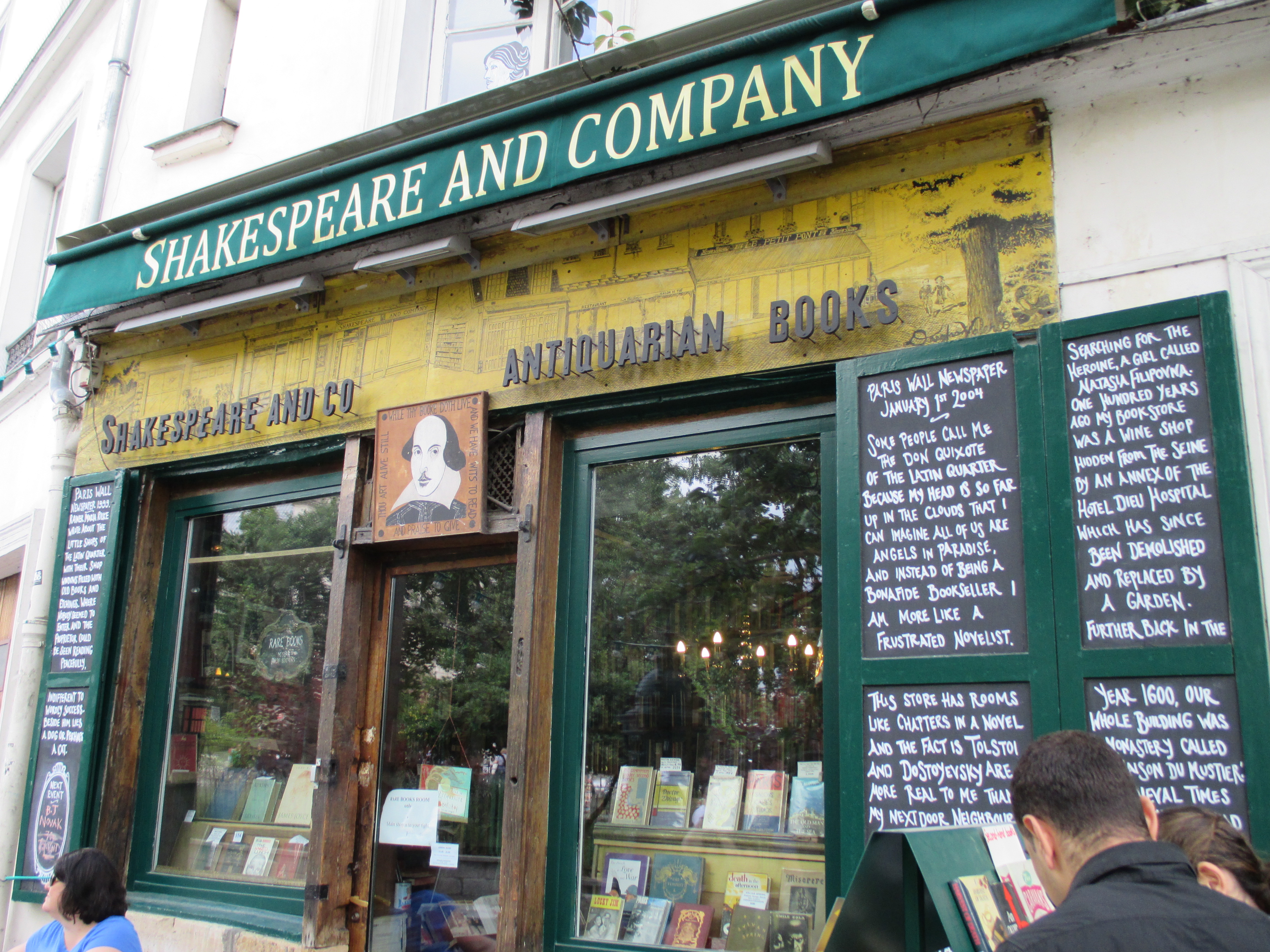
A few days in Paris, Writing . . . Years agoNever forgotten
Instructions for living a life. Pay attention. Be astonished. Tell about it.” ―Mary Oliver
Moving a life forward is an investment in dreams, time, learning, relationship building, and so much more. Moving a writinglife forward is all of that, and I would add it is also, at its best, a life transformed. As Anne Frank so eloquently put it: “I can shake off everything as I write; my sorrows disappear, my courage is reborn.” Writing did not save Anne Frank’s life, but I believe her writing has saved the lives of countless others.
Writers may feel called to the creative life, but that one precious life often must take a back seat to another, more practical life, one that includes a sensible career (aka something with a steady paycheck), perhaps with snatches of scribbling in between the job, chores, and attending to family or societal needs and expectations. The writing life can be a kind of shadow life. It has been for me. Some writers seldom or never mention their craft while engaged in their more acceptable “real” life.
“I love writing. I love the swirl and swing of words as they tangle with human emotions.” —James Michener
It’s hard to explain to nonwriters why a few hours or a whole day spent attending a sporting event or a picnic can create in the writer a kind of panic—a feeling that the time needed to be alone, to read and to write, will never be enough, that time is seeping away, draining their spirit. Spending “free time” in non-creative areas can feel terribly wasted to the writer, while to others, the writer’s avoidance of joining in reeks of selfishness, or delusion. Or perhaps it’s just incomprehensible. Why, people wonder, is writing so important to you? There’s no money in it. And if there is, it’s only available to a few spectacularly talented gifted authors. If you had that gift, surely you’d have been published by now.
The writing life can be an ill-defined series of swells of poetic energy or flow, which is heady and soul lifting. There is nothing quite like those times. Catherine Drinker Bowen says, “For your born writer, nothing is so healing as the realization that he has come upon the right word.” And I have felt that many times. Writing has healed me.
But those transcendent hours or days are for writers seeking an agent or publisher likely to alternate with rejection after rejection after rejection. Writers do much of their writing alone, but if they seek representation and traditional publishing, they must eventually learn the oft times punishing lessons of business.
Soon I’ll be working with a developmental content editor on my completed World War II historical fiction manuscript. I’m excited to be taking this major step forward. It’s been a long journey, and honestly, I’ve loved the myriad lessons and experiences along the way, even the hard ones.
“If a story is in you, it has to come out.” —William Faulkner
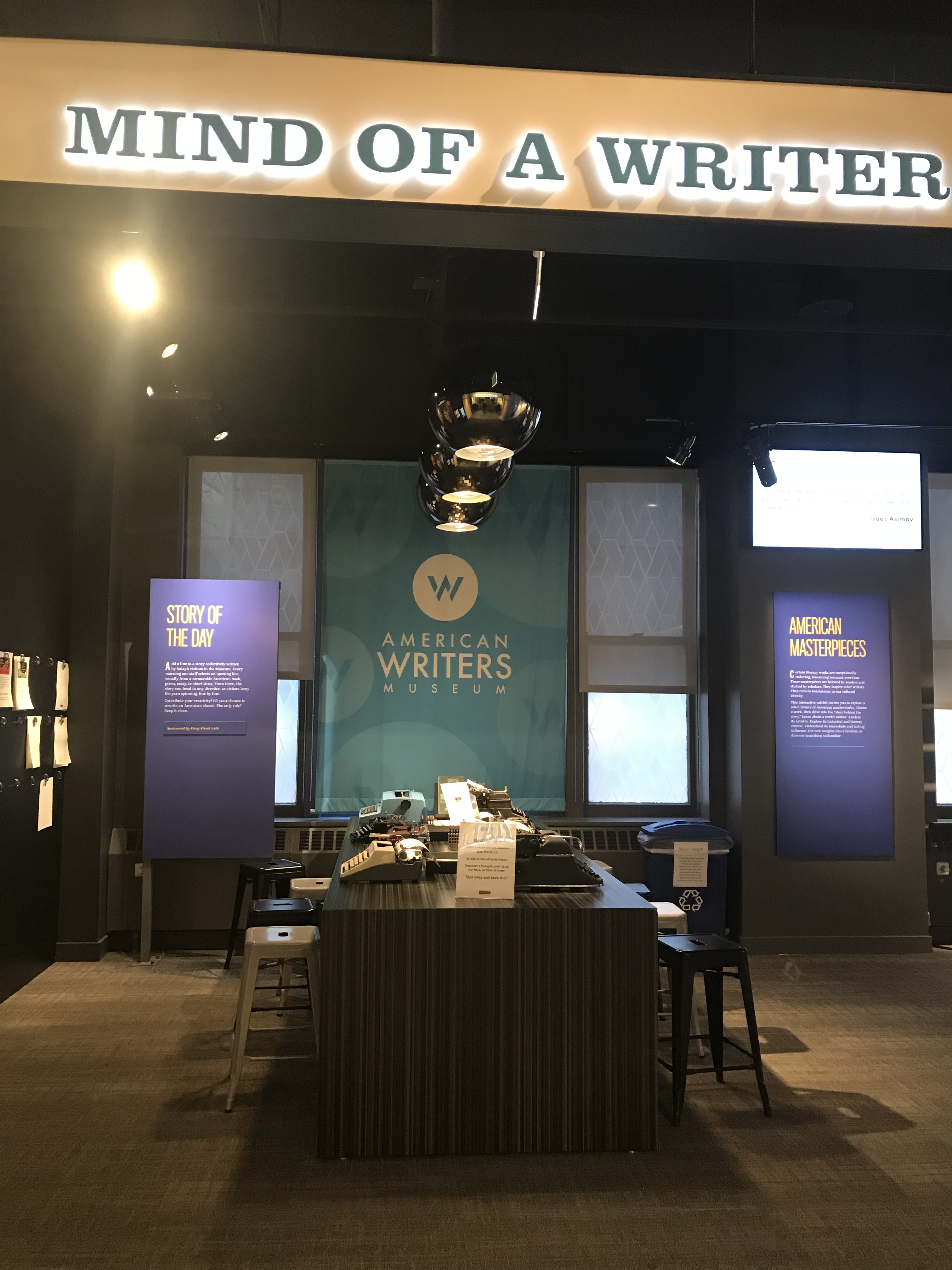
American Writers Museum, Chicago, Illinois
Thank you for visiting! Wishing you a wonderful day, doing exactly what you need and want to do.
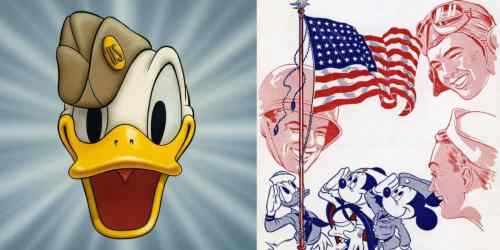
Disney’s Donald Duck, WWII. I can see why Dad chose to imitate this particular character. He was very proud of his Scottish roots!
Some time ago I responded to a fellow blogger, GP, Pacific Paratrooper, a WordPress.com site of Pacific War era information (https://wordpress.com/reader/feeds/4440944/posts/5114548606) about his article, “Disney and WWII,” posted Feb. 12, 2024. The post both tickled my fancy and triggered positive childhood memories, but also, delivered a good dose of regret. I knew so little about my dad’s service, and there was no one living I could ask.
Here is a record of our brief exchange:
Me: My dad was a WWII Marine. I didn’t think it was odd that he could speak to my brother and me in full Donald Duck voice because he just did. He never spoke about why. He did drive us from Wisconsin to California to visit Disneyland when it opened. So much I wish I could ask him now.
GP: May I ask what unit he was in? There might just be a good reason. Disney made training videos, etc. too.
Me: I am ashamed to say that I don’t know his unit.
GP: So many of us have questions we wished we had asked.
As the days passed, I kept going back to GP’s article. I couldn’t reconcile the fact that I had practically no knowledge whatsoever of my father’s service in World War II with who I believed I was: a loving daughter, a lover of history, a teacher of literature, writing, and the Holocaust, a writer of historical fiction, a devoted library worker . . . how was it that I knew so little about my own father’s relationship to such tremendously important world events?
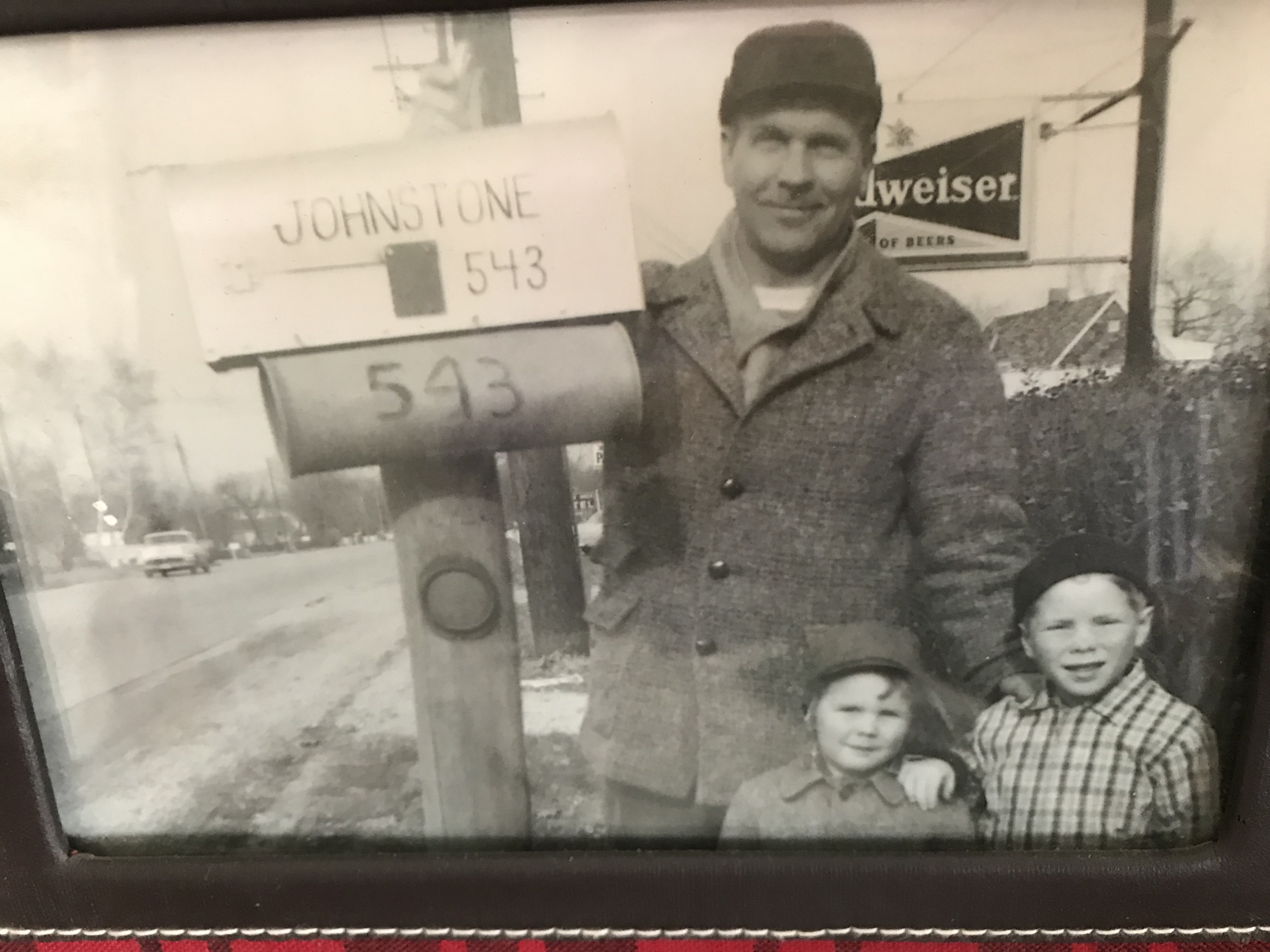
Dad, Lori and Billy. About 1959.We lived next door to a bowling alley, but Lake Michigan was in our backyard!
An online search informed me that I could request my father’s United States Marine Corps Separation Documents and Personnel Records from the National Personnel Records Center at the National Archives, www.archives.gov. I did so, and some months later I received a short stack of copied documents dating back to my father’s voluntary enlistment the day after the Pearl Harbor attack.
I did remember that. It was one of the few stories Dad repeatedly told my brother and me, that he had waited in a line two blocks long in his hometown of Chicago, Illinois to join the Marines the day after Pearl Harbor. It painted a picture of patriotism that stayed with me. I have heard myself repeat it many times throughout my life. My dad, the story revealed, was one of the true heroes of The Greatest Generation.
Here is the rest of the story, as much as I was able to glean from the archives:
Pearl Harbor Attack. World War II Facts.org
When Pearl Harbor was attacked (December 7, 1941), William Harold Johnstone was 21 ½ years old. He had turned 21 on his Flag Day birthday, June 14, 1941. He began active duty on January 5, 1942. He was a high school graduate, and he had completed one year of college. His stated major was Pre Med. Qualified sports listed were track, football, basketball, and swimming. It was also noted that he sang in the church choir. He worked at Montgomery and Ward Co. as a silk screen printer.
I do remember my mom telling me Dad had wanted to be a doctor but that after his war injuries he had never gone back to college. I know he was always interested in medicine. Also, I remember a story about how he swam out and back to a pier or perhaps a buoy some distance off the shore of Lake Michigan and back as a teen, which I gather was somewhat of a feat / badge of honor. Also, he mentioned that at one time he had the nickname “Johnny Rock” — perhaps an homage to both his last name (Johnstone) and his physical fitness. His record shows he was 5 foot, 8 inches tall and he weighed 136 pounds. Not a big man, but strong.
Dad’s father, an immigrant from Scotland, had died when Dad was only four-years-old, so he was raised by his mother, Lorene, and her sister, Mary, along with his older brother, Donald. Tragically, Donald died at age twelve. It was then, my dad told me that he knew he had to give up childish games and work to help his mother and his aunt.
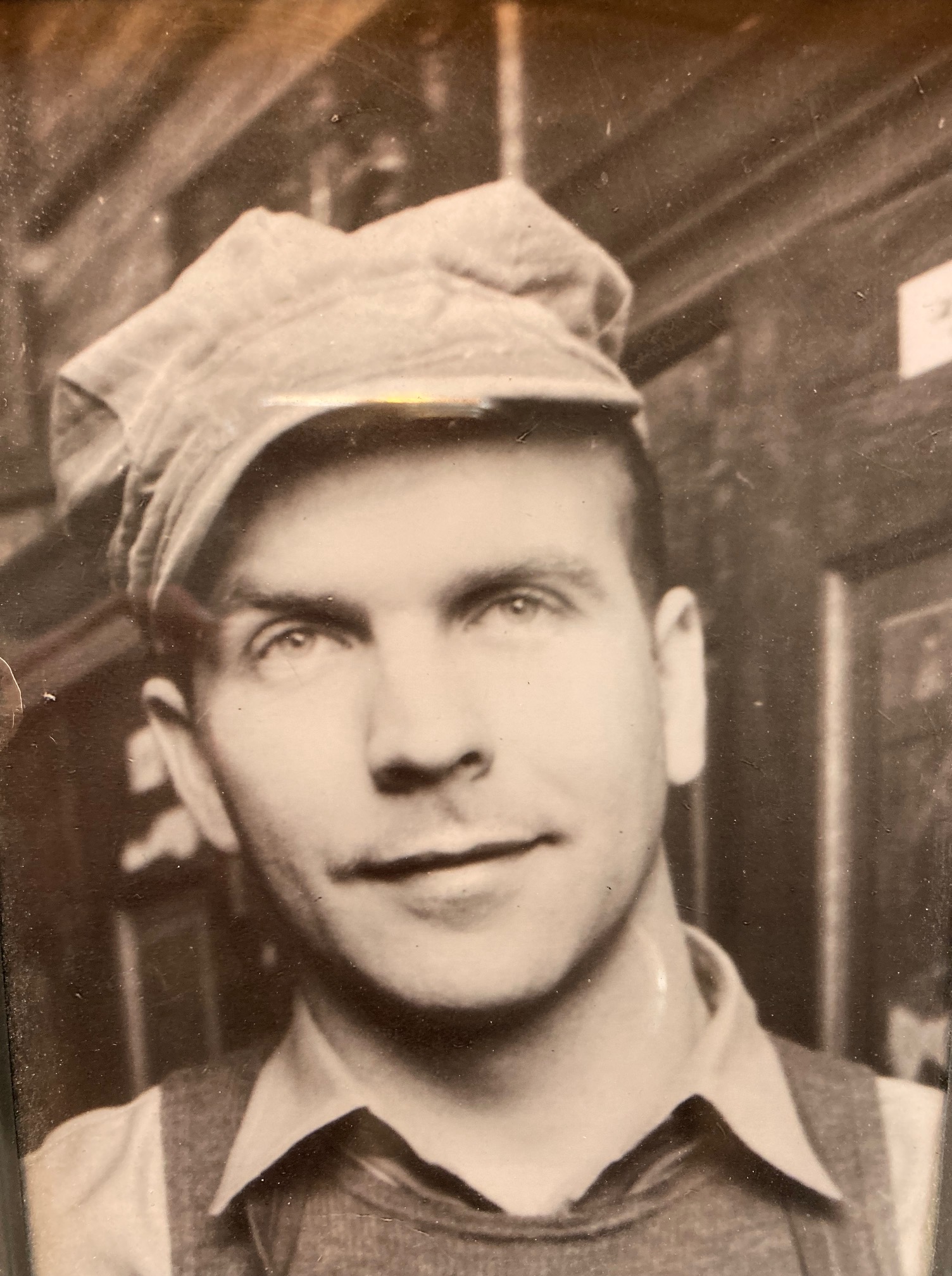
This then, is a portrait of the twenty-one-year-old man who entered the military.
My Handsome Dad
Dad’s original principle military duty early on was Surveyor 227 Rank Private First Class. USMC, 19th Marines Engineer, 3rd Marine Division Fleet Marine Force, Camp Elliott, San Diego, CA.
Later I see him listed as Private 1st Class, 339815, “I” Company, Third Battalion, 22nd Marines, Sixth Marine Division.
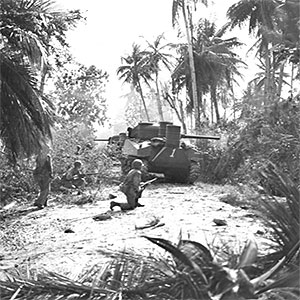
After his initial training, it seems Dad shipped out. The reports are difficult to decipher, but they contain notes of his being in Pearl Harbor, Hawaii; Auckland, New Zealand; Guam, Marianas Islands; Guadalcanal Island, Solomon Group; and Okinawa, Ryukyu Islands, Japan. The only detailed reports refer to Guam and Okinawa.
Guam in World War II, National Park Service
Here is Guam:
From James Forrestal, The Secretary of the Navy, Washington
The Secretary of the Navy takes pleasure in commending the First Provisional Marine Brigade for service as follows:
“For outstanding heroism in action against enemy Japanese forces, during the invasion of Guam, Marianas Islands, from July 21 to August 10, 1944. Functioning as a combat unit for the first time, the First Provisional Marine Brigade forced a landing against strong hostile defenses and well camouflaged positions, steadily advancing inland under the relentless fury of the enemy’s heavy artillery, mortar and small arms fire to secure a firm beachhead by nightfall.
Executing a difficult turning movement to the north, this daring and courageous unit fought its way ahead yard by yard through mangrove swamps, dense jungles and over cliffs and, although terrifically reduced in strength under the enemy’s fanatical counterattacks, hunted the Japanese in caves, pillboxes and foxholes and exterminated them.
By their individual acts of gallantry and their indomitable fighting teamwork throughout this bitter and costly struggle, the men of the First provisional Marine Brigade aided immeasurably in the restoration of Guam to our sovereignty.”
All personnel serving the First Provisional Marine Brigade, comprised of: Headquarters Company; Brigade Signal Company; Brigade military Police Company; 4th Marines, Reinforced; 22nd Marines, Reinforced; Naval Construction Battalion Maintenance Unit 515, and 4th Platoon, 2nd Marine Ammunition Company, during the above mentioned period are hereby authorized to wear the NAVY UNIT COMMENDATION Ribbon.
My dad never described any of these experiences to me, and I don’t remember ever seeing that Commendation Ribbon. I hope he was able to talk about it with someone, but I do not know if that was the case. It grieves me.
On Okinawa:
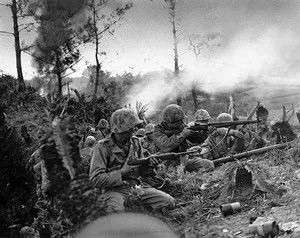
The next specific report in the records begins with a Report of Combat Casualties, which states that William H. Johnstone of the Twenty Second Marines, Sixth Marine Division was Wounded in Action on May 12, 1945 on the island of Okinawa, Ryukyu Islands. Recorded on 13 May 1945. Diagnosis: Wound Fragment Face. Prognosis: Serious.
On 18 May 1945, U.S. Fleet Hospital No. 111 reports William H. Johnstone, Wounds, Multiple. Wounded in action against an organized enemy. Shell struck near patient causing injury.
A U.S. Fleet Hospital letter to my grandmother, written July 1, 1945 reports Dad’s condition as good, and states that he will be returned to active duty in the near future, so it looks like he was hospitalized for approximately a month and a half.
The record states:
In the name of the President of the United States, and by direction of the Commander in Chief, U.S. Pacific Fleet, the Purple Heart is awarded by the Medical Officer in Command, U.S. Fleet Hospital Number One Hundred and Eleven to: William H. Johnstone, Private 1st Class, USMC for wounds received in action against an enemy of the United States on 14 May 1945.
The battle of Okinawa “was one of the bloodiest in the Pacific War, claiming the lives of more than 12,000 Americans and 100,000 Japanese, including the commanding generals on both sides. In addition, at least 100,000 civilians were either killed in combat or were ordered to commit suicide by the Japanese military (Battle of Okinawa | Map, Combatants, Facts, Casualties, & Outcome | Britannica).
Battle of Okinawa, Brittanica
I do remember seeing the Purple Heart. My father gave it to my brother. Unfortunately, it was lost during my brother’s divorce, and it was never returned to the family.
I would like to thank GP and his Pacific Paratrooper WordPress blog for getting me started on this mission of discovery. Without his article on Disney in the Military and my memories of a loving father amusing my brother and me with an array of his silly Donald Duck performances, I doubt that I would have been able to share this information with my children and grandchildren. So, thank you, GP!
Something I don’t write about much is my writing background. And of course there’s a reason for that. I have spent a significant amount of time, effort, and money over a period of many years on writing, and though I don’t consider any of that effort to be wasted, I do think sometimes, sometimes when the shadows fall a little too dark, a little too thick, that I should have done more with it, this writing thing, by now. That it should have gone somewhere. Perhaps I’m even a bit embarrassed to admit that with a BA in English and an MFA in creative writing, and years of study and teaching under my belt, I still haven’t published a novel.
Have I written a novel? Oh, yes. I wrote my first novel three decades ago. I was teaching English and became active in the National Writing Project, a fantastic program for teachers that encourages us to become writers, ourselves. I wrote a contemporary novel during that time but never attempted to have it published. It was my learning novel, the one that I would never throw away, but also, the one that wouldn’t be good enough to publish. Don’t ask me exactly how I came to this conclusion. I think I read an awful lot of books and articles about writing, and this was my take on first novels. They were like the first pancake, or the first kiss. You just had to do it and get it out of the way. The payoff would be better pancakes and better kisses later. Fluffier, more evenly browned, delicious. Or maybe my own writing just embarrassed me so much that I couldn’t even think of approaching anyone with it. So, I printed it out and boxed it away.
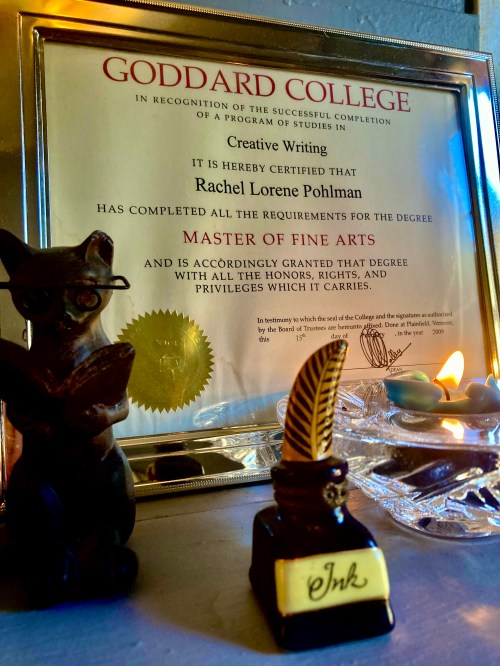
The itch to learn more and to focus more on writing took me to Goddard College next. I continued teaching and worked on my master’s from 2007-2009. During this exciting period, I wrote constantly, including many formal papers for my instructors and my thesis, which was a young adult historical fiction novel about a Catholic Polish teen and his Jewish neighbors during World War II. This one, I thought, I would try to get published. I just didn’t hurry it.
I attended Goddard West in Port Townsend, WA. I have never been to the original campus in Vermont, which has sadly, closed, but I still hope to visit there someday.
After the MFA, I focused on researching agents and publishers and writing queries. Admittedly, I didn’t try very hard. It was excruciating for me to put myself out there—my writing out there—which to me, amounted to putting my inexperience and inadequacy on full display, a neon sign of not-good-enough, flashy and annoying, just begging someone far more hard-working and talented than myself to squash it.
Time went by and I wrote with friends for fun, and to learn more. Shout out to you, Alicia, Lynn, Mike, Maria Elena, and of course all of my amazing students! I thought maybe I needed to put more time between me and my second novel. I started blogging. I was still teaching.
But then I found myself seriously ill with a rare form of cancer, and the world stopped spinning. I lost track of days, weeks. My brother was also ill and had come to live with us. My surgeries were successful. But I felt unwell. Months of chemo took a toll. And my brother. My beautiful brother, my only sibling, died.
I read that the average life span for appendiceal cancer was seven years, and yes, I also read that was not to be taken to mean that I would die in seven years—there were so many factors involved, and it was just an average. Many people died sooner. Others lived for twenty years or more. Blah, blah, blah, I thought. I have seven years.
With my husband’s blessing, I cashed in a small savings account and took a short trip to London and Paris (my one and only trip outside the U.S.), and it was wonderful, and I knew I wanted to write. My writing vision could not have been more clear. I came home and worked on a new novel.
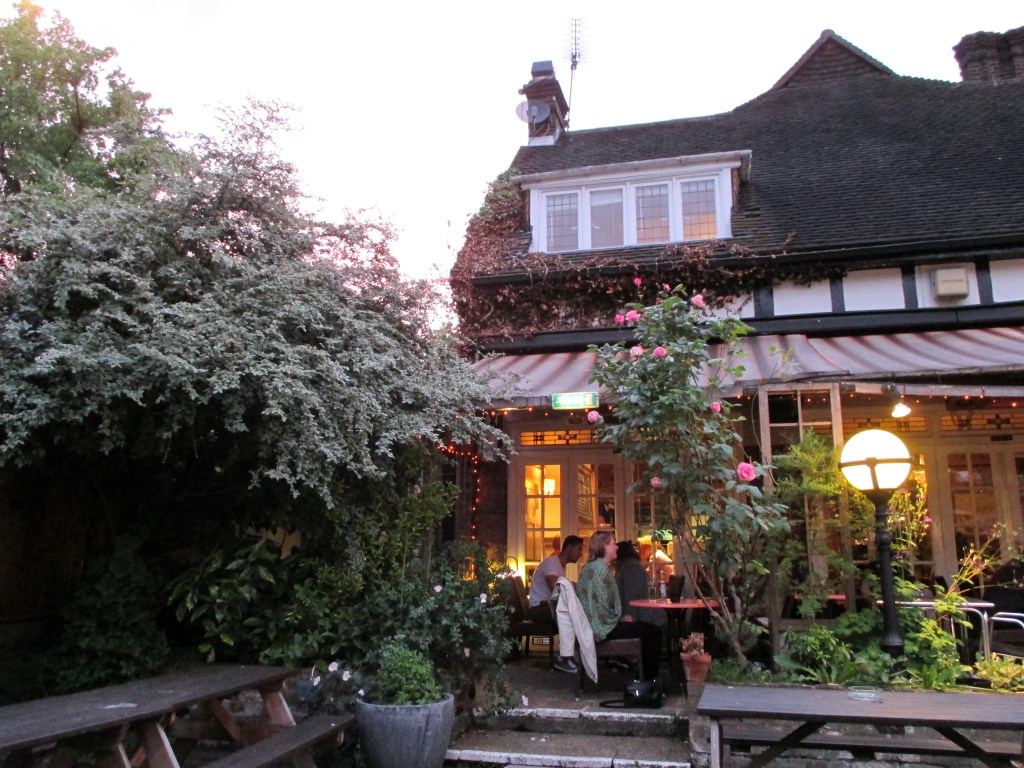
East Finchley, Outside London.
A Beautiful Place to Write.
I taught for a couple more years. Other than my family, my teaching career was what I was most proud of and committed to. Still, I felt my energy shifting. I expected an early death. I imagined myself too weak to be the kind of teacher I had always aspired to be, which was the Robin Williams as John Keating kind of teacher from Dead Poet’s Society. That was who I should be, but instead, I felt—I believed, I was tired, in failing health, more Virginia Poe dying slowly of tuberculous while Edgar became ever more prolific than John Keating taking on the entire world of poetry and elevating young minds and spirits. I saw myself settling into an early writing retirement where my husband would continue to work, but I would just be . . . . the quiet writer in residence.
Robin William as the victorious Mr. Keating
The sadly beautiful Mrs. E. A. Poe
And so, I finished my third book. It is not published.
I found I missed gainful employment and have steadily worked part-time since my early retirement, teaching and library work mostly. I am fighting my hermit-like tendencies, and I’m enjoying getting more involved in actively reading and responding to my fellow writers online, as well as the few writers I know personally. This is a joy and a responsibility. I believe we must support each other, and I am so in awe of all of you! I just finished reading a fellow Goddard graduate’s Sci-Fi thriller, The Regolith Temple, yesterday, and was blown away! Roxana Arama, I will be writing a review for your excellent book very soon!
I am still waiting to hear back from an agent who requested my full manuscript many months ago. I’m considering next steps.
I’m not dead. I stopped going in for cancer scans several years ago. I can’t afford them, and anyway, I’m quite spectacularly healthy. Weirdly! So maybe the seven years thing was really just about itches and actually had nothing to do with my diagnosis. Whatever the reason, I’m grateful, and I’m still in love with this beautiful planet. And pancakes and kisses.
I’m walking every day and working on another novel.
Silly me. I had this idea to write a WWII-era literary fiction novel a while back. Quite a while back.
I spent a lot of time researching in between writing scenes. I felt I had a decent grasp on the time period; my dad was a WWII marine—I grew up waking to The Marine Corps Hymn–and though I majored in English, not history, I spent a good deal of time learning about and teaching the Holocaust to my eighth-grade classes when I taught The Diary of Anne Frank. I even wrote a YA novel about a Polish boy falling in love in war-torn Poland for my Master’s thesis in creative writing.
I’d just need to check a few dates here and there, maybe read a few more books and immerse myself in the movies and music of the 1940s, and presto! I’d be good.
Not so true.
What is true is that old saying about “the more you learn, the more you realize how much you don’t know.” Today’s epiphany: Go Deeper. I stumbled into going deeper today almost by accident. I was looking up a few Roosevelt quotes for a scene in my manuscript where my protagonist listens to the president on the radio. Just a few lines, you know, to add realism and texture to the scene.
GO DEEPER
And I find myself, hours later, too torn up to write the scene. I’ll write it tomorrow, or maybe the next day. You see, I found recordings of Franklin D. Roosevelt speaking to the American public. I listened to them. Then I found recordings of the broadcasts made by the journalists who had followed him throughout his long presidency talking about him on the day of his death.
These recordings are priceless. You will need Kleenex. And maybe a dog. Or a loved one nearby. Luckily, my protagonist has a hankie, a dog, and a brother.
(Not my photo) Silly me? Yes. But also grateful me.
Welcome to a space for all moms. This is a platform where I write my experiences as a mom in her primes—sharing real-life stories, lessons learned, and the ups and downs of motherhood. My goal is to inspire, support, and connect with fellow moms who are also embracing the journey of raising a family while growing as women.













 GO DEEPER
















 LakeArrowheadLadyWriter