“The strongest oak of the forest is not the one that is protected from the storm and hidden from the sun.It’s the one that stands in the open where it is compelled to struggle for its existence against the winds and rains and the scorching sun.” – Napoleon Hill
Hello, Reader and Writer Friends! I hope this post finds you well and blessed with the energy, time, and resources you need and deserve. I am grateful to you and wish you joy. The past few weeks have brought both expected and unexpected news, tasks, challenges, joys, and sorrows to my little corner of the planet, and I suspect they may have to yours also.
Changes of season, the holidays, national and world events, community and family celebrations, work, play, plans, and the shadow of illness and even death for some have been on the hearts and minds of many.
This week in my little town we’ve lost a young woman to suicide. The tragic and violent event has left many of us in shock, and the pain is palpable. And yet, standing right beside that horror, we also have grace in the shape of a group of dear people who planned and cooked and decorated our community center, and fed everyone in town who wished to come. And we had the Christmas tree lighting in the park, followed by fireworks. And we have a live nativity on Main Street coming in a few days. And I’m going to Disneyland with my grandkids next week. And yet, a friend’s cat died and one of our own adopted cats disappeared (you see how the sadness creeps back in). And yet, I got a surprisingly good medical report from my doctor. And in the netherworld of being a writer, I began another round of manuscript submissions today, sending out queries to six publishers.
The light shifts, the wind blows.
We manage as best we can, remembering that the strongest oak
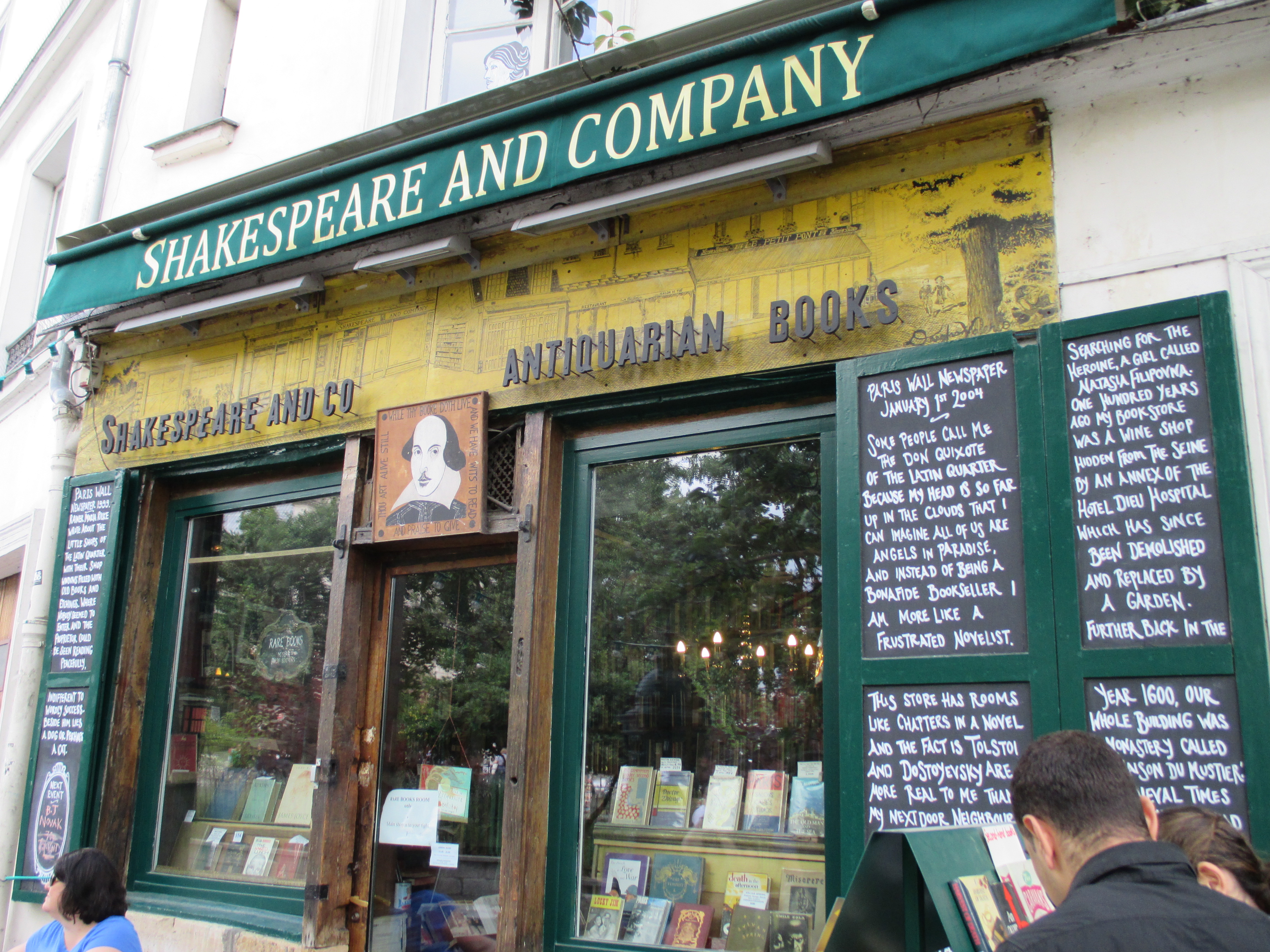
A few days in Paris, Writing . . . Years agoNever forgotten
Instructions for living a life. Pay attention. Be astonished. Tell about it.” ―Mary Oliver
Moving a life forward is an investment in dreams, time, learning, relationship building, and so much more. Moving a writinglife forward is all of that, and I would add it is also, at its best, a life transformed. As Anne Frank so eloquently put it: “I can shake off everything as I write; my sorrows disappear, my courage is reborn.” Writing did not save Anne Frank’s life, but I believe her writing has saved the lives of countless others.
Writers may feel called to the creative life, but that one precious life often must take a back seat to another, more practical life, one that includes a sensible career (aka something with a steady paycheck), perhaps with snatches of scribbling in between the job, chores, and attending to family or societal needs and expectations. The writing life can be a kind of shadow life. It has been for me. Some writers seldom or never mention their craft while engaged in their more acceptable “real” life.
“I love writing. I love the swirl and swing of words as they tangle with human emotions.” —James Michener
It’s hard to explain to nonwriters why a few hours or a whole day spent attending a sporting event or a picnic can create in the writer a kind of panic—a feeling that the time needed to be alone, to read and to write, will never be enough, that time is seeping away, draining their spirit. Spending “free time” in non-creative areas can feel terribly wasted to the writer, while to others, the writer’s avoidance of joining in reeks of selfishness, or delusion. Or perhaps it’s just incomprehensible. Why, people wonder, is writing so important to you? There’s no money in it. And if there is, it’s only available to a few spectacularly talented gifted authors. If you had that gift, surely you’d have been published by now.
The writing life can be an ill-defined series of swells of poetic energy or flow, which is heady and soul lifting. There is nothing quite like those times. Catherine Drinker Bowen says, “For your born writer, nothing is so healing as the realization that he has come upon the right word.” And I have felt that many times. Writing has healed me.
But those transcendent hours or days are for writers seeking an agent or publisher likely to alternate with rejection after rejection after rejection. Writers do much of their writing alone, but if they seek representation and traditional publishing, they must eventually learn the oft times punishing lessons of business.
Soon I’ll be working with a developmental content editor on my completed World War II historical fiction manuscript. I’m excited to be taking this major step forward. It’s been a long journey, and honestly, I’ve loved the myriad lessons and experiences along the way, even the hard ones.
“If a story is in you, it has to come out.” —William Faulkner
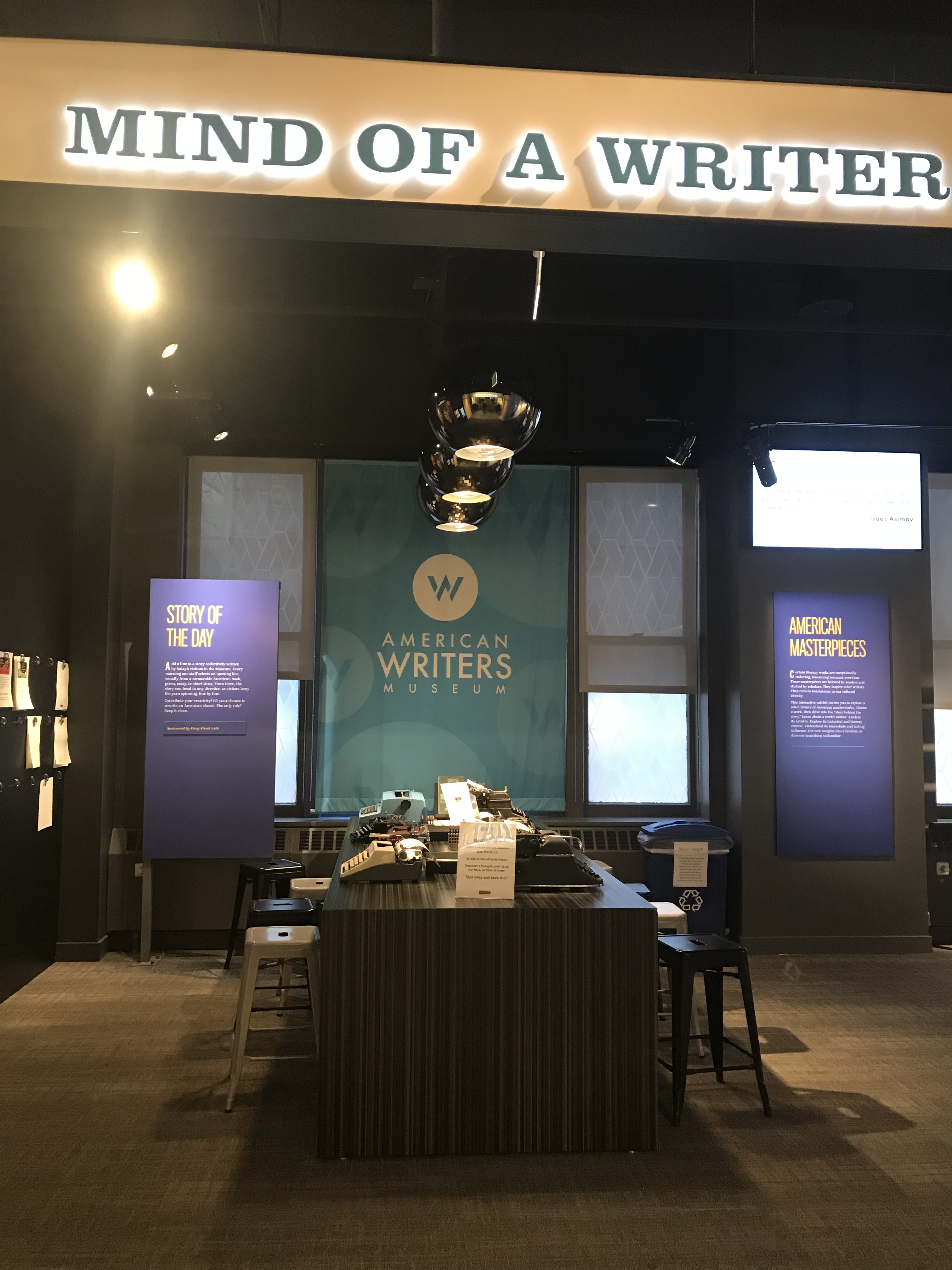
American Writers Museum, Chicago, Illinois
Thank you for visiting! Wishing you a wonderful day, doing exactly what you need and want to do.
Three Months ago, at the beginning of summer, I received an agent request for the full manuscript of my historical fiction novel, A Fine Suddenness. I am told that 3 months is about the time I might begin to expect to hear back from the agent, and so today I am checking my email even more regularly than usual, and I am thinking about the origins of the manuscript.
My Journal
It began in May of 2011 with the glimmer of a character suggested by a signature of ownership in an old red leather-bound book a friend gifted me: The Conqueror, by Gertrude Atherton. My friend Lynn is a librarian, a teacher of history, a seller of used books, and a maker of reclaimed book journals. You can check out her business at brownbagbooks.biz. This book was one of her rescued book journals. The cover was intact, rebound into a smallish wire bound blank journal.
The original inscription inside was simple: Mary Miller 1903. Who was this lady, I wondered? She must have loved her books, I thought, to have signed her name and the year of acquisition on the inside cover, a habit I also have. I usually add the place I acquired the book also, but Mary Miller did not do so. A quick search told me that Gertrude Atherton was a San Francisco author, and The Conqueror had been published in 1902, was about Alexander Hamilton, and was widely acclaimed.
I immediately began writing in Mary’s book-turned-journal, taking on an imagined persona of the unknown lady. It began: “May 8, 1903. Lake Arrowhead, California. I am proposing to tell you a story which I am quite sure you will doubt . . .” Rather quickly it took on the overtones of a ghost story, and I named Mary’s father, described his field of study and stated that her mother had died of influenza when she was a child. All of that came to me very spontaneously. Also, Mary’s husband was dead, but she had a vision of him. So, A Fine Suddenness began as a ghost story. And in some ways perhaps that is what it still is, but not in the way it began.
Eventually, the real Mary Miller, whoever that lady was, disappeared from my mind and became instead a woman who lived in Lake Arrowhead, California during the 1940s—70 years before I read her inscription rather than the actual 108 years. Once I placed Mary in a new time and most certainly a different place than the real Mary had lived, I began to conjure what life was like during World War II on the mountain we shared, not in time, but in place.
All of that pondering gradually grew into a scene of Mary in her yard among her roses, the trees towering in the background. And so, she became real to me, and I wrote her story. She is completely fictional, other than the sense I got from seeing her name, and from the beautiful red and gold embossed cover of a book.
She, I hope, would make her namesake, the real Mary Miller, proud.
Photo generated using AI (which I never expected to use…a story for another day)
“We grow, regress, get stuck, fragment, hide, and find ourselves over and over again.” – Audrey Stephenson, Psychotherapist.
Learn!
Dear Ones,
Today’s readings and my own writing are themselves fragments struggling to find growth. I began by looking at my query status on Query Tracker. Added another rejection to the list. Okay. Next I wrote a short chapter in a new manuscript, one that I do not love in the way that I love the finished one I haven’t found an agent for. It’s hard to fall in love with a new manuscript sometimes. For me, anyway. I am sentimental, perhaps.
To escape, I ventured outside to the laundry room, which is separated from the main house by only a few feet, thinking I would do some productive laundry readying for my work week which begins tomorrow, Tuesday, which is quite wonderful right?–not on Monday, dreaded Monday–but on Tuesday, which I have to be grateful for. And I am. So, a little laundry, and then back to writing, I thought. Until I spotted the giant bug on the laundry room door. Yes, the Mormon crickets are still upon us here. Clearly a sign not to do the laundry.
Then I wrote in long hand–natural left-handed cursive usually brings me back to myself. Maybe even always when I spend enough time there. Today’s topic in my guided journal was Soul Searching: The quest to unlock one’s true self is an ongoing process, because we’re changing all the time (Breathe Journal, c2023. Guild of Master craftsman Publiscations Ltd. http://www.breathemagazine.co.uk. 72-3). Here are two of the prompts given in the journal and my responses:
*Observe every aspect of your surroundings–from the bed you sleep in, to the transport you use. Things around you can shine a light on how you interact with your environment and indicate what you believe about yourself. What do you notice?
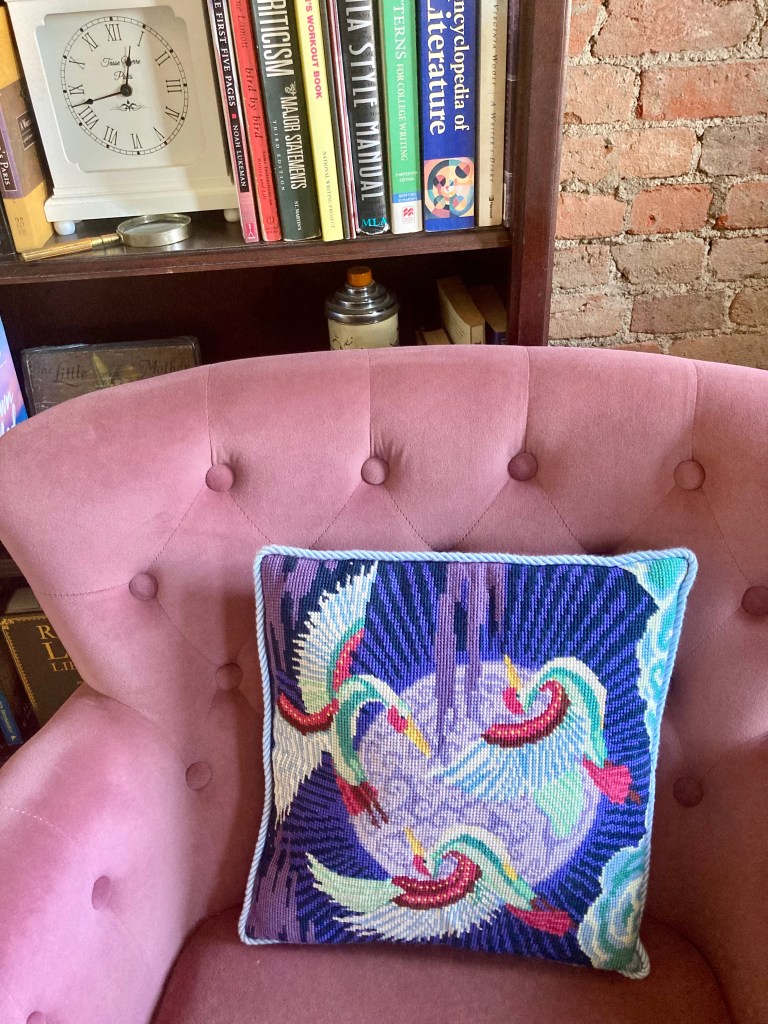
Sue’s pillow
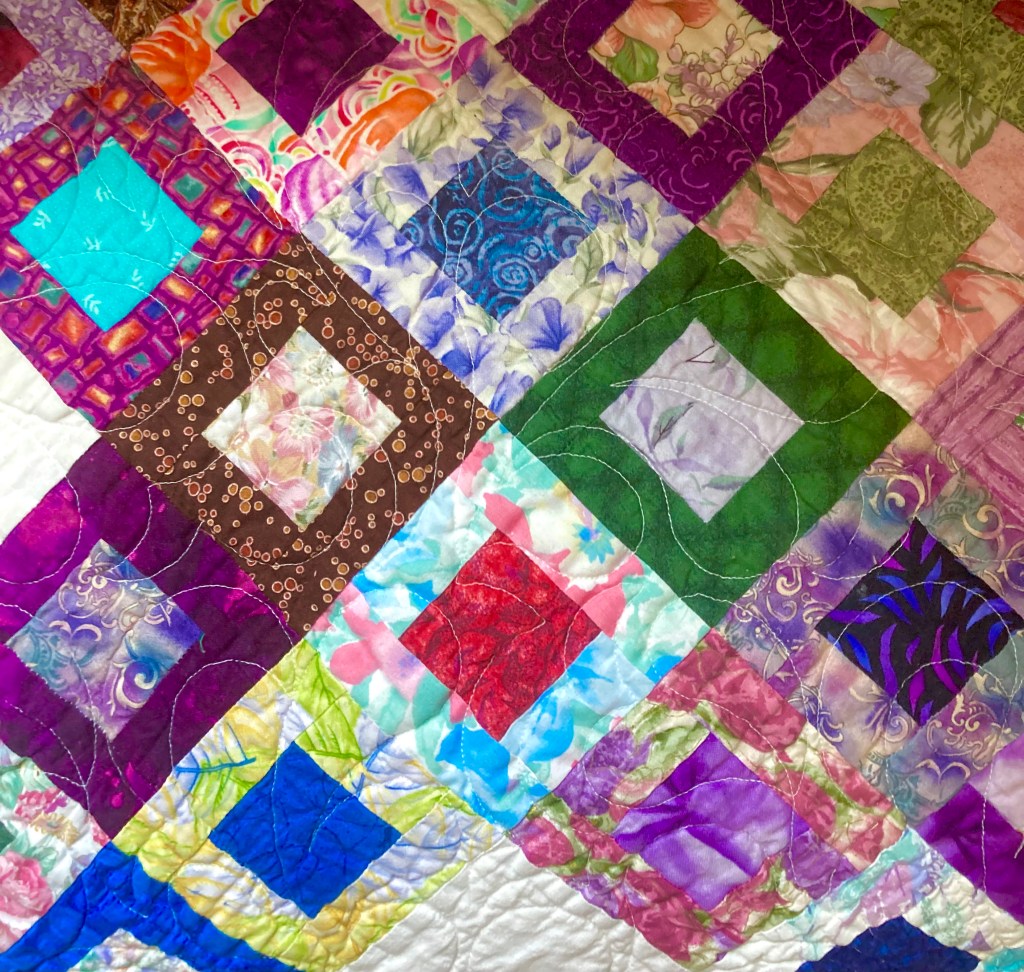
Me: My bed must be clean and bright, soft and matchy-matchy- and made! Looking around me: Polished wood. Sunlight. Windows. Plants. Crystal. Books. Lois’s quilt. Photos. Art. Candles. Sue’s pillow. Baskets. Listening to music…
Lois’s quilt
(After I finished, I noticed I didn’t observe “the transport” I use. I could take a picture of my feet, which is what I try to use the most, but we don’t have a mani-pedi salon in Austin. Then I thought of my dear Jeep, Joni Blue. She’s not new, but she’s paid for, and she’s taken us to many beautiful places. She’s currently outside with the crickets, so I will not be going outside to take her picture.)
2. *Breathe. You will be astonished by how often you hold your breath. Just notice. Drop your shoulders, stretch your neck, allow your abdomen to soften. Breathe. Notice what comes up as you come back to yourself and jot down any thoughts.
Me: This is one of the best gifts I learned way back in Lamaze childbirth class and years later in yoga–the magic loosening and lightening of the body and mind through the breath. Surpisingly, I still forget to practice it, often until I am panicked. I need reminders.
Time to breathe
For today, perhaps this enough. Two hours of dedicated writing, reading, journaling, and blogging. If it doesn’t feel good enough, perhaps it’s because “we grow, regress, get stuck, fragment, hide, and find ourselves over and over again,” and that’s all part of the progress.
Wishing you growth and rest, a room of your own, and the company of good souls. I’d love to hear what you’re working on, or not working on, or dreaming about. Thank you for reading, following, and commenting on my blog. Fondly, Lori
Thoughts on Writing After a Year of Sending out Queries for my WWII-Era Homefront Historical Fiction Novel Set in Lake Arrowhead, CA… and A Whole Lots of Maybes
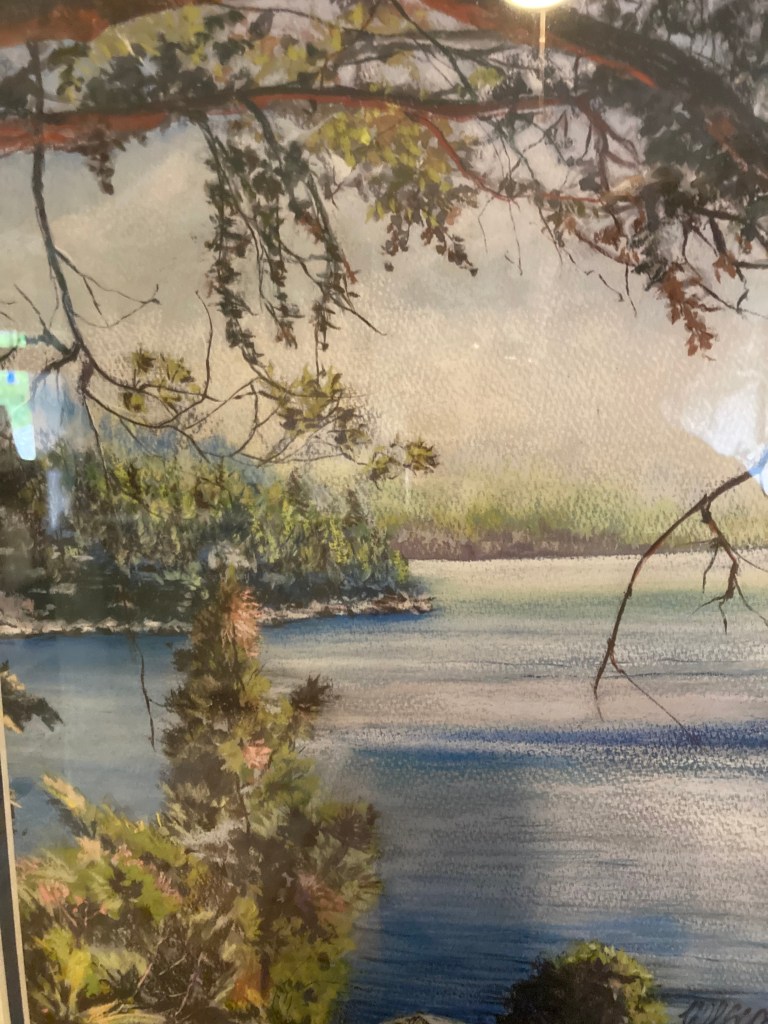
Photo from my collection of prints of paintings by Lake Arrowhead artist and friend, Dave Wescott.
I am discouraged. It’s been a long haul, and I’m tired. I wonder if it’s too late—if I’m even a capable writer. Maybe I am a past-prime-nothing-special-mainstream kind of a writer with nothing new to offer in a world crowded with bright-fresh-creatives churning out compelling new stories that I am not equipped to write.
Maybe, more accurately, I wouldn’t write those compelling new stories even if I could, because I truly don’t want to. But that doesn’t mean I never will. Maybe I’m going to want to! With creating, one never knows. Meanwhile, what I write these days is what I feel the magical desire to create. If I were being paid to write, or I were writing an assignment for a course I was taking, it would be different. At least a little bit different, but still really fulfilling. And I have done that successfully.
So I think that means that stubbornness is not the problem. But who among us knows well their own foibles? A self-examined life is not worth living perhaps, but I am not always sure my self-examinations are thorough or astute enough. That is one of the many reasons I need you, my friends!
Writing from my heart for no other reason than I want to create something of my own is a very different task than an assignment or a job, and that is what I’ve been at with A Fine Suddenness, and with many earlier projects. This self-appointed task has been with me for most of my life, with innumerable hours invested outside of my “real” life, most of them happily. Those hours have stretched into a lifetime of practice.
Another beautiful painting of Lake Arrowhead by my dear friend, Dave Wescott.
Pretty great setting for a novel, don’t you think?
I’ve invested a good amount of my limited income into writing as well. There have been many journals, computers, printers, reams and reams of paper, hundreds of pens (and oh how I love those pink, yellow, green, and blue highlighters!) and yes, the multitude of books I’ve purchased on writing, and the subscriptions to writing magazines. Then there’s the cost of attending various writing events—retreats, conferences, special courses, all of them fabulous and expensive.
The MFA in Creative Writing I earned in 2009 was a big investment that took me years to pay off. I do not regret it. Graduate school was an amazing experience. I loved every moment of being part of a group of writers immersed completely in our projects, all of us in over our heads, happily drowning in words, study, reflection, discussion, research, and ideas, all filled with the satisfying knowledge that no one among us questioned the importance of what we were doing. It often feels as though the rest of the world could care less about poets, screenwriters, non-fiction writers, and novelists, but it didn’t feel that way when we were in school together.
Cheers to all of my creative friends–and all creatives everywhere!
Few parents would encourage their children to enter into any of these fields. I’ve had friends who must have temporarily forgotten what my degrees are in, because they openly laugh at their children’s desires to study any of the humanities while in conversation with me. “Imagine,” they say. “What a waste of tuition.” It’s clear what they mean. Those fields don’t make any money.
I understand that money is necessary, and my life would have been easier if I had more, but I also know my soul would have shriveled had I worked in any field that didn’t allow me to at least exist in close proximity to the world of literature and learning and language that teaching and library work gave me.
It was never about money.
Writing has been my passion for a very long time. And I believe it has been worthwhile, even at this moment, seeing how things stand. I have never developed a writing platform. I don’t have much of a following on my blog (which is admittedly not something I have any technical skill in setting up or growing). Despite regularly studying the publishing field, sending out personalized queries to agents who work with my genre, and working, working, working on improving the queries, the summaries, the comp list, my bio… all the while making my manuscript the best it can possibly be, I haven’t secured an agent.
Maybe I should stop trying. Maybe I should write, but just stop trying to find an agent, or a small publishing house that might consider publishing my work. After all, it’s not about the money. I’ve never expected that.
What is money?
Photo courtesy of Pexels Free Images
Holding a beautifully bound copy of my own work, that’s definitely at least part of what I want, since I so value books, but I understand the process of writing and the joy of finding readers who might enjoy reading what I’ve written are what would move me most.
Maybe I should seriously consider self-publishing, even though I do not want to. Maybe it’s the only way, and maybe it wouldn’t humiliate me in a Willy Loman Death of a Salesman kind of way.
I hope you enjoy this fun and helpful article for Poe lovers, Writers, and most especially Writers who Love Poe! The author’s newsletters can be found on the Substack email newsletter platform: “Poe Can Save Your Life, Darkly inspired self-help for writers and other creators.” She is the also the author of the book, Poe for Your Problems: Uncommon Advice from History’s Least Likely Self-Help Guru.
Hello, Readers! I’m putting together my summer reading list, and getting my historical fiction manuscript ready for submission. One part of this process is to read recent books (published within the last few years) that are in some way comparable to mine, so that I can better describe my own manuscript to potential agents, publishers, and booksellers.
Have you read any recently published fiction set during the 1930s or 1940s? Have you read a novel about a war widow, or a strong woman struggling and coming to grips with some other loss? If so, I’d love to hear about it. My manuscript is set in Lake Arrowhead, California, and the place is integral to the plot, so I’m also interested in any fiction that transports the reader to a specific city, town, or region.
If any titles come to mind, I’d greatly appreciate your sharing them here. I welcome any and all suggestions. Many thanks!
Being vegetarian and eating greens and salads out is always a risk, it s hard to be 100% sure all you eat is absolutely safe, so take it twice a year to guarantee your body is free from unwanted organism
The goal of this blog is to create a long list of facts that are important, not trivia, and that are known to be true yet are either disputed by large segments of the public or highly surprising or misunderstood by many.
This blog feature amusing and heartwarming stories about our late Leonberger dog Bronco, as well as other Leonbergers. It also has a lot of information about the Leonberger breed, the history, care, training, Leonberger organizations, etc. I also wrote a Leonberger book, which I am featuring in the sidebar.