Category Archives: poetry

King Copper Book Review

Lauren Scott, King Copper: Our Dog’s Life in Poetry

Lauren Scott’s love of her family’s beautiful chocolate lab, Copper, shines in this sweet little volume of photographs and poems that follow their lives together from adoption day on. In her words, King Copper is “a poetic account of the joy that arises when a lovable chocolate lab walks into your life and changes it forever. And the eventual heartache you feel when he crosses over the rainbow bridge thirteen years later and still too soon.”

What a touching account, and what a testament to the glorious impact our beloved pets have on our lives. If only all dogs—all pets—were as well loved and appreciated as the delightful lab Lauren writes so poetically about, the world would truly be a better place. Brava to Lauren for giving her beloved Copper a tribute worthy of his beauty and goodness! Did it make me cry a bit? Absolutely. But tears shed over the loss of a dear dog are never wrong. There is nothing purer than a dog’s affection and devotion. Copper wasn’t my dog, but I, too, have loved wonderful dogs. Like Lauren and her family, I know our animal companions deserve our deepest affection in return for the many gifts they give us. Part of the price for that gift is the same as it is for anything we open up our hearts to fully—the possibility, even the probability that one day there will be pain and loss.

But as Lauren so aptly says, “We celebrate his life- those soul-searching eyes that connected to us- we were links in a golden chain and now one link is missing, our golden boy- each day tears follow like a shadow- the shadow he was, but smiles gently find their place because he is in our hearts, because joy needs room to simmer.”

You can visit Lauren’s blog at baydreamerwrites.com.

http://lscotthoughts.wordpress.com

46 Comments

Filed under Authors, Books, Commentary, Loss, poetry, Reading

I Am a Writer

Something I don’t write about much is my writing background. And of course there’s a reason for that. I have spent a significant amount of time, effort, and money over a period of many years on writing, and though I don’t consider any of that effort to be wasted, I do think sometimes, sometimes when the shadows fall a little too dark, a little too thick, that I should have done more with it, this writing thing, by now. That it should have gone somewhere. Perhaps I’m even a bit embarrassed to admit that with a BA in English and an MFA in creative writing, and years of study and teaching under my belt, I still haven’t published a novel.

Have I written a novel? Oh, yes. I wrote my first novel three decades ago. I was teaching English and became active in the National Writing Project, a fantastic program for teachers that encourages us to become writers, ourselves. I wrote a contemporary novel during that time but never attempted to have it published. It was my learning novel, the one that I would never throw away, but also, the one that wouldn’t be good enough to publish. Don’t ask me exactly how I came to this conclusion. I think I read an awful lot of books and articles about writing, and this was my take on first novels. They were like the first pancake, or the first kiss. You just had to do it and get it out of the way. The payoff would be better pancakes and better kisses later. Fluffier, more evenly browned, delicious. Or maybe my own writing just embarrassed me so much that I couldn’t even think of approaching anyone with it. So, I printed it out and boxed it away.

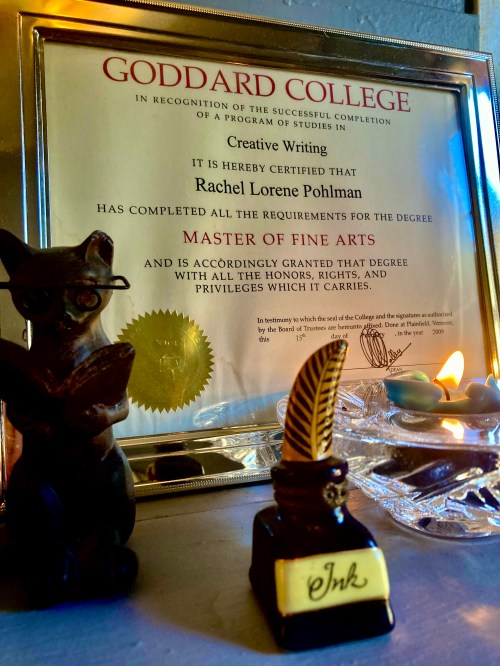
The itch to learn more and to focus more on writing took me to Goddard College next. I continued teaching and worked on my master’s from 2007-2009. During this exciting period, I wrote constantly, including many formal papers for my instructors and my thesis, which was a young adult historical fiction novel about a Catholic Polish teen and his Jewish neighbors during World War II. This one, I thought, I would try to get published. I just didn’t hurry it.

I attended Goddard West in Port Townsend, WA. I have never been to the original campus in Vermont, which has sadly, closed, but I still hope to visit there someday.

After the MFA, I focused on researching agents and publishers and writing queries. Admittedly, I didn’t try very hard. It was excruciating for me to put myself out there—my writing out there—which to me, amounted to putting my inexperience and inadequacy on full display, a neon sign of not-good-enough, flashy and annoying, just begging someone far more hard-working and talented than myself to squash it.

Time went by and I wrote with friends for fun, and to learn more. Shout out to you, Alicia, Lynn, Mike, Maria Elena, and of course all of my amazing students! I thought maybe I needed to put more time between me and my second novel. I started blogging. I was still teaching.

But then I found myself seriously ill with a rare form of cancer, and the world stopped spinning. I lost track of days, weeks. My brother was also ill and had come to live with us. My surgeries were successful. But I felt unwell. Months of chemo took a toll. And my brother. My beautiful brother, my only sibling, died.

I read that the average life span for appendiceal cancer was seven years, and yes, I also read that was not to be taken to mean that I would die in seven years—there were so many factors involved, and it was just an average. Many people died sooner. Others lived for twenty years or more. Blah, blah, blah, I thought. I have seven years.

With my husband’s blessing, I cashed in a small savings account and took a short trip to London and Paris (my one and only trip outside the U.S.), and it was wonderful, and I knew I wanted to write. My writing vision could not have been more clear. I came home and worked on a new novel.
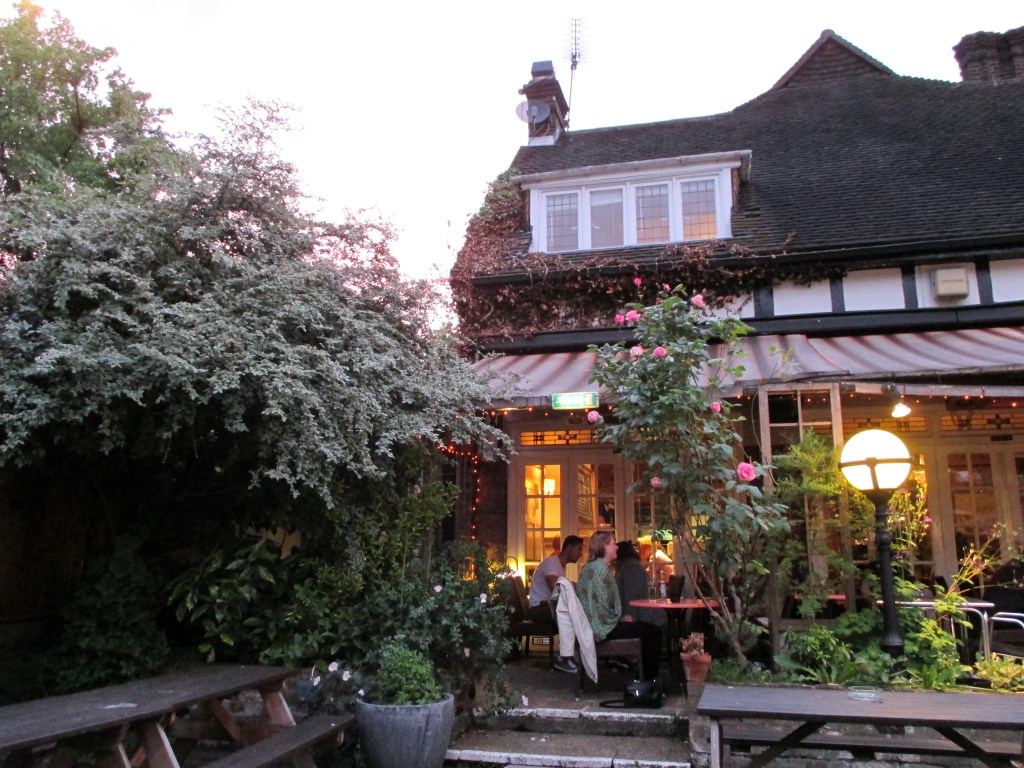
East Finchley, Outside London.

A Beautiful Place to Write.

I taught for a couple more years. Other than my family, my teaching career was what I was most proud of and committed to. Still, I felt my energy shifting. I expected an early death. I imagined myself too weak to be the kind of teacher I had always aspired to be, which was the Robin Williams as John Keating kind of teacher from Dead Poet’s Society. That was who I should be, but instead, I felt—I believed, I was tired, in failing health, more Virginia Poe dying slowly of tuberculous while Edgar became ever more prolific than John Keating taking on the entire world of poetry and elevating young minds and spirits. I saw myself settling into an early writing retirement where my husband would continue to work, but I would just be . . . . the quiet writer in residence.

Robin William as the victorious Mr. Keating

The sadly beautiful Mrs. E. A. Poe

And so, I finished my third book. It is not published.

I found I missed gainful employment and have steadily worked part-time since my early retirement, teaching and library work mostly.  I am fighting my hermit-like tendencies, and I’m enjoying getting more involved in actively reading and responding to my fellow writers online, as well as the few writers I know personally. This is a joy and a responsibility. I believe we must support each other, and I am so in awe of all of you! I just finished reading a fellow Goddard graduate’s Sci-Fi thriller, The Regolith Temple, yesterday, and was blown away! Roxana Arama, I will be writing a review for your excellent book very soon!

I am still waiting to hear back from an agent who requested my full manuscript many months ago. I’m considering next steps.

I’m not dead. I stopped going in for cancer scans several years ago. I can’t afford them, and anyway, I’m quite spectacularly healthy. Weirdly! So maybe the seven years thing was really just about itches and actually had nothing to do with my diagnosis. Whatever the reason, I’m grateful, and I’m still in love with this beautiful planet. And pancakes and kisses.

I’m walking every day and working on another novel.

Trying to say it a little more often.

The simple sentence I’ve never felt worthy of.

I am a writer.

41 Comments

Filed under Cancer, Cancer Journey, HIstorical Fiction, Identity, Literary Agents, London, Memories, Personal History, poetry, Relationship, Research, Teacher, Uncategorized, Voice, Writing, Writing Advice

Polished Maple Tables

An early picture of our old house, before renovation.

One of the most enjoyable writing exercises I’ve done lately comes from a biographical poetry template based on a poem by George Ella Lyon. I came across it on Jeannine Quellette’s brilliant Substack, Writing in the Dark. The exercise is familiar to me in a distant way, as though perhaps I’d done it before but lost it. Or perhaps it suited me perfectly this past week because I have been contemplating writing memoir and fictionalized biography, so it seems as though I always had it—a poem about beginnings, and the echoes still heard, the lessons still being learned.

Thank you, Jeannine Quellette, for sharing the lesson! You can visit Jeannine’s website and read her poem, “From Chickweed to Ash,” here: https://writinginthedark.substack.com/p/from-chickweed-and-ash.

Here is my version:

Polished Maple Tables

I am from polished maple tables

From Pall Malls and Folgers

Green grass, Blue water, the whoosh of wind and wings

Flocks of seagulls

I am from Lilies of the Valley, Bleeding Hearts, Lake Michigan’s endless sand and waves

I’m from World War II, Ramblers, and Divorce

From Rachel and Frederick and William and Lorene

From Rae and Bill

I’m from long car rides and listening to albums on the stereo

From Mr. Wonderful and Stop Crying and What did you learn in school today?

I’m from no church, lost pets, and rented houses.

From a mother who scoffed at religious people

And a father who blamed organized religion

For the world’s woes.

But I’m also from Christmas trees and baking cookies, from bunnies and Easter baskets.

And I’m from the hand-written prayers I found in my father’s bedside table when he died.

I’m from Chicago and Kenosha

From Illinois, Wisconsin, and Minnesota

From Scots called Johnstone, and Swedes called Nelson

From ground beef casseroles, navy bean soup, and sour cream raisin pie

From Great Aunt Mary who broke up with her beau when he jumped into a fountain,

Never to wed, who lived with her sister Lorene’s family and then mine until The Divorce when she

Was sent back to Chicago to an old folk’s home

And Mother was hospitalized

I am from women who sewed and worked in libraries

and who cooked and cleaned other people’s houses.

And from men who sought love and adventure and worked on farms and in factories.

I am from Midwestern barefoot summers and sea glass and wandering the West

Restless and yearning for polished maple tables and a place to call home.

                                                                                                             RLP, 2025

If you would like to write your own “I Am From” poem, here is the template. Use it as a springboard. Jump in and adjust it to suit. I hope the writing brings you joy, or something like joy, which is sometimes as simple as finding a way to express the inexpressible past.

Blessings! And please share your poems in the comments!

Kenosha, Wisconsin

                                                          Template: I Am From

I am from ________________ (specific ordinary item)

From ____________ (product name) and _____________ (product name)

____________ (adjective), ______(adjective), _________ (sensory detail)

I am from _____________ (plant, flowers, natural item)

_______________________________________ (description of above item)

I’m from ______________ (family tradition) and _____________ (family trait)

From ___________ (name of family member) and ______________ (another family member)

I’m from the _______________ (description of family tendency) and ________ (another one)

From ______________ (something you were told as a child) and _________ (another)

I’m from __________________ (representation of religion or lack thereof), __________ (further description)

I’m from ___________________ (place of birth and family ancestry)

_______________________ (a food that represents your family), ___________ (another one)

From the ___________ (specific family story about a specific person and detail).

Dad, Lori, and Billy

Early Days in Kenosha

Thanks for visiting! Wishing you all good things. With Love, Lori

40 Comments

Filed under Family, Personal History, poetry, Relationship, Uncategorized, Voice, Wisconsin, World War II, Writing

Embrace Autumn: October’s Beauty in Nature

Hello, October!

Suddenly the leaves turn red, yellow, and orange; the night temperatures dip into the thirties, and I enjoy sitting in my front yard both in the morning and the early evening. Ahhh . . . those morning coffees and evening wines . . .

The steeple front, right, is on the old Methodist church, now our community center. The steeple across the canyon (you may have to zoom in if the image is too small) is on St. George’s Episcopal church, where I attend. Sunday services have never stopped at St. George’s since the church opened in 1878.

Just a month ago it was much too hot to sit here for any length of time. It is an unusual yard, not yet shaded, one that we created by tearing down an old carport that covered the entire front of our old parsonage for sixty years. This reclaimed space has an incredible view of two one-hundred-plus-year-old church steeples and an impressive hillside on this, the northern end of our section of the Toiyabe Mountains, but no large trees yet. We have planted an oak, a cottonwood, and a blue spruce there, but they are small still.

That evening wine.

Our little town of Austin, Nevada is located in central Nevada’s sparsely-populated, history-rich Lander County in  “. . .the Toiyabe Range, a mountain range in Lander and Nye counties, Nevada, United StatesThe range is included within the Humboldt-Toiyabe National ForestThe highest point in the range is Arc Dome (11,788 feet, 3592 m), an area protected as the Arc Dome WildernessThe Toiyabe Crest Trail runs along the Toiyabe Range for over 70 miles, and is one of the most challenging and secluded trails in the United States.”  U.S. Forest Service, www.fs.us.gov.

In October, we venture out on the mountain trails, we get supplies ready for the long winter to come, and we sit in quiet reverie, grateful for nature’s hush. Enjoying the splendor. Soon, it will be too cold to sit out here without a coat. Soon, there will be more time inside, tending the fire, cooking large pots of soups and stews, reading, and writing.

This gradual gathering of the special autumn light, the relish we feel as we take it in, and our own eventual inner-directed shift is a very great gift as the seasons change, I believe.

Mostly Marigolds! Some of my favorites.

Here is a poem of great beauty by John Keats on the season:

 “To Autumn”

Season of mists and mellow fruitfulness,

  Close bosom-friend of the maturing sun;

Conspiring with him how to load and bless

  With fruit the vines that round the thatch-eves run;

To bend with apples the moss’d cottage-trees,

  And fill all fruit with ripeness to the core;

    To swell the gourd, and plump the hazel shells

  With a sweet kernel; to set budding more,

And still more, later flowers for the bees,

Until they think warm days will never cease,

    For summer has o’er-brimm’d their clammy cells.

Who hath not seen thee oft amid thy store?

  Sometimes whoever seeks abroad may find

Thee sitting careless on a granary floor,

  Thy hair soft-lifted by the winnowing wind;

Or on a half-reap’d furrow sound asleep,

  Drowsed with the fume of poppies, while thy hook

    Spares the next swath and all its twined flowers:

And sometimes like a gleaner thou dost keep

  Steady thy laden head across a brook;

  Or by a cider-press, with patient look,

    Thou watchest the last oozings, hours by hours.

Where are the songs of Spring? Ay, where are they?

  Think not of them, thou hast thy music too,—

While barred clouds bloom the soft-dying day,

  And touch the stubble-plains with rosy hue;

Then in a wailful choir the small gnats mourn

  Among the river sallows, borne aloft

    Or sinking as the light wind lives or dies;

And full-grown lambs loud bleat from hilly bourn;

  Hedge-crickets sing; and now with treble soft

  The redbreast whistles from a garden-croft,

    And gathering swallows twitter in the skies.

Written September 19, 1819; first published in 1820. This poem is in the public domain.

Hello, October! And Welcome!

7 Comments

Filed under Nature, poetry, Reading, Seasons, Uncategorized