Lessons in Chemistry / Lessons in Flexibility

How I missed out on reading Lessons in Chemistry by Bonnie Garmus in the several years since its publication is a classic lesson in the old adage, Don’t judge a book by its cover, and also, a lesson in personal flexibility—that being that there are no doubt a plethora of other excellent books out there that I would love if I had bothered to read them, and sometimes that deprives me of valuable experiences. I heard Lessons in Chemistry was very good, but, eh . . . I thought. Not for me. I’m not into chemistry. The 1950s and early 60s don’t interest me as much as earlier times. It looks somehow . . . I don’t know . . . frivolous?

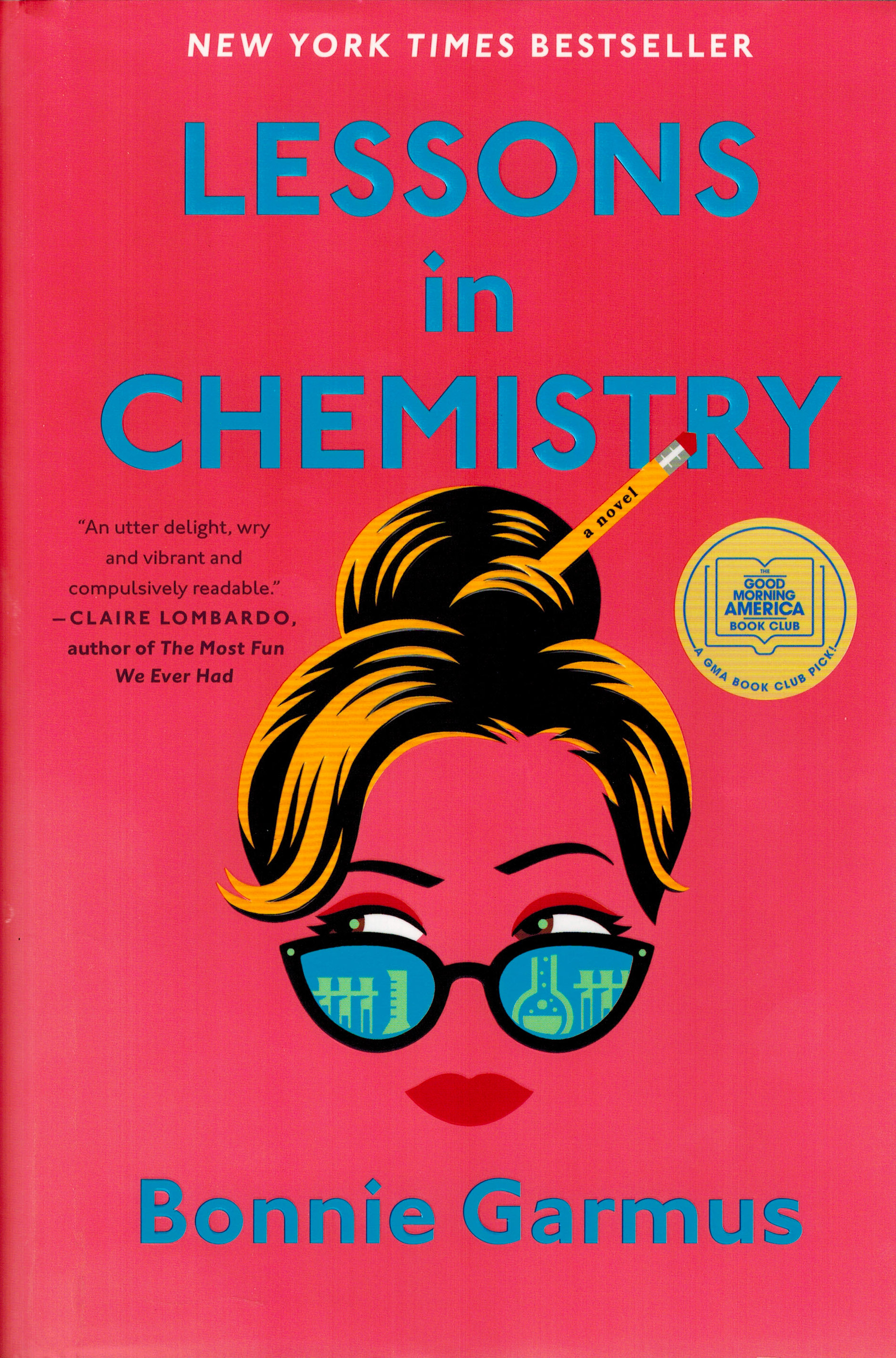
Hardcover Edition

I’m happy to report that I was wrong on all counts. Well, maybe not the I’m not into chemistry part, but as it turns out, that doesn’t matter. I didn’t need to be into chemistry to appreciate chemist Elizabeth Zott’s deep love of it. I just needed to appreciate Elizabeth Zott, the wonderful protagonist of this deeply funny, tragic, and ultimately affirming story. And that was easy. As for my not being interested in the 1950s-60s, I think I took that period for granted because I am a product of it. I have few memories of my earliest childhood, and of those, most are sad. Those years have not been a time I willingly wish to revisit. It appears I prefer visiting earlier and more dramatic times—times that occurred before I was able to suffer through them in person.

As for the idea that the book was probably frivolous, I definitely derived that from the cover. And I wasn’t the only one. Three years ago, a reader named Lisa Wright posted a question on Goodreads, “Am I the only one who was furious about the pink chick-lit, rom-com cover on this book? It belittles the book in exactly the same way Elizabeth Zott is belittled!”

Bonnie Garmus, the author, answered: “I have to agree–and I’m the author! All I can say is, the publisher did let me have input and I told them I thought it looked like chick-lit (nothing against chick-lit but this book isn’t that). Still, publishers have a lot of experience knowing what an audience will respond to and they thought this was the best way. They’ve been great to work with; we just didn’t see eye-to-eye on this. You can google other covers from the other nations and see you if you think anyone else got a little closer–I think Germany and the UK both did a nice job. I have hopes that this cover will change for the paperback.”

Paperback Cover

The way I fell into reading this book

I went on a trip and forgot to bring my library book. The airport gift shop’s book selection was pretty slim. I didn’t see anything from my TBR list. The cover on the paperback version was slightly less frivolous in my very unscientific opinion than the hardcover I had entered in our public library collection. At least it featured something that looked like the periodic table in the background. I picked it up, sighed, and purchased it.

The book delighted me from the first page. When I read these lines: “Fuel for learning, Elizabeth Zott wrote on a small slip of paper before tucking it into her daughter’s lunch box. Then she paused, her pencil in midair, as if reconsidering. Play sports at recess but do not automatically let the boys win, she wrote on another slip. Then she paused again, tapping her pencil against the table. It is not your imagination, she wrote on a third. Most people are awful. She placed the last two on top.”

Bonnie Garmus had my attention on page one, and she had me laughing and crying and feeling every range of emotion throughout the delicious ride through the air from Reno, Nevada to Minneapolis, Minnesota and back again. I loved this book! Highly recommended.

Have you had this experience? Purposely avoiding something, whether a book or a movie or a sport or an activity, that you later found to be good or valuable? I’m sure I’ve done it a lot!

Luckily for me, this time I was given the gift of proving myself wrong.

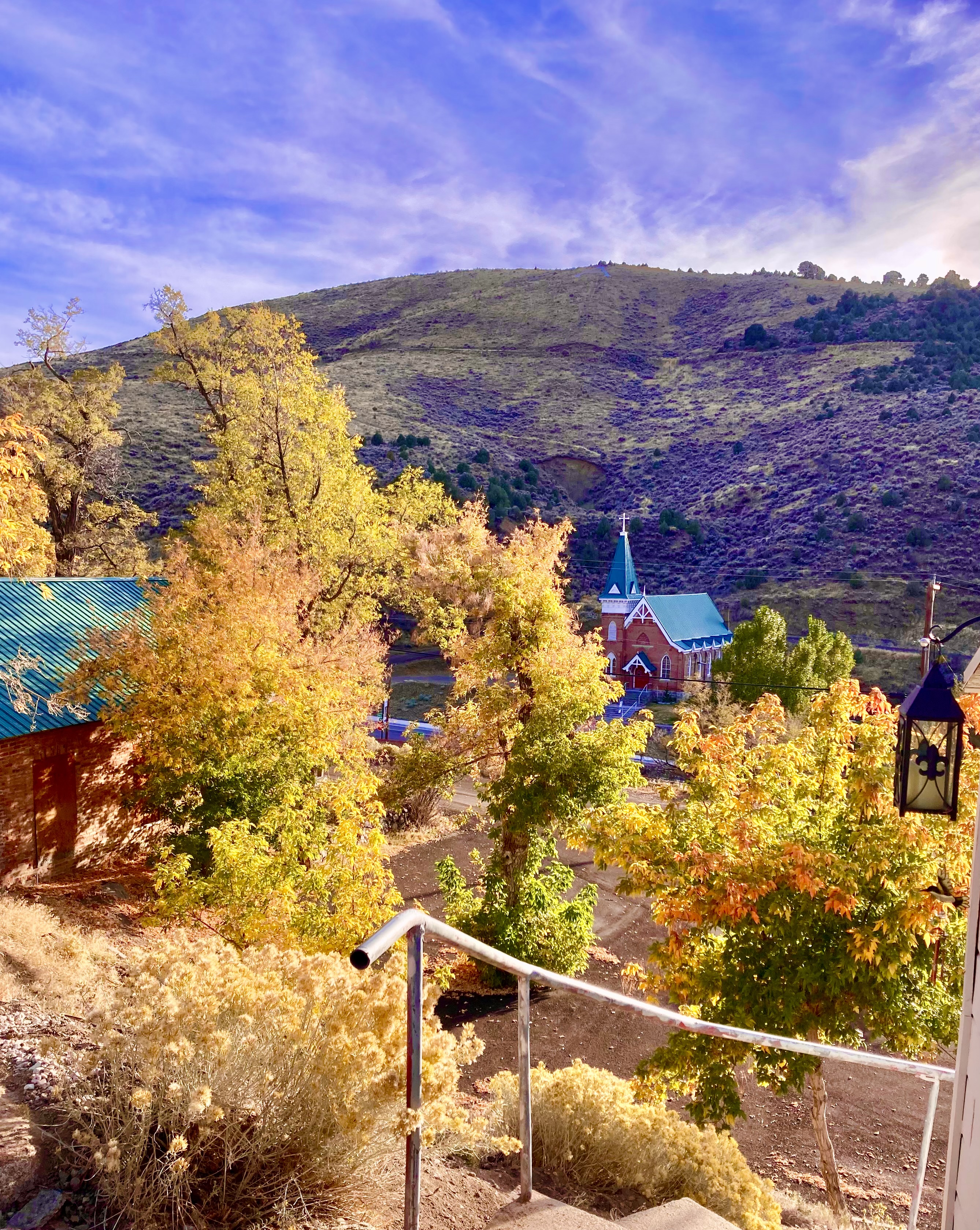
Happy Fall, Y’all!

26 Comments

Filed under Authors, Books, Commentary, Uncategorized

Writing is Thinking

One of my old journals
“The demise of writing matters, because writing is not a second thing that happens after thinking. The act of writing is an act of thinking. This is as true for professionals as it is for students. In “Writing Is Thinking,” an editorial in Nature, the authors argued that “outsourcing the entire writing process to [large language models]” deprives scientists of the important work of understanding what they’ve discovered and why it matters. Students, scientists, and anyone else who lets AI do the writing for them will find their screens full of words and their minds emptied of thought.”
– Derek Thompson, via Substack

From: “The Daily Writer” by London Writers’ Salon.

https://londonwriterssalon.com/

I read the “Daily Words of Wisdom” —well, daily— from the London’s Writers’ Salon. They are always good, and today’s topic is something I’ve been thinking a lot about lately. I’ve always felt that I, personally, discover what I think, what I know, and what I want to know best through writing. I’m also better able to tap into memory and creativity through writing. I seem to retain more information and integrate knowledge into my soul better through writing. For example, if I read a brilliant fiction or nonfiction book and write an essay about it, I amplify the many benefits gleaned from the reading–these benefits range from an awareness and appreciation of literary technique all the way across the spectrum to a synthesis of understanding on any variety of topics.

Because of my love of writing, and my deeply held belief in its power and many benefits, I wanted to share this and ask you for your thoughts. Do you agree with Derek Thompson’s view that “Students , scientists, and anyone else who lets AI do the writing for them will find their screens full of words and their minds emptied of thought”?

34 Comments

Filed under Uncategorized, Writing

King Copper Book Review

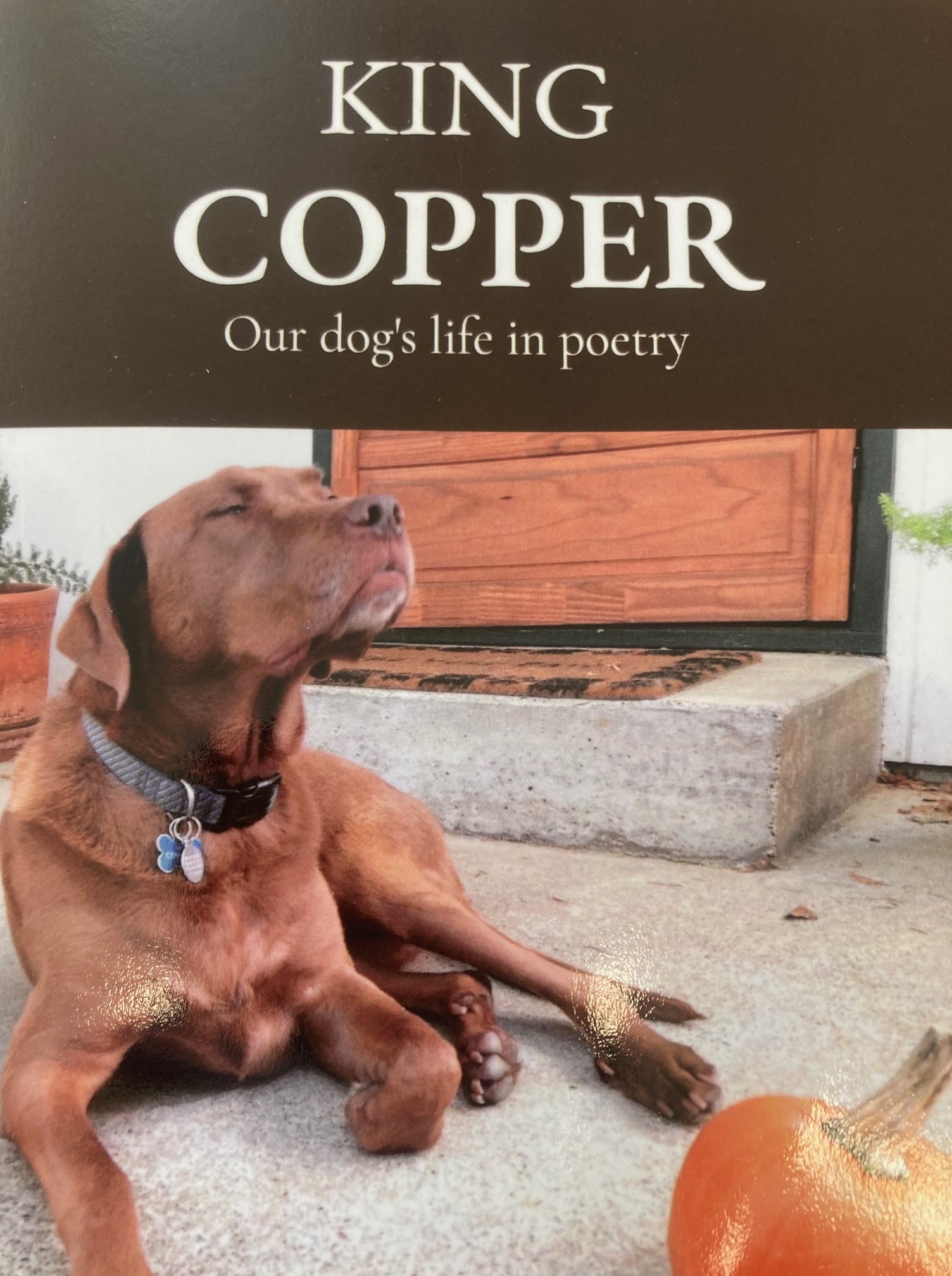
Lauren Scott, King Copper: Our Dog’s Life in Poetry

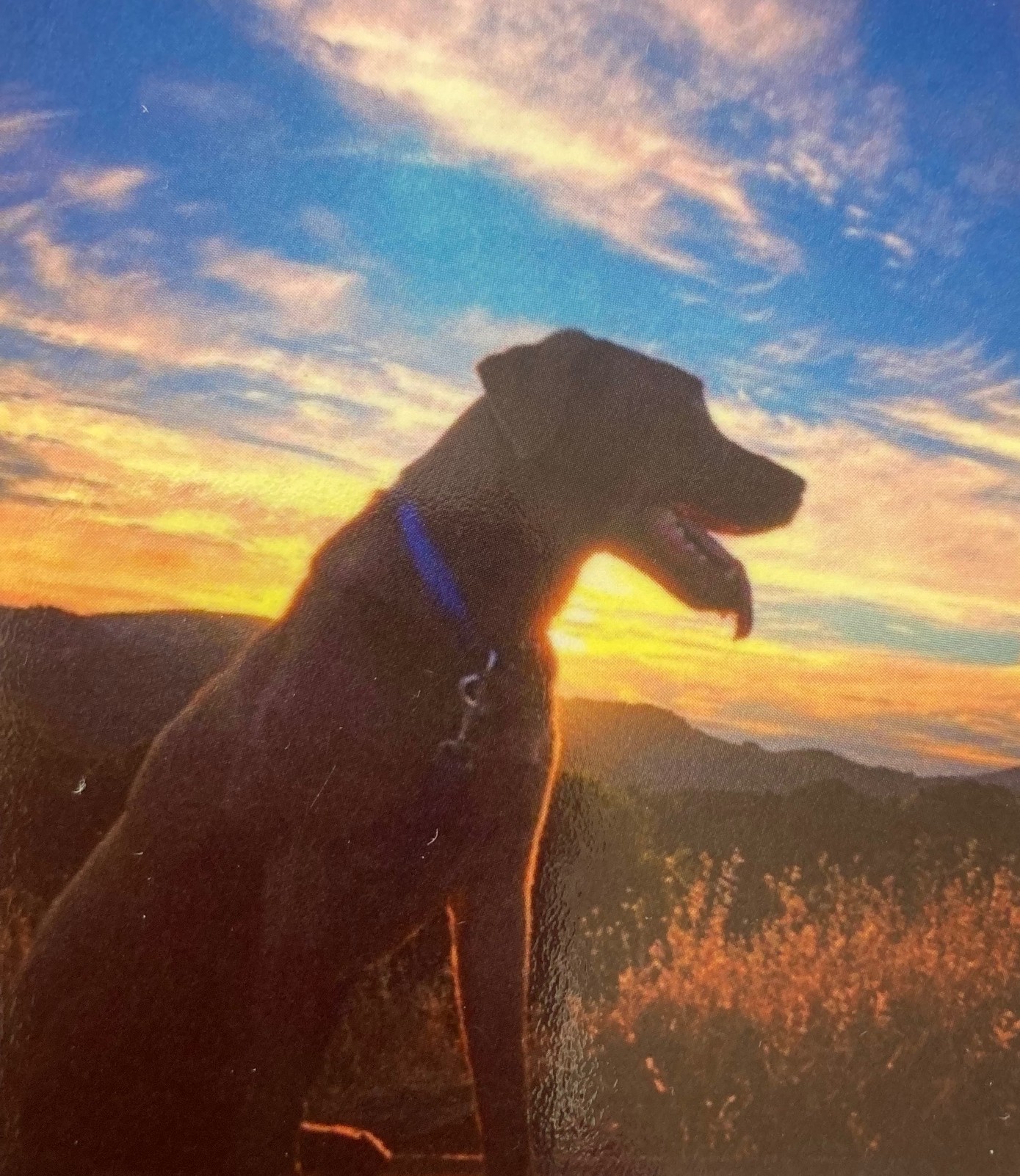
Lauren Scott’s love of her family’s beautiful chocolate lab, Copper, shines in this sweet little volume of photographs and poems that follow their lives together from adoption day on. In her words, King Copper is “a poetic account of the joy that arises when a lovable chocolate lab walks into your life and changes it forever. And the eventual heartache you feel when he crosses over the rainbow bridge thirteen years later and still too soon.”

What a touching account, and what a testament to the glorious impact our beloved pets have on our lives. If only all dogs—all pets—were as well loved and appreciated as the delightful lab Lauren writes so poetically about, the world would truly be a better place. Brava to Lauren for giving her beloved Copper a tribute worthy of his beauty and goodness! Did it make me cry a bit? Absolutely. But tears shed over the loss of a dear dog are never wrong. There is nothing purer than a dog’s affection and devotion. Copper wasn’t my dog, but I, too, have loved wonderful dogs. Like Lauren and her family, I know our animal companions deserve our deepest affection in return for the many gifts they give us. Part of the price for that gift is the same as it is for anything we open up our hearts to fully—the possibility, even the probability that one day there will be pain and loss.

But as Lauren so aptly says, “We celebrate his life- those soul-searching eyes that connected to us- we were links in a golden chain and now one link is missing, our golden boy- each day tears follow like a shadow- the shadow he was, but smiles gently find their place because he is in our hearts, because joy needs room to simmer.”

You can visit Lauren’s blog at baydreamerwrites.com.

http://lscotthoughts.wordpress.com

46 Comments

Filed under Authors, Books, Commentary, Loss, poetry, Reading

This Writing Life

A few days in Paris, Writing . . . Years ago Never forgotten

Instructions for living a life.
Pay attention.
Be astonished.
Tell about it.”
―Mary Oliver

Moving a life forward is an investment in dreams, time, learning, relationship building, and so much more. Moving a writing life forward is all of that, and I would add it is also, at its best, a life transformed. As Anne Frank so eloquently put it: “I can shake off everything as I write; my sorrows disappear, my courage is reborn.” Writing did not save Anne Frank’s life, but I believe her writing has saved the lives of countless others.

Writers may feel called to the creative life, but that one precious life often must take a back seat to another, more practical life, one that includes a sensible career (aka something with a steady paycheck), perhaps with snatches of scribbling in between the job, chores, and attending to family or societal needs and expectations. The writing life can be a kind of shadow life. It has been for me. Some writers seldom or never mention their craft while engaged in their more acceptable “real” life.

“I love writing. I love the swirl and swing of words as they tangle with human emotions.”
—James Michener

It’s hard to explain to nonwriters why a few hours or a whole day spent attending a sporting event or a picnic can create in the writer a kind of panic—a feeling that the time needed to be alone, to read and to write, will never be enough, that time is seeping away, draining their spirit. Spending “free time” in non-creative areas can feel terribly wasted to the writer, while to others, the writer’s avoidance of joining in reeks of selfishness, or delusion. Or perhaps it’s just incomprehensible. Why, people wonder, is writing so important to you? There’s no money in it. And if there is, it’s only available to a few spectacularly talented gifted authors. If you had that gift, surely you’d have been published by now.

The writing life can be an ill-defined series of swells of poetic energy or flow, which is heady and soul lifting. There is nothing quite like those times. Catherine Drinker Bowen says, “For your born writer, nothing is so healing as the realization that he has come upon the right word.” And I have felt that many times. Writing has healed me.

But those transcendent hours or days are for writers seeking an agent or publisher likely to alternate with rejection after rejection after rejection. Writers do much of their writing alone, but if they seek representation and traditional publishing, they must eventually learn the oft times punishing lessons of business.

Soon I’ll be working with a developmental content editor on my completed World War II historical fiction manuscript. I’m excited to be taking this major step forward. It’s been a long journey, and honestly, I’ve loved the myriad lessons and experiences along the way, even the hard ones.
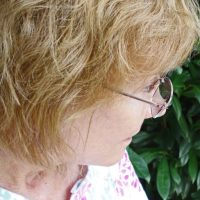
“If a story is in you, it has to come out.”
—William Faulkner

American Writers Museum, Chicago, Illinois

Thank you for visiting! Wishing you a wonderful day, doing exactly what you need and want to do.

With Love Always, Lori

43 Comments

Filed under Authors, Fiction, Gratitude, HIstorical Fiction, Identity, Literary Agents, Publishing, Reading, Research, Uncategorized, Work, World War II, Writing Advice

Book Review. Joy Neal Kidney, Meadowlark Songs: A Motherline Legacy

Version 1.0.0

Joy Neal Kidney’s treasury of family stories traces the lives of seven generations of her ancestors– their joys, their hardships, and their enduring faith.

The short, lyrical portraits of the lives of these women along with their husbands, sons, and daughters begin with Jane (Watson) Branson who was born in 1782 and end with Joy, herself, the memory keeper who researched, gathered photographs, recorded and wrote the lovely tributes, poetry, and historical details, and brought it all together for her family—and for her readers.

This charming volume gives all of us a delightful and heartfelt glimpse into the way our ancestors give us life, tradition, strength, and love, while reminding us of the many reasons we should honor them and remember them.

It’s a beautiful little gem of a book. Highly recommended!

Visit Joy on her blog at https://joynealkidney.com.

30 Comments

Filed under Books, Family, Personal History, Reading, Uncategorized

The Sun Sparkles on the Brook

Big Creek, Austin, Nevada, US

Stained ivory marble glimmers at the edge of the woods

Silent graves behind a rusty fence

Water murmurs in a nearby brook

So small So sweet So Young

A pool of minnows

A mother’s tears

Silver flashes of life

And a blanket of tangled vines, thorns, pink roses

Seek the sun and the angel

Roots curve lovingly around a box lined with satin in the cold earth below

Little bones

Buried in the cold earth below

And the sun sparkles on the brook which speaks softly, softly

A lullaby as it gentles on its way

Soothing the mother now resting next to her child

Buried in grief

Bones reach for bones

And the sun sparkles on the brook

Casting diamonds and tears across the surface

Warming the earth

Descending to the grave

Rising to the heavens

Where the child plays in golden endless days

Hold on hold on hold on to your faith

Austin Cemetery. Austin, Nevada, US. Photos are my own.
I wrote this poem as a kind of meditation. In deeply dark times, I search for faith, comfort, and beauty. I pray for the children.
In peace and love, Lori. 2025

26 Comments

Filed under Uncategorized, Writing

We are So Far Gone

Book Review

Jess Walter’s latest novel tells the story of Rhys Kinnick, a sad-hearted journalist who punches his son-in-law in the face at Thanksgiving, throws his cell phone out his car window, drops out of society, and goes off to live in the forest. The experience of reading So Far Gone reminded me of the not dissimilar experience of watching a Coen brothers movie such as The Big Lebowski or Fargo—odd ball characters, extreme situations, violence, and humor—often jumbled up together in the same scenes—in an overall story that somehow also manages to convey intelligence and love.

Walters is a master at building complicated characters in vivid, precise strokes. The characters in So Far Gone range from the struggling grandfather protagonist, to his charming grandchildren, his confused daughter, a group of religious zealot gun-toting conspiracy theorists, a bipolar retired cop, an old girlfriend with major attitude, his loyal friends Joanie and Brian, and other colorful characters Rhys meets along the way.

It’s a story about a crumbling America, about people lost and found, a world under siege, and ultimately about small miracles of healing magic fashioned by family and friendship. I found it refreshing, and touching, funny, sometimes outrageous, disturbing . . . and also an interesting look at the way some of us old dreamers and staunch believers in the ideals of fairness, justice, and a better future for all are feeling about and reacting to the twisted reality we now see laid out before us. So Far Gone is the perfect title for a book that describes us, now, today.

18 Comments

Filed under Authors, Books, Commentary, Reading

Our Books, Our Shelves

Friends! I have been remiss! I apologize for getting so far behind in reading and responding to your posts. I hope you are all well and I’m looking forward to catching up!

Austin Library, Lander County, Nevada

I’ve been busy of late with revising my historical fiction manuscript after receiving feedback from an agent and a publisher. It’s been fun, in that odd way that perhaps only other writers can understand—a challenge, a wrestling with words, a content shift—all of it within a world that was once mine alone and that now I must share if it is ever to come to fruition as a novel that lives in the world.

Field Trip! I can’t remember where I saw this exercise in visualization. It was likely from one of you, so please accept my apologies for not remembering the source, and let me know if it was you. I love the idea: Go to a book store or a library and find the spot on the shelf where your book would be shelved if it were published. Make a space for your beautiful creation and take a picture. What books will be nestled up to yours?

In the Austin, Nevada library, my book would be shelved right next to Jodi Picoult’s if it were published today!

Your Turn! I’d love to see your spaces! And if you already have a book or books out there, it would be wonderful to see where they sit on the shelf. Please share!

38 Comments

Filed under Authors, Books, Fiction, Writing

Common Threads Lead to Joy

From Top to Bottom: Sierra Boggess and Emily Jewel Hoder in the revival production of “The Secret Garden” at Center Theatre Group / Ahmanson Theatre February 19 through March 26, 2023.
Photo credit: Matthew Murphy of MurphyMade

As a way to identify the activities that bring me joy and find ways to incorporate more of them—more often—into my daily life, I recently completed a writing exercise. It morphed into several disparate, yet ultimately connected and delightful experiences. I had so much fun with it, I just had to share!

Here is the prompt: “Write a letter to your childhood hero. You won’t actually send this letter. Tell them about what has brought you the most joy in each decade of your life. Don’t think too hard about the answers. Write the first things that come to mind. Reread the letter. Do you see common threads?” -Brittany Polat, PhD. Journal Like a Stoic, c2022.

Choosing who to write to was an intriguing part of the process. Who, I asked my little girl self, is your hero? The name that sprang spontaneously to mind was Frances Hodgson Burnett. Of everyone I could have chosen, for some reason I chose a lady author, a woman I’d never met and in fact could never have met because she died thirty-two years before I was born. She may have left the earthly realm, but she was very alive to me. She spoke to me through her books. The Secret Garden was my favorite, and I have continued to love it my whole life, cherishing it through rereads, watching all of the movie versions, and attending the play.

Before writing my letter to Frances, I did a bit of research on her life, and what a full life it was! Born in 1849 in England, impoverished at age four after her father’s death, Frances eventually traveled with her mother to live in a log cabin in Tennessee during the American Civil War. It was writing that finally lifted her out of poverty. She was a highly regarded author who published fifty-three novels and owned homes in both England and America (Gerzina, Gretchen H. “In the Garden: The Life of Frances Hodgson Burnett.” Shakespeare Theatre Company, c2024).

This research into Frances’s life inspired me as I wrote to her about the greatest joys in my own life. The common threads became very clear. Family, friends, nature, wildlife, pets, reading, writing, and learning showed up consistently throughout the decades. These are the things that spark the most joy for me.

Frances with her sons

With this in mind, I agreed to an unplanned day-long trail ride with my husband on a day I had planned to spend doing laundry and vacuuming the house. Seems like an easy choice, venturing out into nature with my guy rather than doing chores, but I honestly might not have agreed to drop everything and go if I hadn’t just completed my “joy inventory.”

Though housekeeping and organization didn’t make themselves known in my letter to Frances, they are important to me, nonetheless. I find it difficult to get to joy in any kind of untidy environment, whether in my own home or anywhere else. Still! I managed to say yes. As a bonus, I thought I could write about it afterwards, thereby including another of my favorite activities in the event.

Here is the result:

Off highway vehicle trails abound in the high elevation areas of the entire Toiyabe Mountain range and extend down into the valleys and basin below. We have an old side-by-side Rhino that can climb just about anything at very low speeds and peaks at 30 miles per hour on a flat road going downhill (a situation not often experienced here). Our chosen route for the day was to begin at our home in Austin, travel to Big Creek Campground, and then continue over the mountains into the adjacent valley to the east.

My guy and the Rhino
Big Creek
Soon to be up and over the top!
Groves Lake

Along the way we experienced the expanse of the Reese River Valley over exposed rocky trails and into and over the mountains with multiple stream crossings, aspen groves, meadows, and significant elevation change. We passed by two campgrounds (Big Creek Campground and Kingston Campground) and Groves Lake, winding up in the charming Kingston community where we were welcomed by the wonderful ladies of a Monday Mahjong groups that meets at our friend Linda’s house. There we were treated to a delicious lunch and lively conversation before heading back over the mountain. Friendship, another joy inducing ingredient added! It was a lovely day.

Old Kingston Ranger Station
Linda and the Mahjong Ladies welcomed us in!

From the initial moments spent reading the prompt in my journal it was indeed a joy to experience the results of contemplating a childhood hero, writing to her, thinking about my life in decades, and saying yes to an impromptu adventure.

It would be wonderful to read about your hero, and the joys of your decades. Who would you write to? What insights about joy might your letter reveal? If the spirit moves you, please do give this little project a go! You might find yourself delighted by the results, as I have done. Looking forward to hearing from you!

Happy Writing!

Joy and Adventure live inside–
and out!

Lori

36 Comments

Filed under Books, childhood, Family, Identity, Nature, Reading, Uncategorized, Writing, Writing Advice

Part II, Flag Day Reflections: My Dad’s Service

Disney’s Donald Duck, WWII. I can see why Dad chose to imitate this particular character. He was very proud of his Scottish roots!

Some time ago I responded to a fellow blogger, GP, Pacific Paratrooper, a WordPress.com site of Pacific War era information (https://wordpress.com/reader/feeds/4440944/posts/5114548606) about his article, “Disney and WWII,” posted Feb. 12, 2024. The post both tickled my fancy and triggered positive childhood memories, but also, delivered a good dose of regret. I knew so little about my dad’s service, and there was no one living I could ask.  

Here is a record of our brief exchange:

Me:  My dad was a WWII Marine. I didn’t think it was odd that he could speak to my brother and me in full Donald Duck voice because he just did. He never spoke about why. He did drive us from Wisconsin to California to visit Disneyland when it opened. So much I wish I could ask him now.

GP:  May I ask what unit he was in? There might just be a good reason. Disney made training videos, etc. too.

Me:  I am ashamed to say that I don’t know his unit.

GP:  So many of us have questions we wished we had asked.

As the days passed, I kept going back to GP’s article. I couldn’t reconcile the fact that I had practically no knowledge whatsoever of my father’s service in World War II with who I believed I was: a loving daughter, a lover of history, a teacher of literature, writing, and the Holocaust, a writer of historical fiction, a devoted library worker . . . how was it that I knew so little about my own father’s relationship to such tremendously important world events?

Dad, Lori and Billy. About 1959. We lived next door to a bowling alley, but Lake Michigan was in our backyard!

An online search informed me that I could request my father’s United States Marine Corps Separation Documents and Personnel Records from the National Personnel Records Center at the National Archives, www.archives.gov. I did so, and some months later I received a short stack of copied documents dating back to my father’s voluntary enlistment the day after the Pearl Harbor attack.

I did remember that. It was one of the few stories Dad repeatedly told my brother and me, that he had waited in a line two blocks long in his hometown of Chicago, Illinois to join the Marines the day after Pearl Harbor. It painted a picture of patriotism that stayed with me. I have heard myself repeat it many times throughout my life. My dad, the story revealed, was one of the true heroes of The Greatest Generation.

Here is the rest of the story, as much as I was able to glean from the archives:

Pearl Harbor Attack. World War II Facts.org

When Pearl Harbor was attacked (December 7, 1941), William Harold Johnstone was 21 ½ years old. He had turned 21 on his Flag Day birthday, June 14, 1941. He began active duty on January 5, 1942. He was a high school graduate, and he had completed one year of college. His stated major was Pre Med. Qualified sports listed were track, football, basketball, and swimming. It was also noted that he sang in the church choir. He worked at Montgomery and Ward Co. as a silk screen printer.

I do remember my mom telling me Dad had wanted to be a doctor but that after his war injuries he had never gone back to college. I know he was always interested in medicine. Also, I remember a story about how he swam out and back to a pier or perhaps a buoy some distance off the shore of Lake Michigan and back as a teen, which I gather was somewhat of a feat / badge of honor. Also, he mentioned that at one time he had the nickname “Johnny Rock” — perhaps an homage to both his last name (Johnstone) and his physical fitness. His record shows he was 5 foot, 8 inches tall and he weighed 136 pounds. Not a big man, but strong.

Dad’s father, an immigrant from Scotland, had died when Dad was only four-years-old, so he was raised by his mother, Lorene, and her sister, Mary, along with his older brother, Donald. Tragically, Donald died at age twelve. It was then, my dad told me that he knew he had to give up childish games and work to help his mother and his aunt.

This then, is a portrait of the twenty-one-year-old man who entered the military.

My Handsome Dad

Dad’s original principle military duty early on was Surveyor 227 Rank Private First Class. USMC, 19th Marines Engineer, 3rd Marine Division Fleet Marine Force, Camp Elliott, San Diego, CA.

Later I see him listed as Private 1st Class, 339815, “I” Company, Third Battalion, 22nd Marines, Sixth Marine Division.

After his initial training, it seems Dad shipped out. The reports are difficult to decipher, but they contain notes of his being in Pearl Harbor, Hawaii; Auckland, New Zealand; Guam, Marianas Islands; Guadalcanal Island, Solomon Group; and Okinawa, Ryukyu Islands, Japan. The only detailed reports refer to Guam and Okinawa.

Guam in World War II, National Park Service

Here is Guam:

From James Forrestal, The Secretary of the Navy, Washington

The Secretary of the Navy takes pleasure in commending the First Provisional Marine Brigade for service as follows:

“For outstanding heroism in action against enemy Japanese forces, during the invasion of Guam, Marianas Islands, from July 21 to August 10, 1944. Functioning as a combat unit for the first time, the First Provisional Marine Brigade forced a landing against strong hostile defenses and well camouflaged positions, steadily advancing inland under the relentless fury of the enemy’s heavy artillery, mortar and small arms fire to secure a firm beachhead by nightfall.

Executing a difficult turning movement to the north, this daring and courageous unit fought its way ahead yard by yard through mangrove swamps, dense jungles and over cliffs and, although terrifically reduced in strength under the enemy’s fanatical counterattacks, hunted the Japanese in caves, pillboxes and foxholes and exterminated them.

By their individual acts of gallantry and their indomitable fighting teamwork throughout this bitter and costly struggle, the men of the First provisional Marine Brigade aided immeasurably in the restoration of Guam to our sovereignty.”

All personnel serving the First Provisional Marine Brigade, comprised of: Headquarters Company; Brigade Signal Company; Brigade military Police Company; 4th Marines, Reinforced; 22nd Marines, Reinforced; Naval Construction Battalion Maintenance Unit 515, and 4th Platoon, 2nd Marine Ammunition Company, during the above mentioned period are hereby authorized to wear the NAVY UNIT COMMENDATION Ribbon.

My dad never described any of these experiences to me, and I don’t remember ever seeing that Commendation Ribbon. I hope he was able to talk about it with someone, but I do not know if that was the case. It grieves me.

On Okinawa:

The next specific report in the records begins with a Report of Combat Casualties, which states that William H. Johnstone of the Twenty Second Marines, Sixth Marine Division was Wounded in Action on May 12, 1945 on the island of Okinawa, Ryukyu Islands. Recorded on 13 May 1945. Diagnosis: Wound Fragment Face. Prognosis: Serious.

On 18 May 1945, U.S. Fleet Hospital No. 111 reports William H. Johnstone, Wounds, Multiple. Wounded in action against an organized enemy. Shell struck near patient causing injury.

A U.S. Fleet Hospital letter to my grandmother, written July 1, 1945 reports Dad’s condition as good, and states that he will be returned to active duty in the near future, so it looks like he was hospitalized for approximately a month and a half.

The record states:

In the name of the President of the United States, and by direction of the Commander in Chief, U.S. Pacific Fleet, the Purple Heart is awarded by the Medical Officer in Command, U.S. Fleet Hospital Number One Hundred and Eleven to: William H. Johnstone, Private 1st Class, USMC for wounds received in action against an enemy of the United States on 14 May 1945.

The battle of Okinawa “was one of the bloodiest in the Pacific War, claiming the lives of more than 12,000 Americans and 100,000 Japanese, including the commanding generals on both sides. In addition, at least 100,000 civilians were either killed in combat or were ordered to commit suicide by the Japanese military (Battle of Okinawa | Map, Combatants, Facts, Casualties, & Outcome | Britannica).

Battle of Okinawa, Brittanica

I do remember seeing the Purple Heart. My father gave it to my brother. Unfortunately, it was lost during my brother’s divorce, and it was never returned to the family.

I would like to thank GP and his Pacific Paratrooper WordPress blog for getting me started on this mission of discovery. Without his article on Disney in the Military and my memories of a loving father amusing my brother and me with an array of his silly Donald Duck performances, I doubt that I would have been able to share this information with my children and grandchildren. So, thank you, GP!

And thanks to all my readers.

I love you, Dad.

48 Comments

Filed under Family, Memories, Research, The Greatest Generation, Uncategorized, World War II